

LJUBLJANA, Slovenia (AFP) — Slovenia’s incumbent liberal Prime Minister Robert Golob claimed victory in parliamentary elections on Sunday, as results put his party just slightly ahead of the conservatives.
Golob took over from pro-Israel Donald Trump admirer Janez Jansa as a political newcomer in 2022, leading a three-party center-left coalition in the country of two million people.
The race had been expected to be tight, and foreign interference claims shook the campaign, with authorities probing whether an Israeli company was behind secretly recorded videos suggesting alleged graft in Golob’s government.
With 99.85 percent of the votes counted, Golob’s liberal party stood at 28.62% and the conservatives of veteran politician Jansa at 27.95%.
The results put Golob’s party on 29 seats compared to 28 for Jansa, in the 90-seat parliament.
Get The Times of Israel’s Daily Edition
by email and never miss our top stories
By signing up, you agree to the terms
“Since we have received the [people’s] confidence, now we can think about going forward under a free sun,” Golob, 59, told cheering supporters at his party’s headquarters.
He hailed a vote for “democracy” in the EU member nation, promising to “do everything to grant a better future to all citizens in our next mandate.”
“We face tough negotiations but we will not negotiate about our sovereignty. We will not let foreigners decide about our sovereignty,” he said, adding he would invite all parties to coalition talks.
‘Count every vote’
Three-time premier Jansa — an ally of nationalist Hungarian Prime Minister Viktor Orban — described the vote as a “referendum on corruption,” in reference to the videos.
“We will count every vote from all polling stations,” Jansa, 67, warned, but also said earlier that he would not form a “weak government.”

Slovenia’s liberal Prime Minister Robert Golob (L) and Slovenia’s opposition leader and nationalist former prime minister Janez Jansa attend the last televised political debate ahead of the parliamentary elections in Ljubljana on March 20, 2026. (Jure Makovec / AFP)
The rest of the vote is shared around a disparate mosaic of smaller parties, so that analysts predict it will be difficult to form a stable government.
An anti-establishment party and a conservative party formed by a former Jansa ally have managed to enter parliament, fragmenting it further.
Under Golob, Slovenia legalized same-sex marriage and became one of the few EU countries to claim Israel’s war against the Hamas terror group in Gaza is “genocide.”
In his campaign, Jansa pledged to put Slovenians “at the forefront” and restore “Slovenian values” such as the “traditional family,” and “close the pipe” of state money to nonprofits deemed political parties.
The last Jansa-led government saw mass protests and EU criticism over rule-of-law concerns.
‘Ugly’ video scandal possibly linked to Israeli firm
Tine Maher, 30, an AI and IT entrepreneur, told AFP at a Ljubljana polling station that he expected “a change of the government, it’s really necessary. There have been many empty promises.”
Ivana Prijatelj, a pensioner from Ljubljana, said she was “satisfied with how things are right now.”
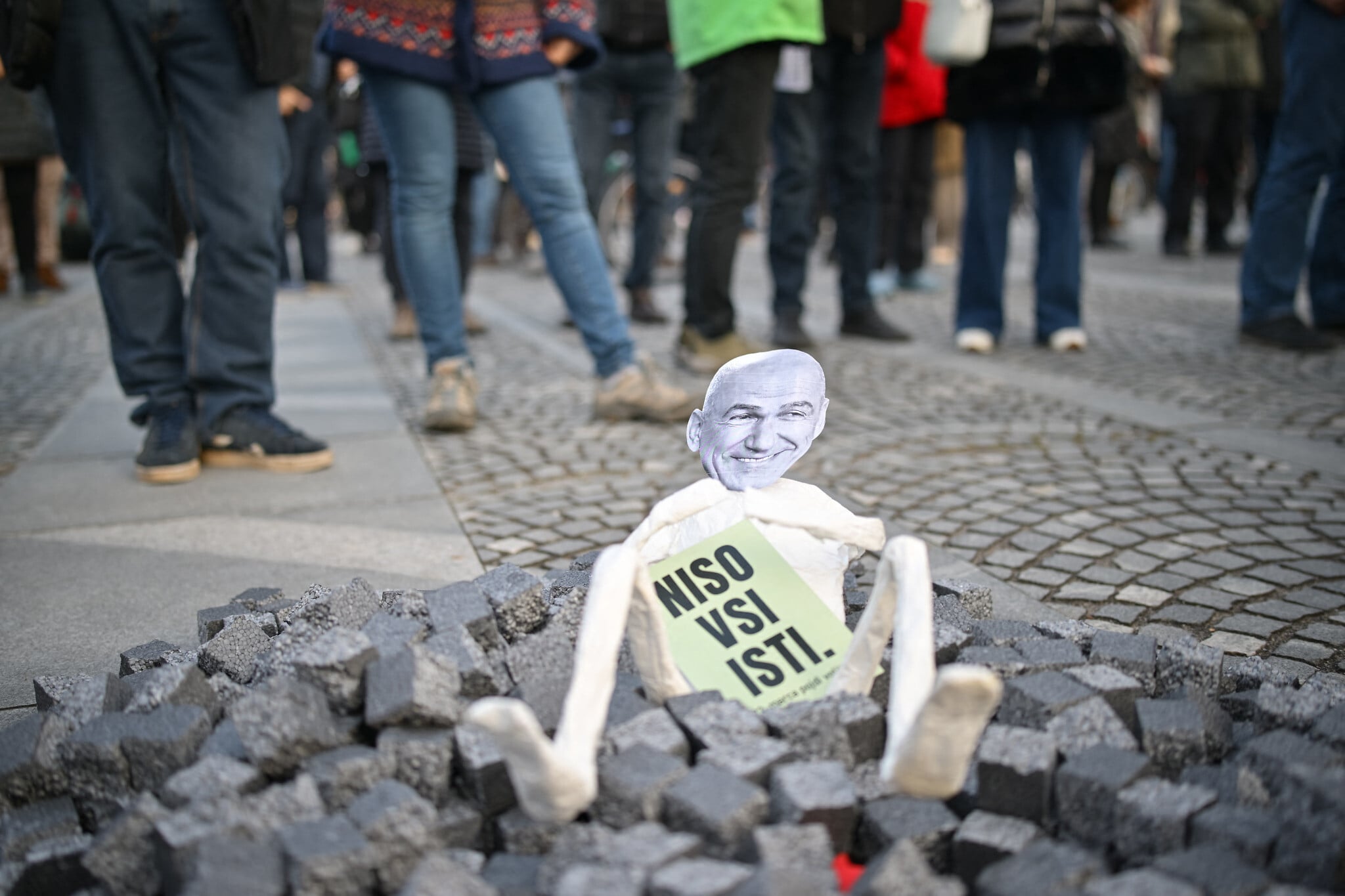
A paper figure depicting Slovenian opposition leader, nationalist former prime minster Janez Jansa, is placed on a pile of black cubes as demonstrators gather at a rally to urge citizens to vote in front of Slovenian Parliament in Ljubljana on March 20, 2026, ahead of the parliamentary elections. (Jure Makovec / AFP)
“Nothing is wrong now, at least for me,” she told AFP at a polling station, adding she did not listen to the secretly recorded videos, saying the whole affair was “too ugly.”
Golob this week asked the EU to probe alleged election interference following the publication of the videos.
Slovenian authorities are investigating whether Israeli intelligence firm Black Cube was behind the videos, which feature a Slovenian lobbyist, a lawyer and a former minister, among others.
The videos allegedly show the officials suggesting ways to influence decision-makers in Golob’s government to speed up procedures or win contracts.
A civil society group, together with an investigative journalist and two researchers, early this week accused Black Cube of being behind the videos and linked it to Jansa’s party.
Jansa has admitted to having met a Black Cube official, but has denied being behind the videos.
Times of Israel staff contributed to this report.
You appreciate our wartime journalism

You clearly find our careful reporting of the Iran war valuable, at a time when facts are often distorted and news coverage often lacks context.
Your support is essential to continue our work. We want to continue delivering the professional journalism you value, even as the demands on our newsroom have grown dramatically during this ongoing conflict.
So today, please consider joining our reader support group, The Times of Israel Community. For as little as $6 a month you’ll become our partners while enjoying The Times of Israel AD-FREE, as well as accessing exclusive content available only to Times of Israel Community members.
Thank you,
David Horovitz, Founding Editor of The Times of Israel