
When the sound of bombs dropping starts, fear rises in most people. However, for some Iranians a war is more bearable, because it brings them hope that there will soon be an end to the Islamic regime.
United States citizens have expressed varied feelings about the current war between the U.S. and Iran. With an internet black out in Iran and a government controlled media, it is hard to know exactly how Iranians feel about the war.
“Iran goes to a communication blackout whenever something like this happens, (which) means that we might not hear from our families for two, three weeks. Imagine they are in a war zone, and you don’t know if they’re alive, what happened. All of this is a struggle for us,” Purdue SCLA professor Negin Goodrich said.
Purdue has students and professors who grew up in Iran and have come to the United States to continue their education and careers. With their families still living in Iran, they are able to help U.S. citizens better understand how the war impacts Iranians and their feelings about the war.
Afagh Farhadi, a graduate researcher at Purdue, said she feels the Iranian community has been left out of the conversation about the war between the United States, Israel, and Iran. For Iranians living in both the US and Iran, this war is the difference between bad and worse, she said.
“When you see Iranian students are not against the war in Iran, it is (not) because they are celebrating the war, but they are celebrating hope. They think this war is making their enemy defeat-able, because this war is making this regime weaker and they are losing,” said Farhadi.
Not only were Iranians facing political tensions with the Islamic regime, but also economic pressures due to inflation. Goodrich said when she came to the United States in 2010, 20 million Iranian tomans was equivalent to $20,000. However, after 16 years, the same amount of tomans is equivalent to $125.

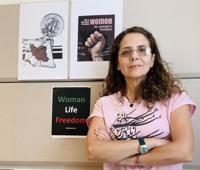
Purdue lecturer and activist Negin Hooseini Goodrich sits in front of posters for the Women, Life, Freedom movement.
Photo provided by Negin Hooseini Goodrich
“Imagine the rate of the inflation in the past 16 years, and it’s absolutely disabling Iranians financial capabilities,” Goodrich said. “At the same time, I’ve seen how the Islamic regime has escalated the political tensions, not only in Iran but also with their neighbors, with their people, with the countries in the Middle East, with the United States. So I’ve seen this come in the layers. Today is the outcome of the past that I’ve lived (through) those experiences, and now this is the future that I could see 20 years ago.”
Sharing similar sentiments with Farhadi is a current Ph.D. student in computer and information technology, Mitra . For the past 47 years the Islamic regime has been in control, Iranians have attempted numerous times to regain their freedom to no avail. Now, many Iranians believe that receiving aid from the U.S. and Israel is the only chance they have at creating peaceful relations with the rest of the world.
Both Farhadi and said that while they are hopeful for the future of Iran, they understand that it comes at the cost of innocent lives, from Iran and the United States. They grieve for the loss of innocent lives, but believes that it could prevent greater loss of innocent lives in the future.
“I want to translate (Iranian’s) own words, ‘as much as we fear the continuation of this criminal government, we do not fear the bombings’,” Panahi said. “This is an investment and strategy that makes the world more peaceful and safe. The people inside believe that what Israel and the United States are doing in the region is in fact, to prevent much more dangerous events in the future, because this is not one country’s issue. It’s a global matter.”
Farhadi said the reaction from Iranians might be hard for U.S. citizens to understand without the context of what those living in Iran have experienced at the hands of their government.
In January, Iranians took to the street in a peaceful protest against the government, these protesters were then met with paramilitary forces that killed thousands of unprotected protesters, Farhadi said. Families had to dig through piles of dead bodies to find their loved ones. Once found, they were not allowed to have a ceremony to honor the dead, unless the family paid for the bullet used to kill them. She said this is not new to Iranians and is something they have experienced for years.
“They wanted this intervention to happen to free them, because those days in January this year, people did everything they could,” Goodrich said. “You cannot say they didn’t do enough. You cannot fight with a regime who has guns in front of you. They did everything they could, and they were just being massacred. So in such a situation, they have no other choice but to call for help. This is a rational, natural reaction.”
There are multiple different perspectives on the conflict between the U.S. and Iran. With a plurality of different voices, oftentimes the different perspectives do not agree.
A source who chose to stay anonymous due to the sensitivity of the topic, said, “There are so many different perspectives on it, and different ideas about whether they approve of the U.S. action or not. I think at the end of the day, all those Iranians I’ve met, want freedom and dignity for their people. They want safety, right for their families, but they disagree with each other a lot about how, how that will come about.”
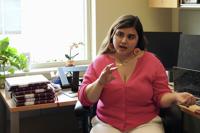
Afagh Farhadi, a graduate researcher in the Department of Speech, Language, and Hearing Sciences, talks about her experiences growing up in Iran. She grew up in Iran, learning about the US through the propaganda from the Iranian regime.
By Joaquin Guerrero | Staff Photographer
Respecting students and staff who are affected by the conflict is the second step after being informed on the background of the conflict. For Goodrich, she incorporates this by bringing up conversations to her SCLA and communication classes.
“I have both American and international students so I make sure that dedicate at least five minutes (of class) to bring up something about politics and human rights, because I wish that my students leave my classes at the end of the semester learning about humanity, kindness and caring about each other,” Goodrich said.
Purdue has yet to take initiatives to assist those who undergo difficulty during this time. Goodrich said when they reach out, the university states that they stay away from politics.
“There (are) no initiatives unless we Iranians get together and come up with an idea, reach out to the university, and ask for something,” Goodrich said. “Other than that, they don’t do anything. But in my workplace, I have supportive colleagues, I have a supportive supervisor. They always care about my (wellbeing). They always ask about what’s going on, what is the situation, you have our support.”
Since there are no initiatives taken by the school to assist students and staff. Goodrich said learning about the situation and reaching out to those affected can help a lot.
“If you have a student, classmate, or a professor or staff, you know they’re from areas involved, please reach out and say, ‘How can I help you?’ It’s so soothing,” Goodrich said. “You can’t believe people know about you. You are not invisible. Your problems can be seen and heard. So just reach out.”
Every Exponent article goes through checks for accuracy before publication. If you have a concern or questions about this article, please email editor@purdueexponent.org.