
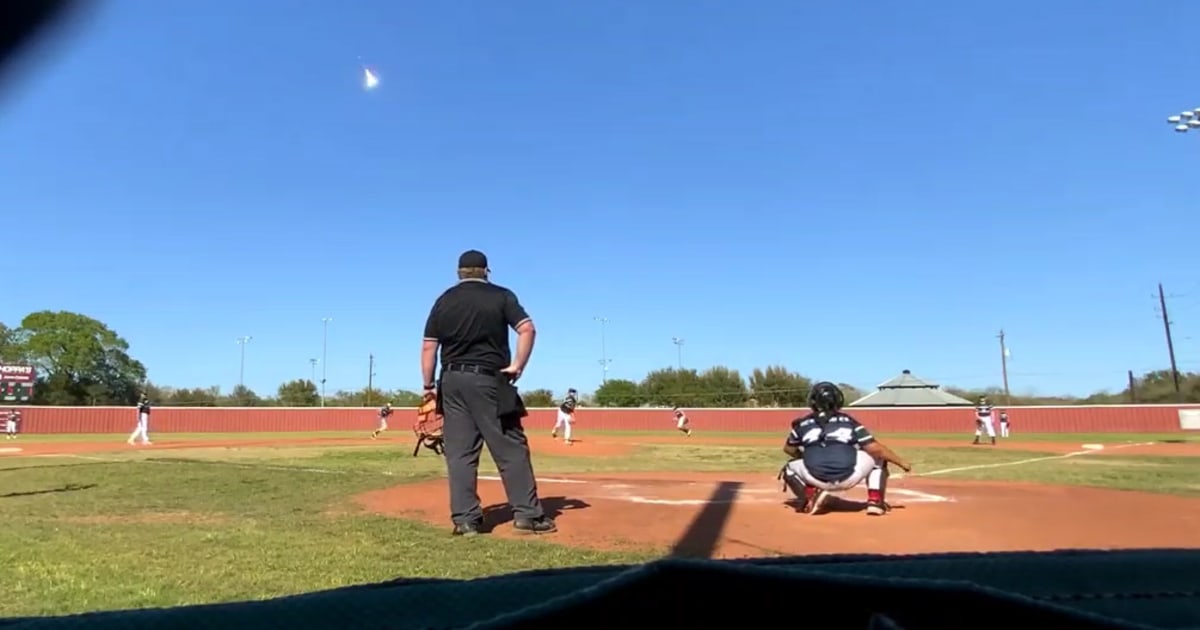
A bright fireball that was spotted Saturday afternoon in the skies over southeastern Texas was a meteor that likely broke apart over the Houston area, according to NASA.
Eyewitness accounts in the greater Houston area — including footage from a doorbell camera, a car’s dashboard camera and video captured during a Little League baseball game — showed a fiery ball of light streaking across clear, blue skies. NASA said the meteor event occurred at 4:40 p.m. local time, first visible in Stagecoach, northwest of Houston.
“It moved southeast at 35,000 mph, breaking apart 29 miles above Bammel, just west of Cypress Station,” the agency wrote in a post on X.
Early estimates suggest the meteor measured around 3 feet across and weighed about a ton, according to NASA. As the space rock plunged through Earth’s atmosphere, the pressure wave caused sonic booms that some people heard.
One Houston-area resident, Sherrie James, said a possible piece of the meteor crashed through the roof of her house Saturday afternoon. James told NBC News that she was in her bathroom combing her hair when she heard a loud boom and then a thud coming from her daughter’s room.
“I just went in and looked, and I saw the hole, and I saw the dent in the floor,” she said.
Next to her daughter’s bed, James found what she described as a “big, black rock.”
“And I’m like: What is this?” she said. “And I called my grandson, and I said: Look at that. I said, ‘Is that a meteor?’ That’s the first thing came to my mind, because it was all black.”
The suspected meteorite was about the size of a baseball, but James said it felt heavier than a baseball. She said no one in her household was injured.
“It just looked like a rock, and ain’t no rocks got no business falling out of the sky,” James said.
The American Meteor Society, which tracks fireball events around the world, had more than 140 reports for Saturday’s meteor across south-central and southeastern Texas, including in Houston, Katy, College Station, San Antonio and Austin.
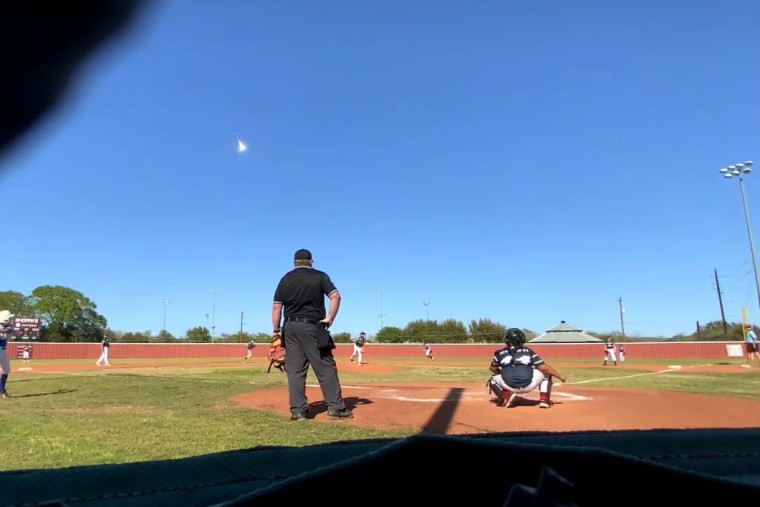 A meteor flies through the sky during a youth baseball game Saturday in East Bernard, Texas.Lucero Marquez de Rivera
NASA said Doppler weather radar indicated that meteorites may have dropped over parts of the Houston area between Willowbrook and Northgate Crossing.
Saturday’s meteor sighting came just four days after a separate daytime fireball was seen — and heard — across northeastern Ohio and parts of Pennsylvania. Bill Cooke, who leads NASA’s Meteoroid Environment Office, said at the time that the fireball and sonic booms were likely caused by a small, 7-ton asteroid measuring around 6 feet across. As the meteor fragmented, Cooke said, it likely unleashed an enormous amount of energy, equivalent to 250 tons of TNT.
Early data suggested the meteor was moving at 45,000 mph through the upper atmosphere before it broke up. Cooke said it likely produced some meteorites around Medina County.
Large meteors that create bright fireballs are relatively rare but not altogether uncommon. Small space rocks, bits of dust and old rocket parts hit Earth daily, according to NASA, but most burn up harmlessly in the atmosphere.
Robert Lunsford, a journal editor at the American Meteor Society, said it is rare for two separate daytime fireballs to occur so close together in time and location.
“I don’t recall this occurring during the twenty years that I have been posting these reports,” he said in an email. “It would seem logical that they would belong to the same meteor shower, but there are no strong showers active in March. I need more data from the Texas event, but my initial feeling is that they are not related.”