
As the war in Iran drags into its fourth week, the direct and indirect costs of the conflict are beginning to mount, highlighting a longstanding challenge of replenishing weaponry and other military assets while waging what some describe as “asymmetric” warfare in a far-flung part of the world.
The U.S. and Israel are deploying costly sophisticated weaponry against the less expensive but highly cost-effective arms being used by Iran, a fact that has brought the evolving dynamics of modern warfare into sharper focus.
“There is a disconnect,” said Denise Garcia, professor of political science and international affairs at Northeastern. “The U.S. and other major powers built massive aircraft carriers, fighter jets and costly missiles, yet it is the cheaper drones that are causing terror — an example of asymmetric warfare at its best.”
Stephen Flynn, a Northeastern University national security expert, said the complexities of disparate military capabilities are starting to be revealed, the longer the fighting goes on.
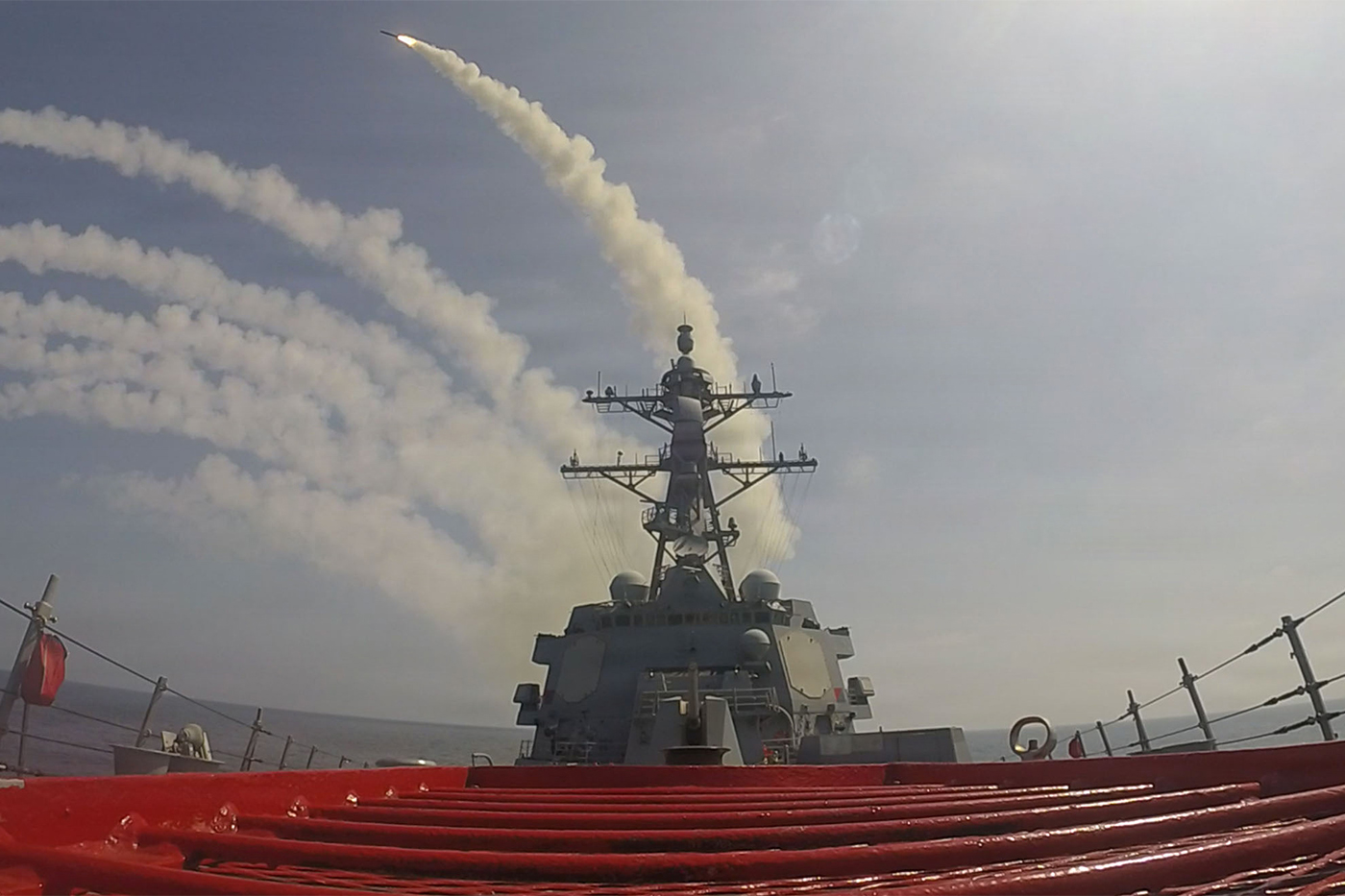
One example, Flynn said, is the Tomahawk missile, a long-range, precision-guided cruise missile central to U.S. naval strike capabilities. In the opening phase of the campaign, U.S. forces fired some 170 Tomahawk missiles in just 100 hours, according to the Center for Strategic and International Studies, or CSIS, a Washington, D.C.-based think tank that monitors geopolitics. That is roughly three times the number the Pentagon had requested from the American defense contractor Raytheon, for the entire 2026 fiscal year, Flynn noted.
“We are using them far quicker than we can replace them,” he said.
At around the one week mark, CSIS put the cost of the war at roughly $12.7 billion, with billions more projected as the weeks drag on. The Pentagon is now asking Congress for an additional $200 billion budget supplemental to further fund the conflict.
 Stephen Flynn, a Northeastern University national security expert, said the complexities of disparate military capabilities are starting to be revealed, the longer the fighting goes on. Photo by Matthew Modoono/Northeastern University
To sustain the campaign, the military has also begun drawing from munitions stockpiles in the Indo-Pacific, where those weapons had been prepositioned as a deterrent against China, particularly over Taiwan and broader territorial ambitions in the South China Sea.
Beyond pointing to a deep lack of wartime planning, shifting those munitions carries strategic risk, Flynn said.
“A large part of our deterrence strategy is showing that you have a lot of military capability so that if China decides to act — whether to reclaim Taiwan or pursue other efforts — it would be costly,” he said.
Domestic manufacturing constraints limit how quickly weapons stockpiles can be replenished. But the U.S. defense industrial base was already under strain before the current conflict, according to Flynn, citing major delays in “high-priority” submarine programs stemming from shortages in skilled labor, supply-chain bottlenecks and limited advanced manufacturing capacity.
Flynn said the Columbia-class submarine, designed to replace the aging Ohio-class that underpins roughly 70% of the nation’s nuclear deterrent, is now nearly two years behind schedule. Production of the Virginia-class attack submarines is also falling short, with output at roughly 1.2 boats per year despite targets closer to two annually.
Adding to the strain is the difference between the cost of weaponry used by the Iranians and the weaponry used by the U.S., Persian Gulf nations and Israel.
Iran’s drones are lethal, effective and — at roughly $20,000 to $50,000 a pop — cheap. The Patriot missiles the U.S. and Gulf nations are using to shoot these drones down, on the other hand, cost $4 million. The only defensive missiles that are roughly equivalent in cost to the drones are those used by Israel’s Iron Dome system, according to CSIS.
Iran has launched thousands of drones toward Israel and other countries in the Middle East since the U.S.-Israeli strikes that killed Iranian Supreme Leader Ali Khamenei on Feb. 28.
Called Shahed drones, the Iranian guided missiles fly toward pre-designated targets and explode on impact, according to the Open Source Munitions Portal, a tool for researchers, journalists and practitioners launched in 2023 by the nonprofit civilian harm watchdog Airwars together with Armament Research Services, or ARES, a technical intelligence consultancy specializing in munitions.
The drones have been nicknamed “the poor man’s cruise missile” by analysts, including Behnam Ben Taleblu, senior director of the Iran program at the Foundation for Defense of Democracies, and media, including the Associated Press. They cost between $20,000 and $50,000 and have been extensively used in the Ukraine War by Russia. The drones are known for their precision, lethality and ability to overwhelm missile defense systems when fired in groups.
The American and Israeli defense systems that intercept them are more expensive, and the U.S. is “moving aggressively” to try to address the cost disparity, Flynn said.
American Patriot missiles are fired from batteries mounted on trucks and trailers and used by the U.S., Saudi Arabia, Jordan, Qatar, Kuwait, UAE and Bahrain. They cost an estimated $4 million per missile, according to CSIS, as cited in a report by the Congressional Research Service. Terminal High Altitude Area Defense, truck-mounted missile interceptors, cost $12.8 million per missile. Ship-based ballistic missile interceptors called SM-3s cost between $10 million and $28 million a shot, CSIS said.
Israeli defense systems use missiles that are less expensive than their American counterparts, but which still outprice the Iranian drones.
The vaunted Iron Dome portable rocket defense system uses missiles that cost $50,000 each, according to CSIS, while the policy center says David’s Sling, a trailer-mounted ballistic and cruise missile interceptor, fires $1 million missiles.
“The longer this conflict goes on, the more it exposes the limits of our industrial base and the strain on our ability to sustain it,” Flynn said.
On Monday, President Donald Trump wrote on the social media platform Truth Social that the two sides were engaging in “productive talks” and that things could be “winding down” soon.
But administration officials have indicated that it’s possible U.S. troops could still be deployed to Kharg Island, a key Iranian oil export terminal in the Persian Gulf.
“All options are on the table,” U.S. Treasury Secretary Scott Bessent told the NBC News show “Meet The Press” over the weekend.
Tanner Stening is an assistant news editor at Northeastern Global News. Email him at t.stening@northeastern.edu. Follow him on X/Twitter @tstening90.