
Sign up for the Slatest to get the most insightful analysis, criticism, and advice out there, delivered to your inbox daily.
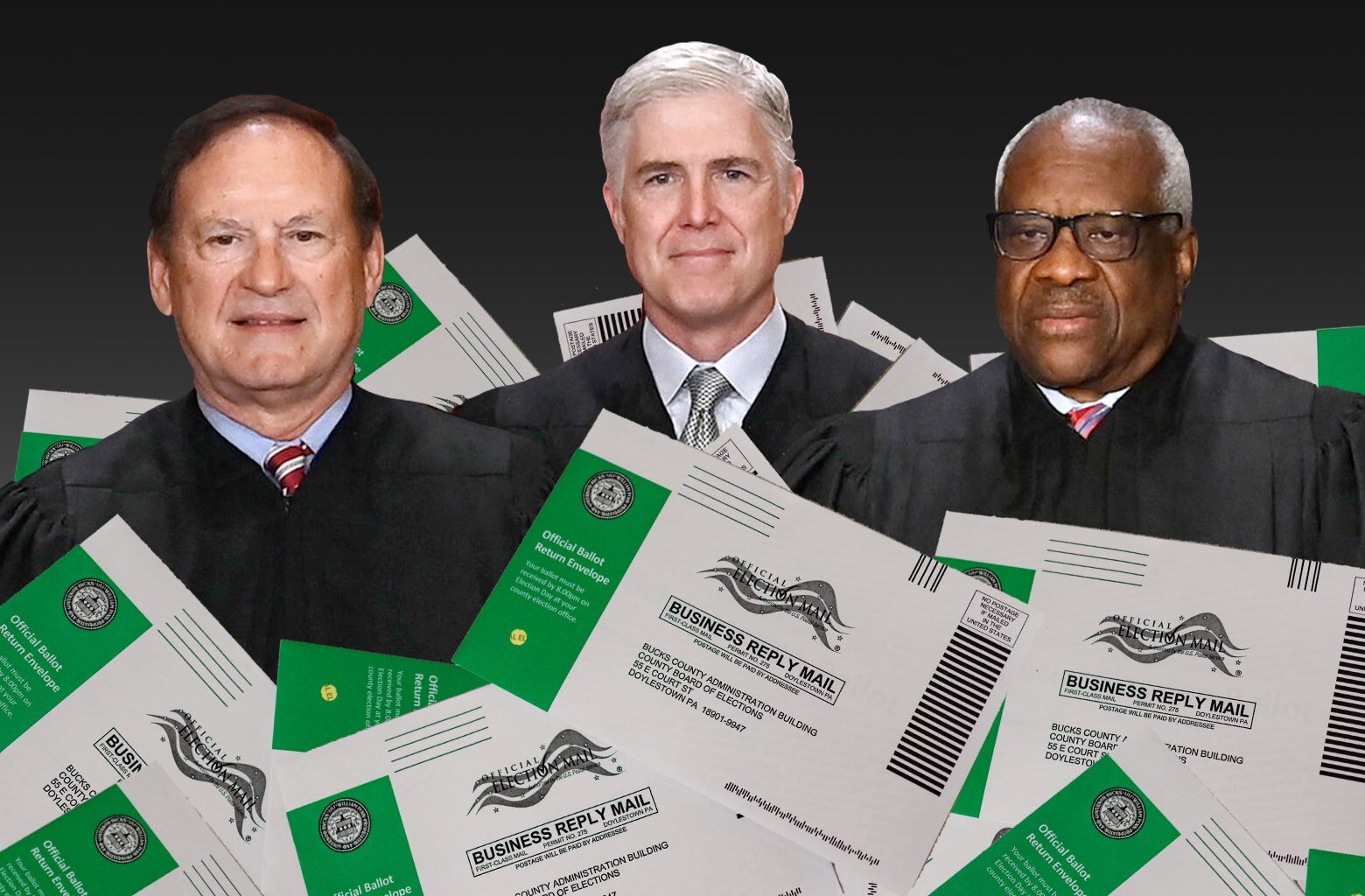
The Supreme Court may be poised to commit the single biggest act of disenfranchisement in modern history in a direct assault on the constitutional authority of states to set election laws. During Monday’s arguments in Watson v. Republican National Committee, the conservative justices lined up to attack state laws permitting the counting of ballots that arrive shortly after Election Day if they were postmarked on time. About 30 states have enacted similar laws, and they have had a major impact on American elections: In 2024 alone, more than 750,000 late-arriving ballots were counted because of a state’s grace period. Now there is a very real chance that the Supreme Court will wipe out these laws in one fell swoop, causing chaos in the upcoming midterms that could disproportionately impact Democratic voters.
That news, in itself, is a five-alarm fire for democracy. But what makes it even more disturbing is the fact that so many justices proved eager to embrace a legal theory that is incoherent, dishonest, and rooted in paranoid hostility toward mail voting. The court’s right flank spent much of Monday’s arguments airing grievances about vote-by-mail’s supposed potential for fraud alongside partisan hostility toward lax ballot deadlines. Because there is so little evidence of said fraud, these justices warned of the threat of “appearance of fraud” as being just as dangerous—with little note about who the biggest purveyor of the false perception that fraud infests our elections is and what his real aims are. These justices concocted absurd hypotheticals seemingly designed to highlight the nation’s ostensible lack of election integrity. Yet they spent remarkably little time offering any legal justification for striking down democratically enacted laws that govern more than half the country. This court may not have endorsed Donald Trump’s big lie in 2020, as the president recently griped. But it could be on the brink of imposing one of his favored voter suppression policies by judicial decree.
Watson began when the Republican National Committee challenged a Mississippi law that directs election officials to count mail ballots postmarked by Election Day, as long as they arrive within five business days of Election Day. The RNC argued that Congress has preempted such laws through federal legislation, mostly passed in the 19th century, setting the date for federal elections. Just before the 2024 election, the far-right 5th U.S. Circuit Court of Appeals agreed, striking down the Mississippi statute. It asserted that the words “Election Day,” as used in the federal code, mean the date by which state officials must receive an eligible ballot. So federal law, according to the 5th Circuit, nullifies state statutes that seek to count any ballots that come in after that date. When the Supreme Court took up the case, the Trump administration sided with the 5th Circuit, urging the justices to strike down Mississippi’s statute and those like it.
The problem with this theory—as the liberal justices hammered throughout arguments—is that it has no basis in law, history, or precedent. “Election Day” has long been understood to mean the date by which voters cast their ballots. (For federal elections, it’s enshrined into law as the first Tuesday after the first Monday in November.) This settled meaning is, Justice Sonia Sotomayor pointed out, why many states allowed soldiers to vote in the field before Election Day during the Civil War. It is why some of those states established a grace period by which officials could receive absentee ballots from soldiers in the field after Election Day, including through the mail. It is why, in the 20th century, states expanded early in-person voting and mail voting without serious legal issue. And it is why, in this century, Congress deferred to states’ own ballot deadlines when creating rules to help military and overseas voters participate in elections.
The unbroken principle is straightforward: Voters must submit their ballots by Election Day. And until Congress declares otherwise, states get to decide how long after that date a valid ballot can arrive. That’s how it works under the Constitution, Justice Ketanji Brown Jackson reminded both Paul Clement, arguing for the RNC, and Solicitor General John Sauer, who teamed up to oppose Mississippi’s law: States have primary authority to regulate federal elections until Congress chooses to override those rules with a clear voice. And Congress has made no such choice here.
One by one, the Republican-appointed justices swatted away these inconvenient facts, fixating instead on wild hypotheticals about voter fraud. Justice Samuel Alito asked Mississippi Solicitor General Scott Stuart, who defended the Mississippi law, if he thought it was “legitimate for us to take into account” Congress’ passage of Election Day statutes “for the purpose of combating fraud or the appearance of fraud.” The justice noted that “some of the briefs have argued that confidence in election outcomes can be seriously undermined if the apparent outcome of the election on the day after the polls close is radically flipped by the acceptance later of a big stash of ballots that flip the election.”
Stuart explained that even the Trump administration had failed to identify “a single example of fraud from post–Election Day ballot receipt in this century.” But Alito’s argument was not grounded in reality—or, for that matter, law. It is not the Supreme Court’s job to decide whether Mississippi’s law increases “fraud or the appearance of fraud” (though it doesn’t). Its job is to decide whether Congress intended to foreclose grace periods for mail ballots when it set federal Election Day more than 150 years ago. It obviously did not; indeed, it could not have foreseen the widespread adoption of mail voting well over a century later. Besides, Alito’s logic (to the extent there was any) is circular: The only reason there may be an “appearance of fraud” is because opponents of mail voting spread unfounded claims of fraud. If the resulting paranoia can be weaponized against otherwise valid voting rules, then the Republican Party has found a cheat code to kill off any election law in court.
Most of Alito’s conservative colleagues, however, shared his suspicion of mail voting, some in conspiratorial turns. Justice Brett Kavanaugh fretted that “late-arriving ballots open up a risk of what might destabilize the election results,” warning that “charges of a rigged election could explode.” Should the court, he asked Stuart, safeguard “confidence in the election process?” He also pressed Stuart to acknowledge that states do not “disenfranchise” voters by setting an Election Day ballot deadline—evidently to defend the court from charges that it would be putting its thumb on the scale for Republicans at the expense of voters in future elections by invalidating these laws.

Mark Joseph Stern
The Supreme Court Just Heeded One of Ketanji Brown Jackson’s Sharpest Dissents
Read More
If the court does strike down these laws in June, giving 30 states fewer than 150 days to change their mail voting rules, the results could be disastrous. Perhaps sensing that threat, Kavanaugh asked Clement if the “Purcell principle”—the idea that courts can’t significantly alter election rules too close to the vote—was an issue in this case. Clement waved away that concern, and Kavanaugh seemed satisfied, declining to ask any follow-ups. Of course, neither man explained what such a scenario would look like on the ground: State election officials would scramble to change the rules on the fly and somehow inform millions of voters that they must now mail their ballot well in advance of Election Day.
With his questions, it sounded as if Kavanaugh was trying to manage backlash to his eventual vote to, yes, “disenfranchise” countless Americans. The justice continues to transform into the new Alito. Meanwhile, Justice Clarence Thomas questioned whether there was any difference between mailing a ballot and handing it to your neighbor, and rejected the Civil War precedent as irrelevant. (Thomas has previously promoted Trump’s claims of widespread voter fraud.)
Justice Neil Gorsuch picked up the baton to spin out a strange scenario in which voters “recall” their ballots shortly after Election Day in response to a late-breaking sex scandal. “In that hypothetical,” he asked Stuart, “did the election happen on Election Day?” Stuart explained that “recalling” a ballot after Election Day is already forbidden by state law. Gorsuch at first refused to believe him, claiming greater expertise in the minutiae of the Mississippi code. Then the justice asked what would stop it from happening even if it were illegal.
Stuart did not have a particularly good answer to this and many other bizarre questions, perhaps revealing that, as a MAGA Republican, his heart was not in the case. But he could have pointed out that Gorsuch’s hypothetical proves too much: Until a ballot has been counted, it could be changed in any number of ways; a voter could break into the election office and alter her ballot, too. (This scenario is only a tad more fanciful than the justice’s hypothetical, since there is no evidence of voters “recalling” a mail ballot after an election.) No state requires every ballot to be counted on Election Day, which undermines Gorsuch’s all-on-one-day theory.
So does another point in Mississippi’s favor: The fact that early voting does not, by definition, occur on Election Day. If federal law really requires voting on “the day of the election,” as the plaintiffs claim, how can states let people cast ballots well in advance of the election? Both Chief Justice John Roberts and Amy Coney Barrett sounded hung up on this question, and Justice Elena Kagan seemed to angle for their votes by pressing Clement and Sauer on it. Neither Roberts nor Barrett gave away their view, but both sounded genuinely troubled by this issue. Rightly so: Neither Clement nor Sauer could offer a cogent reason why, under their theory, early voting is legal but late-arriving ballots are not. “It seems to me,” the chief told Sauer pointedly, “maybe you’re not saying anything other than, Well, that’s different.”
Barrett, too, sounded skeptical that Clement and Sauer could insist that Congress preserved one historical aspect of elections—requiring ballots on Election Day—while disregarding the rest. After all, when Congress enacted our modern election dates, we didn’t have early voting; why isn’t that suspect, too? “It seems to me if you look at historical practice,” she told Clement, “what an election meant was showing up in person and casting your vote and being qualified as the voter on that same day.” So if “we’re just going to say that historically it needs to look like it always looked, how come those features fall out?” Clement told her “they probably fall out because nobody thinks they’re essential,” a remarkably weak answer: There’s no evidence that Congress thought Election Day ballot deadlines were essential, either.
This Content is Available for Slate Plus members only
If You Think Iran Is a Political Disaster for Trump, You Have Another Thing Coming
The Alito Wing of the Supreme Court Sure Sounds Sold on Trump’s Voter Fraud Lies
As these questions indicate, Barrett and Roberts hold the case in their hands. All three liberals, meanwhile, forcefully argued in defense of Mississippi’s law. The four most conservative justices trashed it. So it likely comes down to these two, and the stakes are chillingly high for such a photo finish. As the Republican National Committee concedes, Democrats are more likely to vote by mail today and thus more likely to be disenfranchised if late-arriving ballots are tossed out. Three quarters of a million voters relied on these laws to protect their vote in the last federal election. If they are wiped away, Americans voting by mail will have to rely on the vagaries of the Postal Service to ensure their ballots arrive on time. And just last month, the Supreme Court stripped away citizens’ ability to sue USPS when postal carriers intentionally destroy or withhold their ballots.
Looming over this dispute is another, more existential concern: Can this Supreme Court be trusted to safeguard free and fair elections in 2026 and 2028 when Trump is committed to subverting them? Monday’s arguments indicated that four justices are, at a minimum, easily swayed by Republicans’ bogus claims of fraud, and open to changing the rules to tilt the playing field. Watson should have been laughed out of court. Instead it received a warm reception. Even if the plaintiffs lose 5–4—and it is an if—that margin will be far too close for comfort. A democracy that rests on the knife’s edge of a single Supreme Court vote is living on borrowed time.

Sign up for Slate’s evening newsletter.