
As the Iran war enters its fourth week, the many faces of Russian propaganda are once again flooding X.
While the well-known antisemite and rogue-regime enthusiast Jackson Hinkle continues to mourn the murder of Ali Khamenei, and Russian-Israeli blogger Andrey X preaches about the “evils” of Israel from the West Bank, other, lesser-known but still influential handles have entered the scene.
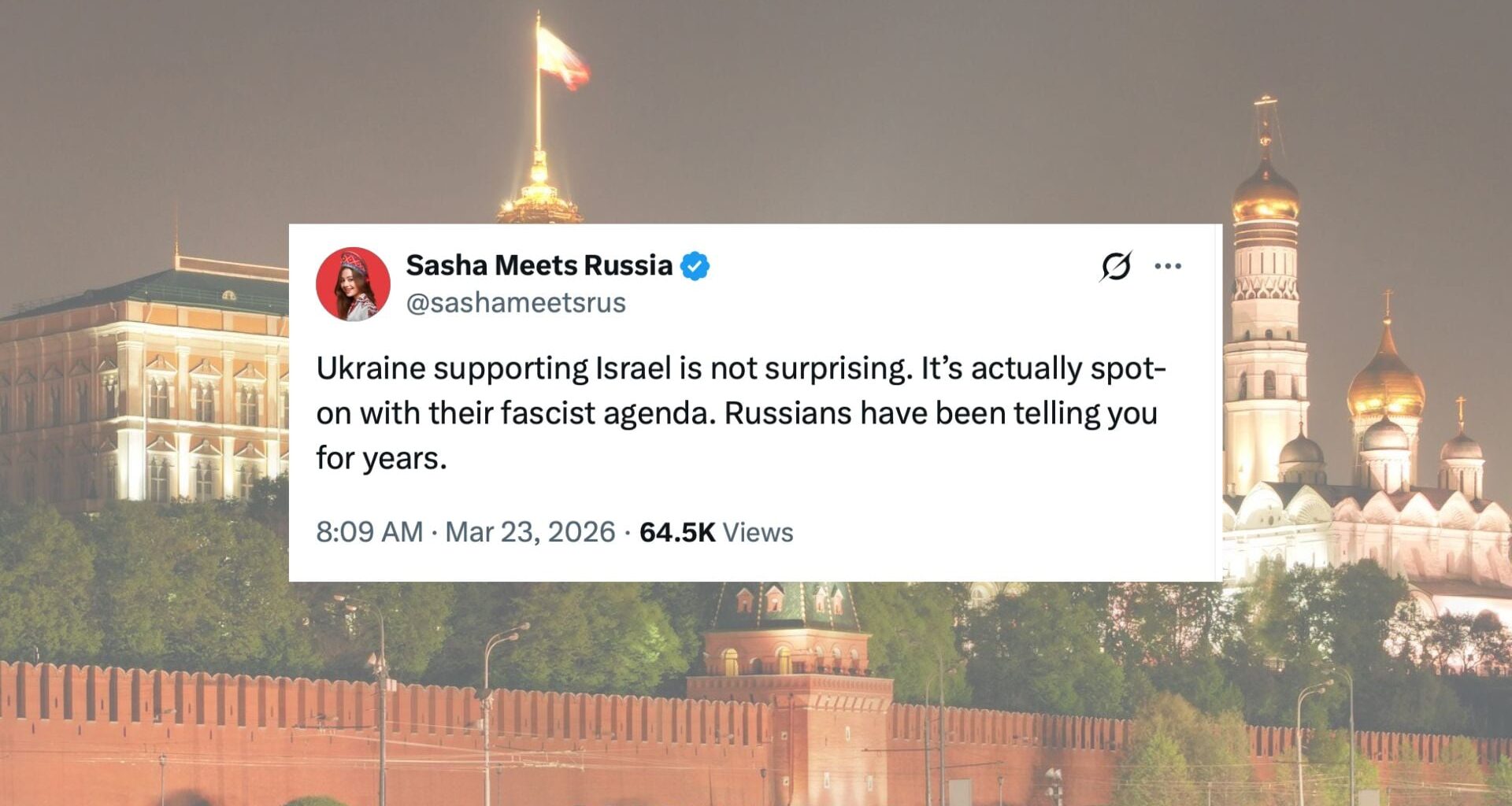
One of them is Sasha Meets Russia, who suddenly took to X to lambast both Kyiv and Jerusalem: “Ukraine supporting Israel is not surprising. It’s actually spot-on with their fascist agenda. Russians have been telling you for years.”
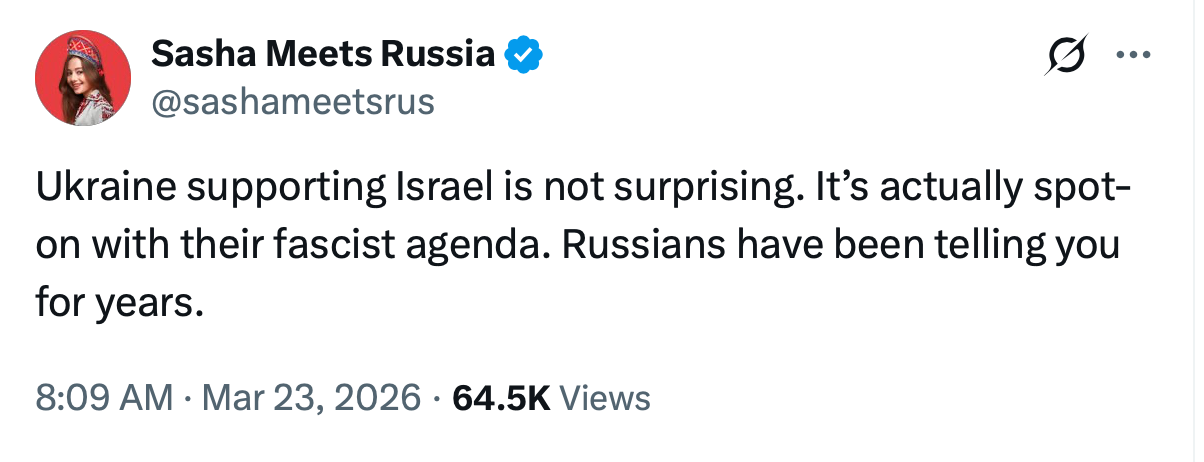
Kremlin’s influencer Alexandra Jolt attacking Ukraine and Israel. Source: X
Her real name is Alexandra Jost, and she enjoys a following of 58,000 on X. Her legend goes like this: half-American, half-Russian, she abandoned her life in the West to travel around Russia, showcasing its landmarks, cultural agenda, and the many advantages of living in a country that has now effectively restricted access to the internet.
I don’t know about most readers, but every time I travel around Italy, for example, I don’t get to meet Italian Prime Minister Giorgia Meloni or high-profile officials to enjoy an Aperol Spritz while watching the sun set over the Colosseum. Jost, however, does. She has met Russia’s Foreign Ministry spokesperson Maria Zakharova, Putin’s ideologue Alexander Dugin, and other Kremlin-aligned figures.
This is not accidental. In 2025, Ukraine’s United24 project identified Jost as part of the Kremlin’s “influencer army,” funded through the Presidential Foundation for Cultural Initiatives. Their task boils down to exporting Russia’s cultural products—like ballet or Dostoevsky—demonising the West and its alleged lack of “spirituality,” and whitewashing Russia’s wars, foremost the war against Ukraine.
Now, as we in Ukraine call it, the “metodychka” (a set of instructions issued by the Kremlin to its propagandists) has changed. Russia is now directing accounts like Sasha Meets Russia—previously largely avoiding the topic—to attack Israel as well.
This is hardly surprising.
Iran is Russia’s chief ally in the Middle East. It has supplied the now-infamous Shahed drones used to attack Ukraine and supports Hamas and Hezbollah. The U.S.–Israel war on Iran came as a blow to Moscow, following the collapse of the Bashar al-Assad regime in Syria in late 2024.
The spike in oil prices, which funds the Russian war machine, offers little long-term consolation given the broader damage caused by the Iran war, as well as the apparent seclusion of Iran’s new Supreme Leader, Mojtaba Khamenei, the son of Ali Khamenei.
It is likely for this reason that figures like Sasha Meets Russia are being mobilised. A young, attractive woman can influence a significant audience, particularly in Israel-hostile countries that are indifferent to Ukraine or the true causes of the war. The use of Nazi/fascist rhetoric is especially telling, given that in today’s Russia, even a banana could be labeled “Nazi” if deemed necessary by the Kremlin’s propaganda machine.
But it’s not just Sasha Meets Russia. Numerous other Russian or Russia-linked accounts are attempting to defend Iran, at least in the information space. This became especially evident after my meme tweet about Russia denying Ukraine’s right to exist reached 1.1 million impressions. Bizarrely, not because of Ukraine and Russia, but because it was quickly reframed into the Iran–Israel narrative, where Iran—despite its official policy calling for the destruction of the “Zionist regime”—was portrayed as the “victim” of Israeli “aggression.”
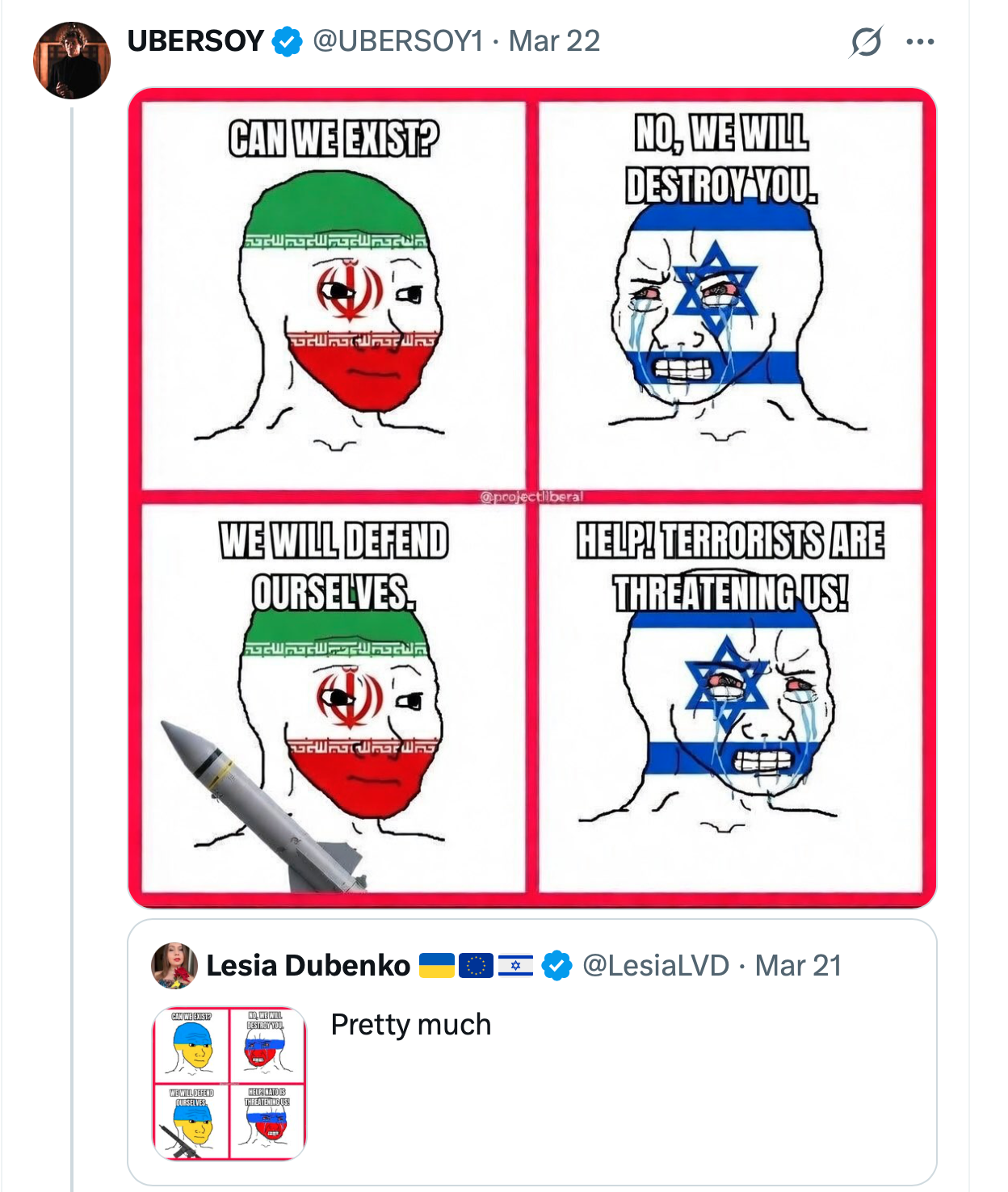
Russia-linked ‘right-wing progressive publication’ UBERSOY mocking Russia’s war on Ukraine. Source: X
Sadly, none of this is new, nor is it anywhere close to ending. Anti-Israel propaganda was rampant in the USSR, and it remains so today—with one key difference: it now seeks to demonize both Ukraine and Israel on an unprecedented scale.
This calls for greater cooperation between Israel and Ukraine, and I can only welcome Israeli Prime Minister Benjamin Netanyahu’s decision to request assistance from Ukraine in intercepting Iranian Shahed drones.
It is long overdue.
Lesia Dubenko is a Kyiv-born journalist and analyst, previously featured in the Financial Times, Politico Europe, Washington Times, New Eastern Europe, and Kyiv Post, with a degree in European Affairs (Lund University). Her work focuses on the Russo-Ukraine war, global politics, propaganda and more.