
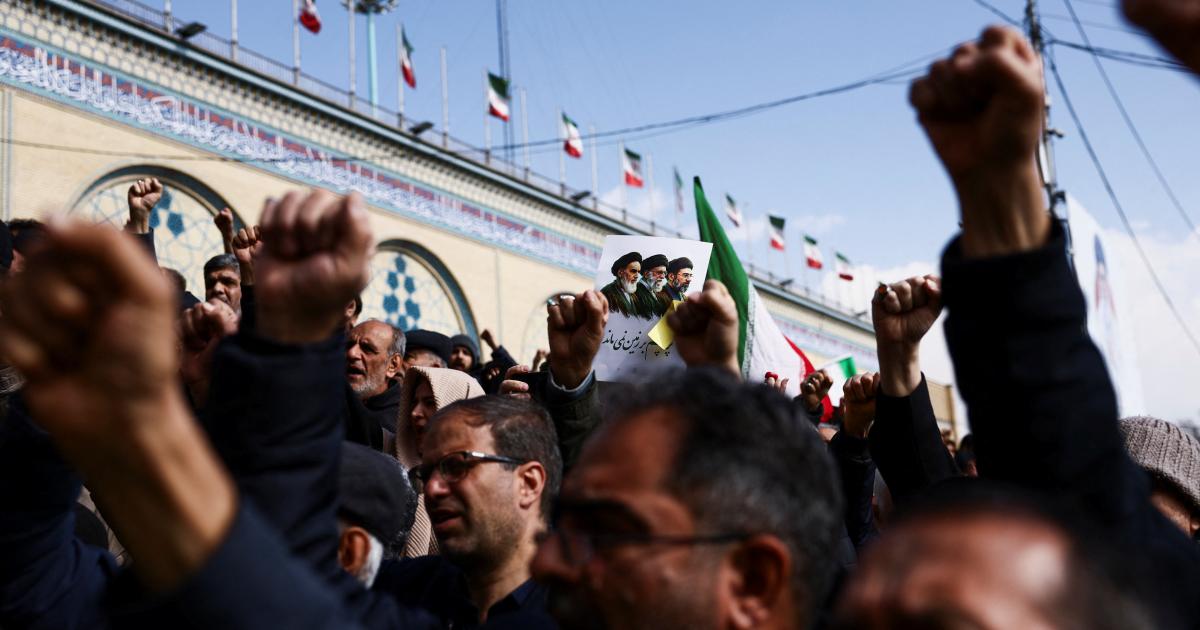
At the outset of Operation Epic Fury, U.S. authorities went on a nationwide high alert against acts of terrorism carried out by Iran and its proxies—with good reason. Days after U.S. and Israeli strikes killed Iranian Supreme Leader Ali Khamenei, the Islamic Revolutionary Guard Corps’s Qods Force broadcast over Iranian television a warning that “the enemy should know that their happy days are over and they will no longer be safe anywhere in the world, not even in their own homes.”
Since the threat, operatives acting at Iran’s behest have been tied to plots in Azerbaijan, Kuwait, Qatar, the United Arab Emirates, and the United Kingdom. According to U.S. President Donald Trump, Iran may be trying to activate sleeper cells in the United States. “We know a lot of different things that have happened that have been very bad,” he announced, adding that Washington was “very much on top of it.”
Iran has long employed terrorism as a tool of foreign policy, not only to export the revolution abroad by supporting like-minded proxy groups in the Middle East but also to strike fear in the regime’s perceived enemies, including Iranian dissidents, Israelis and Jews, diplomats from Europe, the Gulf states, and the United States. But Tehran has typically been careful about how, when, and where to employ terrorism to achieve these goals. It favored operations for which it could assert reasonable deniability, hoping to avert retaliation in the form of sanctions, diplomatic isolation, or reprisal attacks. Iranian plotters practiced strategic patience and did not act on every opportunity that presented itself. Today, however, the regime feels its revolutionary project to be under existential threat by the United States and Israel. The assassination of Khamenei and other senior officials, along with open discussion in Washington and Jerusalem of regime change, has convinced Tehran that it should go to any length possible to stop the war—including by bringing it home to the United States.
With its leadership badly damaged and its security establishment humiliated by deep Israeli and U.S. intelligence infiltration, Iran sees little downside in greenlighting a wide variety of attacks, from small scale plots to potential mass-casualty events, with little regard for potential repercussions. It is likely wagering that the American public and its politicians lack the stomach to withstand civilian losses, and that, should it successfully carry out a mass casualty event, the political cost of continuing the war will become prohibitive for the Trump administration.
As bombs continue to fall, the regime could resort to increasingly desperate acts of terrorism to show Washington that, though it may be down, it is not yet out. With nothing to lose, it may go to unprecedented lengths to carry out attacks, particularly against soft targets, as it plans for more sophisticated attacks against harder targets. Iran has rarely succeeded in targeting the United States at home or around the world. But the long track record of foiled and failed plots should not give Washington a false sense of security. After all, counterterrorism officials need to get it right every time; bad actors need to succeed only once.
A HISTORY OF VIOLENCE
The Qods Force message may indicate a relative consensus in Tehran today about the utility of terrorism as a geopolitical tactic, but there was once a contentious debate inside the regime about when and how it should be used. In the mid-1980s, the CIA assessed that revolutionary leadership was divided between “Islamic radicals,” who advocated for the use of terrorism as a legitimate tool of state policy to export and defend the principles of the revolution, and regime “pragmatists,” who condoned the selective use of terrorism because they saw it as an effective instrument for furthering national interests, even as they sought improved economic ties with other countries.
Over time, the radicals won out. The Islamic Revolutionary Guard Corps came to play an increasingly important role in policymaking as former IRGC officials rose to senior regime positions. As a result, terrorism became a tool of choice in Tehran, though for years Iran avoided plotting attacks in the United States for fear of retribution. That changed in 2011, as Iran engaged in a shadow war with the West over U.S.-and-Israeli-led efforts to undermine Tehran’s nuclear program. Iran pursued what U.S. investigators called “a jumble of overlapping plots” targeting U.S. and Israeli diplomats and Jewish targets between 2011 and 2012. One in particular forced Washington to change its understanding of the threat.
In October 2011, U.S. officials foiled an Iranian plot to assassinate the Saudi ambassador to the United States in Washington, D.C. After the discovery of the plot, the U.S. intelligence community concluded that “some Iranian officials—probably including Supreme Leader Ali Khamenei—have changed their calculus and are now more willing to conduct an attack in the United States in response to real or perceived U.S. actions that threaten the regime.” At the time, Iranian officials concluded that the threat the United States, Israel, and other Western powers posed to Iran’s nuclear program—evident in joint offensive cyber-operations such as the Olympic Games campaign, sabotage at IRGC missile bases, and assassinations inside Iran—warranted the creation of the Qods Force’s Unit 400. The unit’s sole mission was to carry out attacks against countries trying to undermine Iran’s nuclear program, including the United States.
Then came the January 2020 killing of IRGC Commander Qasem Soleimani, head of the Qods Force, by a U.S. airstrike in Iraq. Iranian officials quickly pledged to avenge his death and plotted several attacks targeting current or former U.S. officials the regime believed to be involved in Soleimani’s death. “U.S. law enforcement has disrupted multiple potentially lethal Iranian-backed plots in the United States since 2020,” the Department of Homeland Security reported in June 2025. Many of these foiled attacks were products of Iran’s yearslong investment in developing a “homeland option” in which Iranian operatives, criminals hired to carry out attacks at Iran’s behest, and terrorist proxies would be positioned to wreak havoc in the United States. In 2016, for example, a Hezbollah operative in New York described himself to the FBI as a sleeper agent carrying out preoperational surveillance for Hezbollah in the United States and Canada, to be activated if the United States were to go to war with Iran. Around the same time, another Hezbollah operative was caught stockpiling 300 pounds of explosive precursor materials in the Houston area.
Earlier this month, a Brooklyn jury convicted a Pakistani man and trained IRGC operative of terrorism and murder-for-hire in a plot targeting U.S. politicians or officials, including Trump, in 2024. Iran has also attempted to enlist criminal networks with no previous links to Tehran to maintain plausible deniability and reduce the likelihood of retaliation. After multiple failed attempts to kidnap Iranian American dissident and human rights activist Masih Alinejad from New York and bring her to Iran, in 2022 the IRGC hired members of an Azerbaijani faction of the Russian mafia as part of an unsuccessful assassination scheme. Iranian operatives have taken to recruiting other European criminals through Telegram channels, offering cash for surveillance and potential acts of violence. “They will literally hire anyone to commit arson, criminal damage, assault,” one British official told The i Paper, adding that “professional criminals are recruited for the more sophisticated operations.” In other cases, most notably a recent series of attacks on Jewish institutions in several European countries, those criminal groups have outsourced the work to local teenagers.
THE ISLAMIC REPUBLIC STRIKES BACK
In its 2025 threat assessment, published just weeks prior to the 12-day war in June, the Office of the Director of National Intelligence predicted that Iran “will continue to directly threaten U.S. persons globally and remains committed to its decade-long effort to develop surrogate networks inside the United States.” Since then, the United States and Israel have launched two wars against the country, first targeting its nuclear capabilities and now its leadership, ballistic missile and other conventional military capabilities, and the remnants of its nuclear program.
According to NBC News, as the Trump administration mulled over striking nuclear facilities at Natanz and Fordow last June, Iran sent a message to the president threatening to “activate sleeper-cell terror inside the United States” if the U.S. military followed through. That did not happen—perhaps because U.S. law enforcement was on high alert—but within days, European authorities exposed an Iranian plot to target Israeli and U.S. embassies in Sweden and another to target Jewish institutions and individuals in Germany.
Nine months later, Israel and the United States are again at war with Iran—and have wrought far more damage with Operations Epic Fury and Roaring Lion than they did with Operations Midnight Hammer and Rising Lion. Israel has continued to target top Iranian officials for assassination after Khamanei’s death, and Israeli and U.S. leaders have explicitly mentioned regime change as a preferred, if not imminently likely, outcome.
A senior Israeli National Security Council official told the Jerusalem Post that Tehran has fundamentally changed its operational doctrine in response to the strikes, removing any operational constraints and instructing any agents to carry out whatever attacks they can. Iranian officials “feel they have nothing to lose,” the official explained, adding that unlike past plotting, which was more calculated and considered, today “where they can act, they act.” To that end, the Israeli official said, Iran has issued an unprecedented call for action, recruiting widely among organized crime groups, mercenaries, Iranian agents, and Shia militants from Azerbaijan and Afghanistan, and hoping to inspire lone actors.
Iran has long employed terrorism as a tool of foreign policy.
U.S. officials appear to concur with the Israeli assessment. According to a federal government alert shared with U.S. law agencies, encrypted communications believed to have originated in Iran and intercepted by U.S. authorities may have been “an operational trigger” activating “sleeper assets” outside the country in the wake of Khamenei’s death. The intelligence community is also worried about lone wolf attacks by individuals inspired by Iranian and proxy incitement. In its 2026 threat assessment released last week, ODNI concluded that after prominent Shia religious leaders in Iran issued religious decrees calling to avenge the death of Khamenei, some individuals could be inspired “to seek to conduct terrorist activities against U.S. targets worldwide.”
These assessments already appear to be bearing out. In the weeks since the start of the war, two different Iranian operations targeting Israeli diplomats in the United Arab Emirates were thwarted by Emirati authorities. Qatari authorities announced the arrest of two cells of operatives accused of collecting intelligence on “vital and military infrastructure,” “conduct[ing] sabotage activities,” and having trained on the use of drones at the direction of the IRGC. The UK Metropolitan Police announced the arrest on counterterrorism charges of one Iranian and three dual British-Iranian citizens accused of conducting “surveillance of locations and individuals linked to the Jewish community in the London area” as part of a “long-running investigation” predating the war, the start of which appears to have accelerated preparations. And Azerbaijan’s State Security Service agents foiled what they described as a “series of planned terrorist and intelligence operations . . . orchestrated by Iran’s intelligence service” targeting an oil pipeline, the Israeli embassy in Baku, a leader of the local Jewish community, and a synagogue. Euronews has reported that authorities identified IRGC Colonel Ali Asgar Bordbar Sherami as “one of the main organizers” of the plots. As the war continues, still more plots are likely to be uncovered.
U.S. and Israeli decapitation strikes, along with Israel’s weakening of Iranian proxies across the Middle East since Hamas’s October 7 attacks, could at least partially constrain the regime’s ability to plan acts of terror. But Iranian security agencies and their proxies may attempt to overcome those losses by pooling their remaining resources and work together to carry out attacks targeting their shared enemies around the world. They already have the institutional framework for such missions. The Qods Force unit 3900, organized by the Qods Force’s Palestine Branch and Hezbollah and Hamas, plans joint attacks abroad. In 2023, authorities in Sierra Leone uncovered what Israeli authorities describe as a joint Qods Force and Hezbollah plot. More recently, European officials thwarted a series of Hamas plots planned by operatives in Lebanon, working in concert with Unit 3900.
DETERRENCE BY REVENGE
That none of Iran’s plots have succeeded to date is as much a credit to counterterrorism authorities as it is an indictment of the capabilities of the Iranian operatives and proxy agents involved. But as long as the war persists—and likely well after it ends—the threat of Iran-related terrorism will remain high, precisely because Iran is so militarily and politically weak. The strategic patience Iran once exhibited may go by the wayside now that Tehran believes this war is truly existential. Simply put, the more concerned the remaining leaders of the Islamic Republic are that the revolution is under threat, the higher the likelihood that they employ terrorism against those they perceive to be undermining the regime.
With every leader decapitated by the United States and Israel, a further weakened Iran grows more likely to be dominated by the IRGC, which, despite having lost several key leaders and commanders itself, could seek to strike back against its enemies, just as it did after Soleimani’s death. Exacting revenge in this way could also serve a tactical purpose in the eyes of the regime. Tehran may believe that a successful terrorist attack on U.S. soil could fan the political flames in the United States, prompting protests against an unpopular war and forcing the Trump administration to find an off-ramp.
Such an attack could produce the opposite result: a “rally around the flag” effect that gives the war the mandate among the U.S. public it so far lacks. But at the moment, Iran may see no option other than hitting back as hard as it can, wherever it can. Tehran remains a desperate regime. U.S. officials should take its desperation—and the danger that desperation entails—seriously.
Loading…