
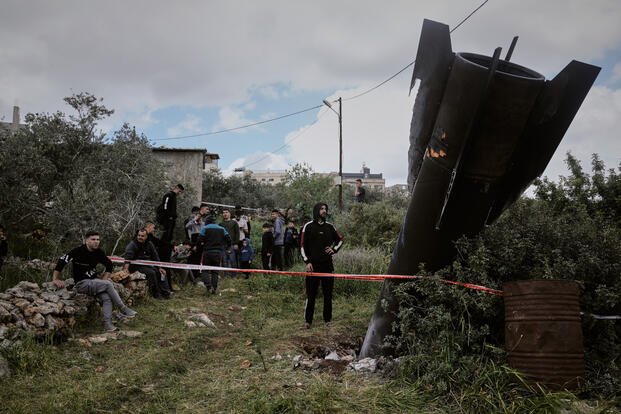
Iran unleashed new strikes across Israel and Gulf states Tuesday as the war widened fast, even as President Donald Trump insisted talks were underway and Iranian officials said no negotiations had taken place.
New strikes hit Israel and key Gulf states Tuesday, signaling a major expansion of the conflict beyond its initial fronts and raising the risk of a broader regional war with global energy implications. Trump said talks with Iran were “very good” and “productive,” while Iranian officials denied any negotiations were underway, sharpening a growing contradiction at the center of the crisis. Military.com reached out for comment to the White House, Department of Defense and U.S. Central Command.
Trump had already pushed back his deadline for reopening the Strait of Hormuz by several days while holding off on threatened strikes against Iran’s power infrastructure, buying time for a possible diplomatic off-ramp.
Iran Widens War with Strikes Across Region
New attacks pushed the conflict beyond Israel Tuesday, with Iran targeting Saudi Arabia, the United Arab Emirates, Bahrain and Kuwait in one of the widest coordinated assaults since the war began.
Air defenses across the Gulf intercepted incoming missiles and drones, while Israeli forces responded with large-scale strikes in Iran and Lebanon, according to multiple reports.
In Kuwait, air-defense shrapnel hit power lines and caused partial outages, while Saudi Arabia said it intercepted drones targeting its Eastern Province.
The widening strike pattern marks a clear shift from contained exchanges to sustained regional operations, pulling key U.S. partners directly into the fight and accelerating the pace of retaliation across multiple fronts.
The escalation also places new pressure on U.S. forces in the region and heightens concerns about the security of the Strait of Hormuz, a critical global oil chokepoint.
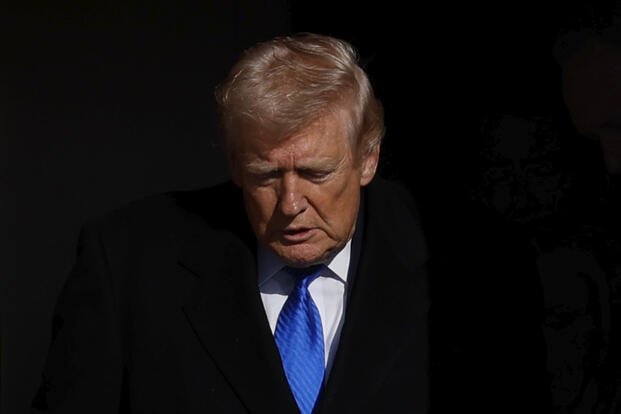
President Donald Trump disembarks Air Force One upon his arrival at Joint Base Andrews, Md., Monday, March 23, 2026.(AP Photo/Luis M. Alvarez)
Trump Pauses Strike Deadline as War Surges
Pressure surged after Trump issued a 48-hour ultimatum demanding Iran reopen the Strait of Hormuz or face potential U.S. strikes on key infrastructure.
The warning raised the prospect of direct U.S. military action in a conflict that had already begun spilling across the region.
By Monday, the White House delayed that timeline by several days, pointing to what officials described as progress in discussions. Trump said the talks could lead to a “complete… resolution of hostilities.”
Iran rejected that claim outright, stating no negotiations with the United States were underway, deepening uncertainty as military activity escalated and leaving unclear whether diplomacy or further strikes will drive the next phase of the conflict.
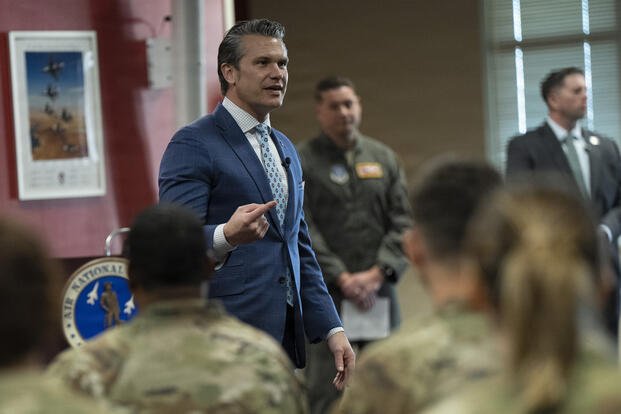
Secretary of War Pete Hegseth delivers remarks to troops assigned to the 164th Airlift Wing, Tennessee Air National Guard, in Memphis, Tenn., March 23, 2026. (DoW photo by U.S. Navy Petty Officer 1st Class Alexander Kubitza)
Pentagon Signals Military Focus as Diplomacy Unclear
Mixed signals from Washington continued as Trump publicly emphasized diplomacy while defense officials pointed to ongoing military objectives.
Defense Secretary Pete Hegseth said the U.S. aims to “destroy Iranian offensive missiles, destroy Iranian missile production, destroy their navy and other security infrastructure,” underscoring a strategy focused on degrading Tehran’s ability to project force across the region.
The contrast between public diplomatic messaging and military planning has added to uncertainty over how the conflict could evolve.
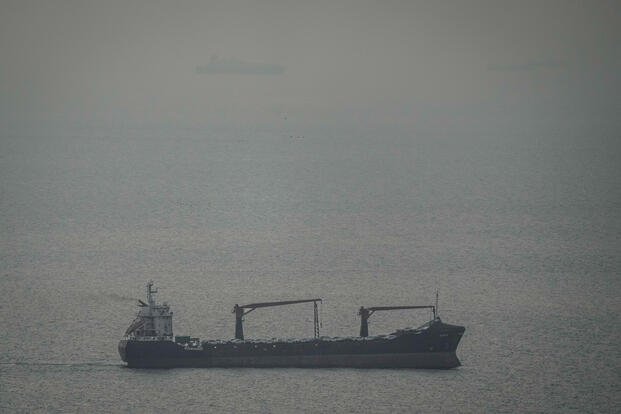
A cargo ship carrying vehicles sails through the Arabian Gulf toward the Strait of Hormuz in the United Arab Emirates, Sunday, March 22, 2026. (AP Photo)
Hormuz Disruption Sends Shock Through Global Oil Markets
The Strait of Hormuz remains heavily disrupted, threatening a conduit for about a fifth of the world’s oil and liquefied natural gas and sending energy markets higher as traders brace for prolonged instability.
The narrow waterway, which handles a critical share of global crude exports from the Persian Gulf, has become a central flashpoint as the conflict intensifies and shipping risk increases.
Iran has warned it could mine the Persian Gulf and expand attacks on commercial shipping, raising the risk of a wider maritime crisis that could choke off global supply routes.
U.S. naval forces have increased their presence in the region to protect shipping lanes, but any sustained disruption could trigger global supply shocks, higher fuel prices and broader economic fallout.
The fighting has also fed a broader shipping and energy emergency around Hormuz, where the blockade has become a central military and economic pressure point.
War Spreads Fast as Strikes Hit Multiple Nations
Cross-border strikes accelerated Tuesday as Iran targeted Israel and key Gulf states including Saudi Arabia, the United Arab Emirates, Bahrain and Kuwait, marking a sharp expansion of the conflict beyond its initial fronts.
Missile and drone attacks are now hitting multiple countries in rapid succession, stretching air defenses across the region and increasing the risk of miscalculation as more actors are pulled into the fight.
The widening battlefield raises the likelihood of a prolonged regional war that could draw in U.S. forces and further destabilize global energy markets already under pressure from disruptions in the Strait of Hormuz.
No clear off-ramp has emerged as military operations intensify and competing claims about diplomacy continue to cloud the trajectory of the conflict.