
JD Vance could lead Iran peace talks for US side in Pakistan if negotiations go ahead – sources
Pakistan’s military leadership has been attempting to broker negotiations between the US and Iran, after the White House confirmed that Pakistan’s army chief, Asim Munir, had a call with Donald Trump on Sunday to discuss the conflict.
Diplomatic sources said the US and Iran could meet for negotiations in Islamabad as early as this week to discuss an end to the war, which began almost a month ago.
It was emphasised that Islamabad had yet to be officially confirmed as the venue for any peace talks, which neither side has formally agreed to so far. Trump’s Middle East envoy, Steve Witkoff, is believed to be preparing to travel to Islamabad but there was no confirmation that anyone from the Iranian side would be in attendance.
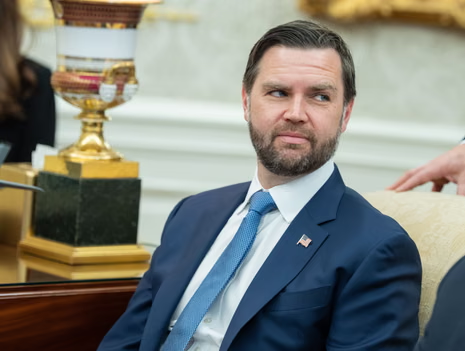 It is possible Pakistan could become the venue for talks that would include JD Vance, the US vice-president. Photograph: Aaron Schwartz/Pool/Aaron Schwartz – Pool/CNP/Shutterstock
Pakistani sources said that the US vice-president, JD Vance, was being put forward as a probable chief negotiator from the US side if talks went ahead, rather than Witkoff or Trump’s son-in-law, Jared Kushner, who led the nuclear negotiations with Iran before the war. You can read more from my colleagues Hannah Ellis-Petersen and Shah Meer Baloch here:
Key events
Show key events only
Please turn on JavaScript to use this feature
Donald Trump is about to hold a swearing-in ceremony for his new homeland security secretary at the White House. I’ll bring you any relevant lines here if he makes any comments about his war on Iran.
Updated at 13.43 EDT
US to send thousands more soldiers to the Middle East – reports
The Pentagon is expected to send thousands of troops from the elite 82nd Airborne Division to the Middle East, two people familiar with the matter have told Reuters, adding to the massive military buildup even as the Trump administration apparently seeks talks with Iran.
The Wall Street Journal hears similar, and puts the number of additional troops at 3,000.
A written order to send the soldiers from the US army’s 82nd airborne unit is expected to be released in the coming hours, two US officials told the paper.
It’s unclear where in the region the troops would be sent to and when they would arrive there.
The US military referred to the White House, which did not immediately respond to Reuters’ request for comment.
It follows reports on 13 March of 5,000 US marines and sailors, along with an amphibious assault ship, being sent to the region.
Donald Trump has repeatedly insisted that he doesn’t want to US boots on the ground in Iran – but also hasn’t ruled it out.
ShareBritish troops shoot down 14 drones in Iraq overnight
UK forces shot down 14 “kamikaze” drones overnight, the largest number downed in a single night since the start of the Middle East crisis that was sparked by US-Israeli attacks on Iran on 28 February.
Britain’s defence secretary John Healey told ministers at Tuesday’s cabinet meeting that a counter-drone team had brought them down during an attack on a joint base in Iraq.
The one-way attack drones were gunned down from the Erbil base, which houses UK and US troops, the PA news agency understands.
Specialist troops from the RAF Regiment, which defends British assets, used the UK’s Rapid Sentry air defence system to defeat the unmanned aerial vehicles (UAVs).
ShareLebanon faces ‘existential crisis’ as Israel moves to control south, official says
Similarly, Michel Helou, secretary-general of the National Bloc, a centre-right, secular Lebanese political party, has told NBC News that Lebanon is facing an “existential crisis” amid fears of a long-term occupation by Israeli forces of the country’s south.
double quotation markThe amount of destruction in South Lebanon and in Beirut and in the Bekaa Valley is absolutely disastrous. And that has also pushed a million Lebanese on the roads.
With Israel’s defence minister announcing that the IDF would take control of a so-called “security zone” in southern Lebanon, as well as over the remaining bridges over the Litani River it hadn’t yet destroyed (see my last post), Helou said Lebanon faced a more “desperate situation” than it had seen in decades since the civil war.
He also accused Israel of “psychological terrorism” over Katz’s comparisons of Israel’s “model” for operations in southern Lebanon to those executed in parts of Gaza that were reduced to rubble, while – as I reported yesterday – Israel’s far-right finance minister Bezalel Smotrich has openly and explicitly called for Israel to annex southern Lebanon.
On the hundreds of thousands of Lebanese people who have had to flee the south, Helou added:
double quotation markFor the first time, there is no more life. There’s no more human presence. So, it’s much more dangerous than occupation. It’s really the destruction of an entire area.
ShareHezbollah describes Israel’s intention to occupy much of southern Lebanon as ‘existential threat’
Hezbollah will fight to prevent Israeli troops from occupying southern Lebanon, one of the group’s top lawmakers Hassan Fadlallah has told Reuters, saying such an occupation would pose an “existential threat” to Lebanon as a state.
Israel’s defence minister, Israel Katz, earlier said he had instructed the IDF to establish a so-called “security zone” south of the Litani River, about 20 miles from the current Israel-Lebanon border – meaning Israeli occupation of a large area of southern Lebanon.
Katz said the hundreds of thousands of south Lebanon residents who were displaced by the war this month “will not return south of the Litani River until security is guaranteed for the residents of the north” of Israel.
Israeli forces attacked the Qasmiyeh Bridge, a key crossing linking Lebanon’s south to the rest of the country, over the weekend, in what Lebanese president Joseph Aoun described as a “prelude to ground invasion”.
Indeed, on Tuesday, Katz said the military would “control the remaining bridges and the security zone up to the Litani”. Israel has already destroyed five key bridges over the river since 13 March, leading many Lebanese people to fear that Israel is attempting to separate southern Lebanon from the rest of the country ahead of a large-scale invasion.
This would mean many people displaced from their homes, following evacuation orders across large areas of southern Lebanon, would have nowhere to return to.
Israel’s forced displacement of civilians in Lebanon is a possible war crime, according to the United Nations and Human Rights Watch.
In the last hour, Saudi Arabia’s ministry of defence said it had intercepted and destroyed a drone in the country’s eastern region.
ShareIran’s military vows to fight until ‘complete victory’
Iran’s military will continue its response to the war launched by the US and Israel until the regime has achieved “complete victory”, the commander of the country’s armed forces said earlier, in a statement issued via state media.
Major general Ali Abdollahi Aliabadi didn’t elaborate on what the regime would consider “complete victory”. However, he mocked the United States as a “hollow” nation that has been “brought down in front of the world”, with Donald Trump left “trying to escape from the war” it started.
He continued:
double quotation markThe American president, Trump, after realizing the situation and becoming stuck in the war, has lost hope in his goals and is now seeking help from other countries to get out, which is a historic moment and a great honor for the Iranian people.
At this sensitive time, Iran’s armed forces remain loyal to their promise, fully follow the supreme leader and commander-in-chief Mojtaba Khamenei and will continue this proud path with the support of the people until complete victory.
ShareIranian missile intercepted over Lebanese airspace – report
An Iranian missile was intercepted over Lebanese airspace for the first time on Tuesday, according to three senior Lebanese security sources, with two of them saying a foreign naval vessel was responsible for the interception.
Lebanon’s state-run National News Agency reported that shrapnel from an interception had landed over a series of towns north of Beirut and led to some light injuries.
ShareIsraeli attacks have killed more than 1,070 Lebanese since start of war
In its latest figures, Lebanon’s health ministry has said that Israel’s renewed offensive on the country has killed at least 1,072 people and wounded 2,966 others since 2 March.
Share Graeme Wearden
The Iran war risks undermining the US dollar’s role as the world’s reserve currency, Deutsche Bank has said.
Analyst George Saravelos said the foundations of the “petrodollar regime” – under which global oil sales are priced in US dollars – will be tested by the Middle East conflict.
There could be “significant downstream effects” to the dollar’s use in global trade and savings, and the dollar’s role as the world’s reserve currency, he argues – after all, a world that is more self-sufficient in defence and energy could also be a world that holds fewer reserves in dollars….
Saravelos explains:
The world saves in dollars in large part because it pays in dollars. The dollar’s dominance in cross-border trade is arguably built on the petrodollar: globally traded oil is priced and invoiced in USD. This arrangement can be traced to a deal struck in 1974 where Saudi Arabia agreed to price oil in USD and invest surpluses in USD assets, in exchange for US security guarantees. Because oil is a core input to global manufacturing and transport, there is a natural incentive for global value chains to dollarize, and global surpluses to accumulate in USD.
The foundations of the petrodollar regime have been under pressure even before this conflict. Most Middle East oil is now sold to Asia not the US; sanctioned oil from Russia and Iran has already been trading off dollar rails; Saudi Arabia has been localizing defence, and experimenting with forms of non-dollar payment infrastructure such as Project mBridge.
The current conflict may expose further fault lines, by challenging the US security umbrella for Gulf infrastructure and the maritime security for global trade in oil. Damage to Gulf economies could encourage an unwind in their foreign asset savings. In this context, reports that the passage for ships through the strait of Hormuz may be granted in exchange for oil payments in yuan should be closely followed. The conflict could be remembered as a key catalyst for erosion in petrodollar dominance, and the beginnings of the petroyuan.
A bigger risk could come if the world begins to move away from globally traded oil and gas itself, to more resilient sources of energy including domestically available fuels, renewable energy, and nuclear power. The energy choices of the Global South, Europe and North Asia will be key to track. A move away from oil could be as powerful as the pressure to price it in other currencies.
Read more here:
Updated at 11.46 EDT
Here are some of the latest images from around the Middle East:
A cat walks amid debris at the site of an Israeli airstrike in Beirut’s southern suburb of Haret Hreik. Photograph: AFP/Getty ImagesSmoke rises from the site of an Israeli airstrike that targeted the eastern outskirts of the southern Lebanese coastal city of Tyre. Photograph: Kawnat Haju/AFP/Getty ImagesA soldier helps a man at the site of a strike on a residential building in Tehran, Iran. Photograph: Majid Asgaripou/ReutersRockets fired from Lebanon towards Israel. Photograph: Kawant Haju/AFP/Getty ImagesShare Patrick Wintour
Mohammad Bagher Ghalibaf, who has threatened US, is being weighed up by Donald Trump as potential interlocutor to bring war to an end. Diplomatic editor Patrick Wintour has written this profile of Ghalibaf:
Just as in 1967 when a rank outsider won the Grand National due to a massive pile-up of other horses at one of the final fences, Mohammad Bagher Ghalibaf, the speaker of Iran’s parliament and Donald Trump’s putative interlocutor, appears to have come to the front as the field around him rapidly thinned.
In the pantheon of Iran’s leaders, ruthlessly reduced by targeted assassinations, Ghalibaf stands out as a survivor, but if the US president hopes he has finally located the Delcy Rodríguez of Iran – a pragmatic leader from within the regime willing to do business with America – he may need to think again.
Ghalibaf lacks the sophistication of Ali Larijani, the previous secretary of the supreme national security council, who at times fell out with the previous supreme leader but had a range of international contacts. Ghalibaf’s image is instead that of a strongman – possibly the one characteristic in any human that most appeals to Trump.
But trying to appoint Ghalibaf from Washington reveals either a misunderstanding of the Islamic Republic’s multilayered political system or a determination to upend it: power in Iran historically lies with the supreme leader, and Mojtaba Khamenei has been selected to that role by the Assembly of Experts.
Read the full profile here: