
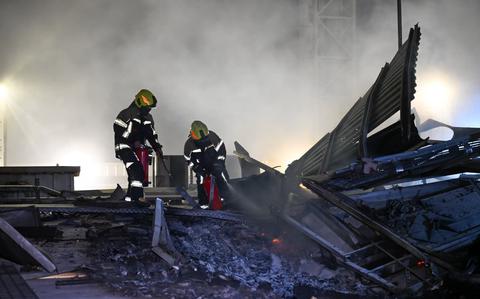
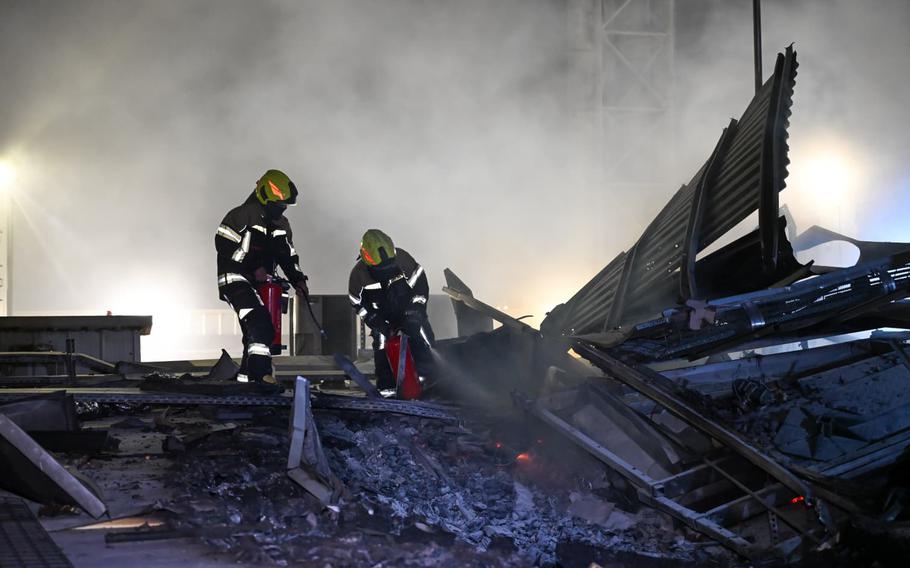
Emergency personnel with Bahrain’s Civil Defence force work to put out a fire after an Iranian strike hit a company facility in the country. Missiles and drones continued to fly in the Middle East on Tuesday after President Donald Trump announced the U.S. would pause its strikes against Iranian energy infrastructure until the end of the week. (Bahrain Ministry of Interior via X)
Missiles and drones continued to fly in the Middle East on Tuesday after President Donald Trump announced the U.S. would pause its strikes against Iranian power plants and energy infrastructure until the end of the week.
The ongoing fighting comes as the president says U.S. negotiators are holding positive talks to potentially end the war — a claim that Tehran’s leadership has vehemently denied. The president has threatened to attack Iran’s energy infrastructure if the country doesn’t free up traffic through the Strait of Hormuz, which acts as a critical waterway for nearly 20% of the globe’s fuel.
Despite the break in U.S. strikes, Gulf nations said they were continuing to receive drone and missile attacks late Monday and into Tuesday morning.
Iranian missiles slammed into Tel Aviv’s city center, destroying property and wounding several people, Israeli authorities said. The Israel Defense Forces, meanwhile, fired a barrage of attacks on Iran overnight, striking 50 targets, including ballistic missile storage and launch sites, the IDF said.
In Bahrain, home to U.S. Naval Forces Central Command, emergency workers responded to a blaze caused by Iranian attacks on Tuesday morning, the Interior Ministry said. Amazon said its Bahrain data centers were also disrupted as a result of the ongoing conflict.
The United Arab Emirates, which has received some of the heaviest fire from Iran since the war began, said it intercepted 17 drones and five ballistic missiles on Tuesday. Emirati authorities also said that a civilian contractor in the UAE Armed Forces was killed in a strike against Bahrain while on a routine mission.
Military forces in Kuwait and Saudi Arabia also reported intercepting drones and missiles.
As negotiations continue, the U.S. is prepared to send in thousands more troops and at least three warships to the Middle East to aid in Operation Epic Fury. The president has not ruled out sending in ground forces. A total of 13 U.S. service members have died since the war began on Feb. 28. As of Tuesday, U.S. Central Command said 290 troops had been wounded in the operation, 255 of which have returned to duty. Ten have been seriously injured, it added.
The ongoing hostilities have some allies in the Gulf inching towards joining the U.S.-Israeli fight against Iran.
The New York Times reported Tuesday that Saudi Arabia’s de facto leader, Prince Mohammed bin Salman, has been pushing Trump to continue the war, and sees an historic opportunity to remake the Middle East.
Saudi Arabia’s foreign minister, Prince Faisal bin Farhan, told reporters last week that the kingdom’s patience with Iranian attacks was not unlimited, and that “any belief that Gulf countries are incapable of responding is a miscalculation.”
A coalition of 22 nations, including many NATO members and partners, signed a statement over the weekend condemning Iran’s attacks on commercial vessels and civilian infrastructure, and said they are ready to contribute to “appropriate efforts to ensure safe passage” through the Strait of Hormuz.