
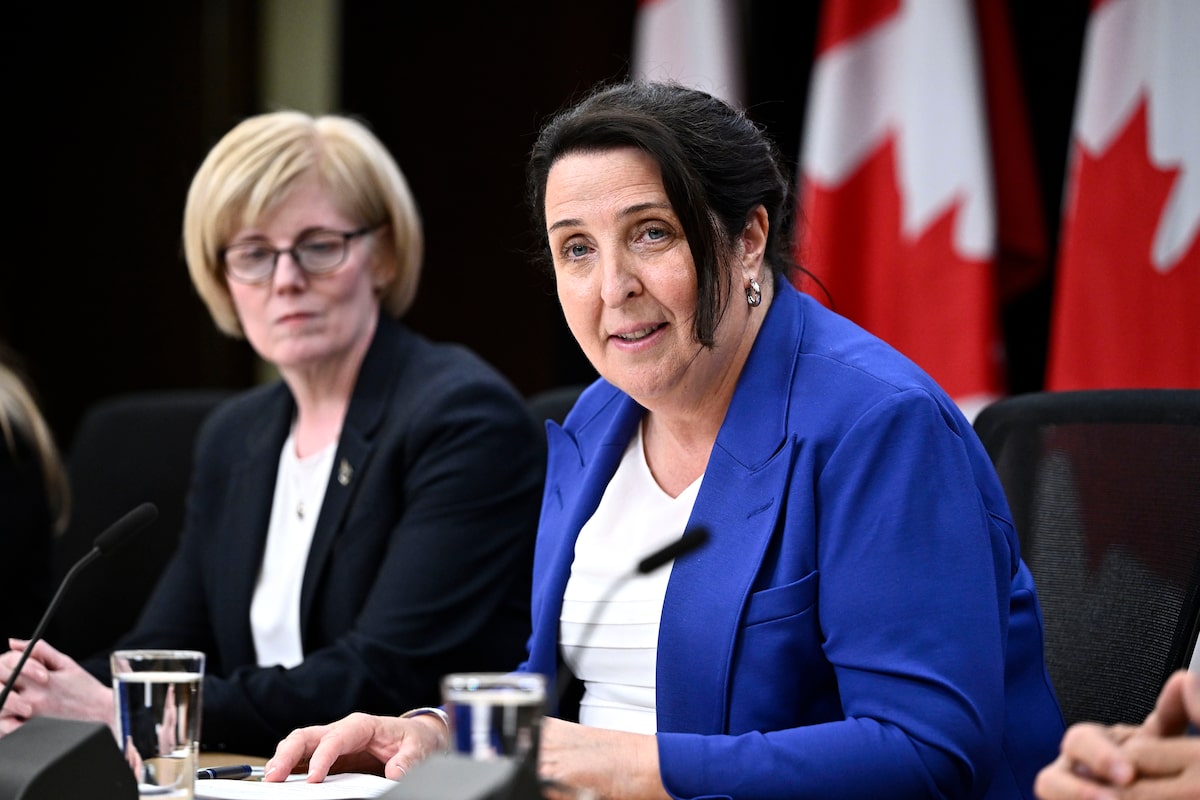
Justice Lise Maisonneuve, pictured on the right in 2024, led the Future of Sport in Canada Commission. The panel presented findings from its 790-page report today.Justin Tang/The Canadian Press
The Canadian sport system is riddled with abuse and in urgent need of a fundamental overhaul, according to a former chief justice leading a commission created to study the sector after revelations of a safety crisis in sport.
Among the 98 calls to action in the Future of Sport in Canada Commission’s final report, released Tuesday after almost two years of study, is the creation of a Crown corporation to oversee sport and physical activity across the country, from grassroots to high performance. It also calls for the creation of a registry system for people who are sanctioned by disciplinary bodies, to ensure rule violators are better held to account.
“Maltreatment in sport is widespread and is ongoing in all jurisdictions and all levels of sport,” Lise Maisonneuve, a former chief justice of the Ontario Court of Justice and the commission’s head, said at a news conference.
Speaking outside the House of Commons on Tuesday, Adam van Koeverden, the secretary of state for sport, called the report, “the most important document, potentially ever, in Canadian sport.”
Download and read the Future of Sport in Canada Commission’s final report
The commission was created in the spring of 2024 after years of reports about maltreatment in sport. Though the country’s attention has focused on high-profile cases, such as the acquittal last year of five former world junior hockey players who were on trial for an alleged 2018 sexual assault, The Globe and Mail and other media have documented many other allegations against coaches and other officials across a number of sports, ranging from physical and psychological mistreatment to sexual abuse.
Ms. Maisonneuve said the commission heard evidence of “psychological abuse, neglect, sexual harm, physical harm, racism, discrimination, bullying, and hazing. These harms occur at the national, provincial, territorial, and grassroots levels in community clubs, and in high performance sports.”
She said the sport sector is characterized by a “culture of silence” that punishes whistle-blowers, and “chronic underfunding” that imposes unreasonable expectations on organizations that are not equipped to confront a constellation of challenges.
“Too often, winning, reputation, and funding are prioritized over safety and dignity,” she said.
The commission also called for the establishment of a pan-Canadian public registry of those who have been sanctioned by disciplinary bodies. The registry would replace the patchwork of federal, provincial and territorial registries that currently exist, to ensure individuals are not able to move to another jurisdiction and re-enter sport.
While the commission foresees taking up to five years to implement some of its changes, it calls on the federal government to immediately increase the amount of money it gives to national sport organizations, which have not seen core funding raised since 2005, to make up for the effects of inflation.
Several organizations, including the Canadian Olympic Committee, have been trying for years to sound the alarm about the urgent need to make up for funding shortfalls in high-performance sport. Some observers blamed underfunding after Team Canada brought home fewer medals than expected at the Winter Olympics last month.
But Ms. Maisonneuve noted that lack of money has more damaging consequences.
“Chronic underfunding makes sport less safe,” she said on Tuesday. “Organizations are being asked to do much more, like governance, safe sport, equity, compliance, with fewer resources. And the fear of losing funding feeds directly into the culture of silence.”
She also said there was money to be saved by eliminating a range of functions that are duplicated across sport organizations.
On Tuesday, Mr. van Koeverden deflected questions about when the federal government might increase its funding of sport, and by how much. He said the Liberal government “is focused on revamping the Canadian sport system from playground to podium. We want to ensure that that increases funding at all levels of government.”
The report noted that, within the federal government, the sport portfolio is “not prioritized and does not get the attention it deserves. It has typically remained an entry-level ministerial position.”
When the commission began its work in May, 2024, the sport portfolio was overseen by Carla Qualtrough, who held the title of minister of sport and physical activity. She was replaced by Mr. van Koeverden, who was named the secretary of state for sport.
Secretary of State Sport Adam van Koeverden.Sammy Kogan/The Canadian Press
Sport Canada itself is a branch of the Department of Canadian Heritage, without its own ministry.
Nevertheless, Ms. Maisonneuve said she is confident the political will exists for a fundamental overhaul of sport.
“The political will needs to exist. There’s no choice,” she said in an interview with The Globe on Tuesday. She called on the Canadian public “to make sure that they keep the government accountable to this list of calls to action, and that they ask the proper questions to make sure that they are implemented.”
Among the report’s recommendations is a caution to ensure that, as the government implements the calls to action, “they are inclusive of Indigenous perspectives.”
The report also offers a crumb that might cheer hockey parents and others who struggle to afford equipment and registration fees, calling for the federal government to work with its provincial and territorial counterparts to find ways to reduce costs of sport participation for Canadians of all ages. “This could include possible tax exemptions on sport equipment and a subsidy program for Canadian youth,” it says.
The commission said it held 591 meetings and met with more than 1,000 individuals over almost 22 months, including 175 victims and survivors of maltreatment in sport as well as representatives from 270 sport organizations. It added that it received more than 1,400 documents and submissions.
Ms. Maisonneuve was assisted by special advisers Noni Classen, the director of education and support services for the Canadian Centre for Child Protection, and Dr. Andrew Pipe, who served as a physician at 12 Olympic Games.
Ms. Maisonneuve praised the victims of maltreatment who shared their stories with the commission.
“They came forward with nothing to gain,” she said. “They came forward because they want the system to change and they want to make sure that what happened to them doesn’t occur to other people.”