
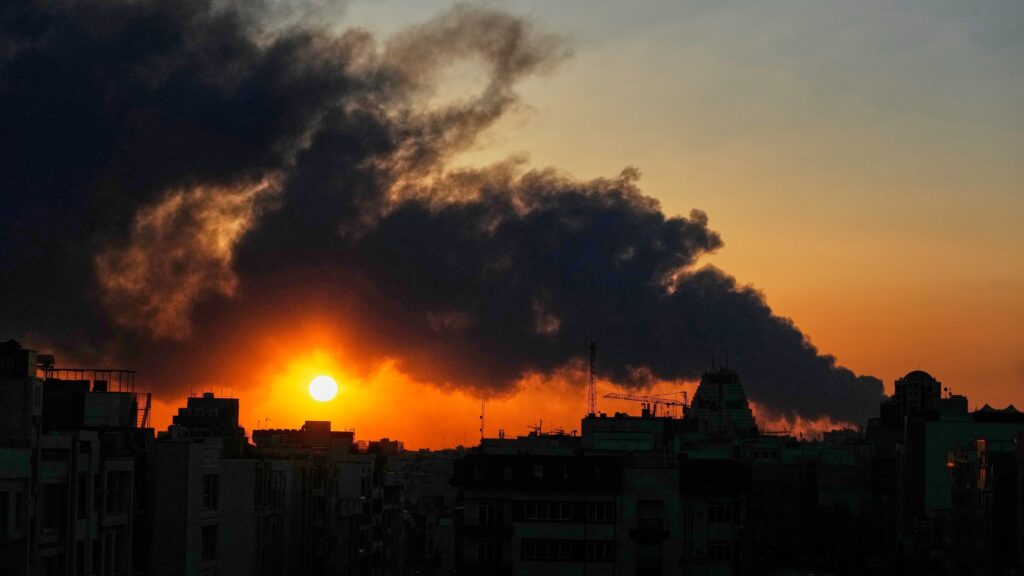
The war with Iran has focused the world’s attention on nuclear weapons and oil. Those risks are real. But there is a third category of danger that the conflict has brought into sharp relief — one that the United States is far less prepared to handle than most people realize.
Iran likely has a biological weapons capability. This has been the view of the U.S. government for several years now, predating the second Trump administration.
The U.S. State Department’s most recent compliance report concludes that Iran “maintains flexibility to use, upon leadership demand, legitimate research underway … to produce lethal biological weapons agents.” The Office of the Director of National Intelligence similarly assesses that Iran “very likely aims to continue R&D of chemical and biological agents for offensive purposes.” These are unclassified assessments, sitting in government reports that too few people have read.
War makes an already serious problem harder. When command structures fracture, when facilities are struck and personnel scatter, the custody of dangerous materials unravels. Dangerous materials don’t secure themselves.
We have seen this before. After the Soviet Union collapsed, the United States spent years — and billions of dollars through the Nunn-Lugar program — scrambling to secure biological, chemical, and nuclear stockpiles that suddenly had no reliable custodian. That program worked because the post-Soviet states were willing partners.


Iran is neither stable nor a willing partner. Its biological capabilities sit within a network of military-affiliated universities, IRGC-linked research centers, and dual-use pharmaceutical and biotechnology institutions. Some of those facilities have already been targeted in strikes. Others may be. We do not have a reliable inventory of what biological materials were present at targeted sites, what was destroyed versus dispersed, or what risks the surrounding areas now face.
The Congressional Research Service has warned that ongoing military operations “may complicate onsite damage assessments and efforts to secure CBRN” — chemical, biological, radiological, and nuclear — materials.
In plain English: The U.S. may not know what it’s hit, what is now unguarded, or where it might go.
Biological agents pose a particular challenge. Unlike nuclear material, they don’t trigger radiation detectors at border crossings. Unlike chemical stockpiles, they can be small, portable, and capable of spreading on their own once released.
A vial doesn’t need a missile to become a weapon.
The consequences of a release — deliberate or accidental — would be unlike anything disrupted oil markets can produce. Covid-19 — which was not a weaponized pathogen and not optimized for lethality — erased tens of trillions of dollars from the global economy and reshaped daily life for years.
Here’s what a biological release in this conflict might actually look like: A strike damages a storage or research facility and materials are dispersed into the surrounding environment — an accident that no one intended nor immediately recognizes.
Or the chaos of a collapsing command structure creates an opportunity for a small quantity of a dangerous agent to fall in the hands of someone with motive and access. Even the government, facing existential military pressure, might calculate that asymmetric biological retaliation carries less risk than conventional defeat.
These are the scenarios that have worried experts for years. A deliberately engineered pathogen, released under any of these circumstances, could be far worse than anything disrupted oil markets can produce. Disrupted oil supplies are painful and recoverable. A biological event is not.
Which is why the most urgent question raised by this conflict is less about Iran than it is about us. The war in Iran has exposed a gap in American preparedness that predates this conflict — and will outlast it.
The United States does not have the biosurveillance infrastructure to detect a novel or engineered pathogen release quickly enough to contain it. The systems we rely on — syndromic surveillance, emergency department reporting, wastewater — are built to recognize diseases we already know. An engineered agent, or one we have never encountered, will likely be missed. It may circulate for days or weeks before the signal is strong enough to register. By the time it is showing up in emergency rooms, it has likely already seeded transmission chains across multiple cities. The window for containment isn’t just smaller — it may already be closed.
Beyond surveillance, our Strategic National Stockpile has documented gaps in the very countermeasures we would need — medical countermeasures against threat agents that have been on the U.S. concern list for decades. The research and manufacturing infrastructure to close those gaps quickly doesn’t currently exist at the scale this moment requires, and the workforce to deploy them has shrunk.
Congress should demand a full accounting of what we know about Iranian biological materials — where they are, and what has happened to them since strikes began. More importantly, Congress needs to treat biological preparedness as the national security priority it is: not as a subcategory of pandemic response, not as a line item that gets cut when budgets tighten, but as a core defense investment.
The world has spent 70 years building treaties, monitoring systems, and institutions to manage nuclear risk. For biological threats, we have a fraction of that infrastructure — and the current conflict is exposing exactly what that deficit costs.
A missile launch is visible. A vial leaving an unsecured facility is not.
Ashish K. Jha, M.D., M.P.H., is a physician and senior fellow at the Harvard Kennedy School Belfer Center for Science and International Affairs. He served as White House Covid-19 response coordinator from 2022 to 2023. He is co-founder of BioRadar, a company building biointelligence infrastructure for biological threat detection.