
Almost four weeks into the Iran War, Washington and Jerusalem have reportedly destroyed over 8,000 Iranian targets, often seeking to portray the conflict as an intensive, short war (though messages have been mixed). Iranian missile attacks are down 90%, drone attacks are down 95%, and dozens of Iran’s senior leaders are dead. Yet Tehran is still in the fight. Bloodied and degraded, but not broken. Iran’s ability to keep punching back should not surprise anyone.
The real surprise is that some senior leaders, both in the White House and on Capitol Hill, are acting surprised by Iran’s defiance and resilience.
Iran has spent the last 25 years watching the American way of war in its neighborhood. It watched U.S. campaigns in Iraq, Afghanistan, Libya, and Syria. It watched how the American military built up majestic, lightly defended bases across the region. It watched how American power likes to open wars: blind the enemy, wreck command-and-control, suppress air defenses, kill senior leadership, and fracture state control. Any competent adversary would have learned from this American way of war. Iran did. It would have been foolish for Tehran not to build a military system designed to withstand exactly that kind of opening blow.
For years, Iran has reorganized around persistence rather than elegance. Its leaders understood that if the United States and Israel came with their usual ‘shock-and-awe’ playbook, the peripheral aspects of the government and military had to keep functioning. So, Tehran invested in decentralization, dispersal, and redundancy. With a mosaic strategy, Iran built a resilient system meant to keep operating even after decapitation strikes and communications disruption. The point was not to stop the first punch, but to remain standing.
Iran may not be thriving, but it is surviving. That distinction matters, because too much American strategic thinking is entrapped by the seductive belief that if the opening barrage is violent enough, the enemy’s coherence will unravel on schedule. Iran has spent decades developing the ability to deny that outcome.
The lesson for Washington should be a familiar one: the enemy gets a vote. But the harder lesson is that the enemy also studies. In the ongoing war, Iran did not have to match American or Israeli firepower to hang on past the massive initial bombardment; it only had to study America’s scripted playbook and build an architecture designed to survive the first act. Concretely, that meant expecting air defense suppression, command-and-control strikes, loitering drones, and leadership targeting. Tehran built around those expectations because it had every reason to think that was exactly how this war would begin. And it was right.
The bigger lesson this war is teaching both the United States and its adversaries is one about American strategic complacency. For too long, the U.S. military has acted as if initial operational dominance translates into a quick strategic outcome. But most adversaries don’t just sit around, waiting politely to be dismantled. They adapt, learn, and develop tactics to exploit American strengths and assumptions.
For example, Iran has shot down at least a dozen MQ-9 drones and damaged one F-35 with innovative loitering surface-to-air-missiles. It has pioneered and deployed swarms of inexpensive Shahed drones that are depleting U.S. weapons stockpiles. Missile barrages, combined with drones, have damaged at least eleven U.S. bases across the region. And by effectively closing the strategic Strait of Hormuz, it has exploited U.S. vulnerability to energy market shocks to dramatically increase its leverage.
Iran’s staying power is not proof that the regime is strong; it is proof that it read the American way of war playbook.
Forcing a Hard Look at Military Assumptions
Putting aside the myriad policy and legal questions raised by this war, its operational realities demand a reckoning with core U.S. military assumptions. For years, Washington acted as if superior defenses and precision strikes would be sufficient to deter or defeat Iran. But war always exposes the gap between peacetime plans and enemy actions. Decades of de-emphasizing capabilities like mine warfare while relying on the comfort of air superiority reinforced an illusion: that the United States could dictate a war on its own terms. Adaptive adversaries, however, make their own terms.
This matters well beyond the current war. If Iran, under heavy sanctions, can absorb decapitation strikes and continue operating, Washington should think carefully before assuming that more capable adversaries will be easier to coerce with the same playbook. It should also be wary that use of U.S. firepower alone (often framed as “deterrence” by current leadership) will achieve the strategic outcomes envisioned. The danger is not merely underestimating Iran, but overestimating how far old assumptions still travel.
None of this is an argument against confronting Iran’s nuclear ambitions or regional coercion. It is an argument for realism. The United States should not be shocked that Iran’s military proved resilient to a style of war it has watched America wage for decades. As many explained both prior to and since the war began, it actually would have been stranger if Iran hadn’t prepared.
American military complacency must end. In this conflict, that starts with finally learning the Ukrainian way of defense against drones and adapting tactics to overwhelm Iran’s retaliatory approach. Whether the goal is forcing surrender, regime change, achieving leverage for negotiations, or something else entirely, Washington must finally recognize that Iran has agency, it adapts, and it knows the playbook front to back.
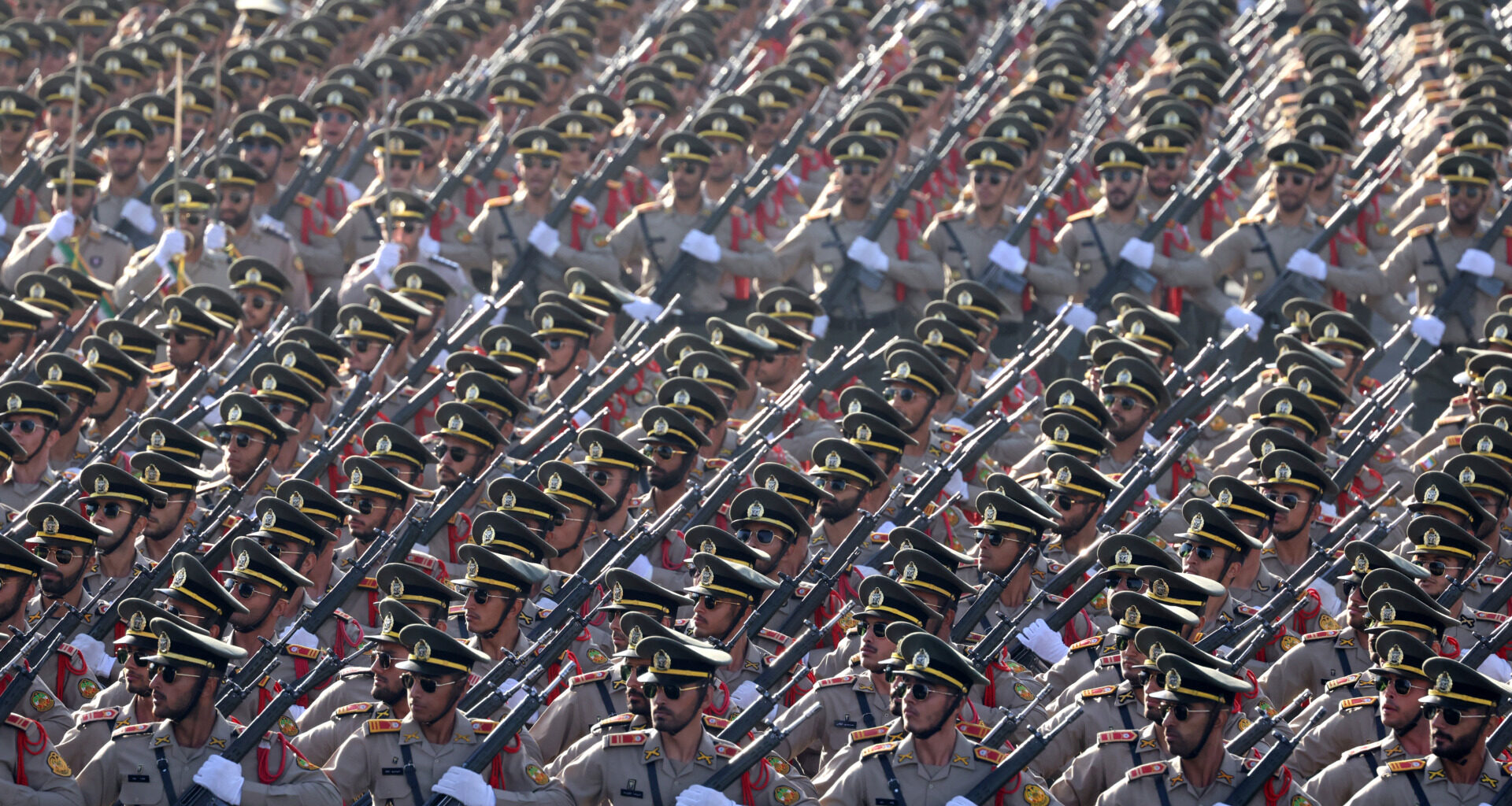
FEATURED IMAGE: Soldiers from a unit of the Iranian army march during the annual military parade marking the anniversary of the outbreak of the 1980-1988 war with Saddam Hussein’s Iraq, in Tehran on September 21, 2024. (Photo by ATTA KENARE/AFP via Getty Images)