
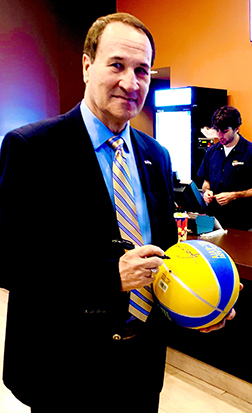
When the University of Houston men’s basketball team faces the University of Illinois in the NCAA South Regional Semifinals at 9:05 p.m. CST on Thursday, March 26, the greatest basketball player in Israel’s history will be closely watching it from more than 7,000 miles away in Tel Aviv.
Tal Brody, an 82-year-old Trenton, N.J., native and Naismith Basketball Hall of Fame finalist, made aliyah and was a star basketball player for Maccabi Tel Aviv after a successful college basketball career at the University of Illinois.
Watching the game, even at 4:05 a.m. Friday Israel time, will be something of a relief for Brody, the father of three and grandfather of 13, who, like all of his fellow Israelis, has spent a great deal of time seeking shelter.
“It hasn’t been easy or pleasant, but we are lucky that the people of Israel are disciplined,” said Brody, who has lived in Israel for 57 years. “We get the air raids four to six times per day, with an early-warning system. If we’re home, we go into the safe room. If we’re out, we go into the closest bomb shelter.”
Brody would typically root for the third-seeded Illini, but he’s conflicted as the 1965 All-American’s alma mater prepares to face second-seeded Houston at the Toyota Center.
The Cougars are led by Emanuel Sharp, an Israeli citizen and the son of another Maccabi Tel Aviv star, Derrick Sharp. Sharp scored 18 points in a second-round victory over Texas A&M last weekend.
“Derrick put a lot of work into helping Emanuel develop as a basketball player,” Brody said. “I’ve been following Emanuel since he was in high school and to see his success is an honor for Israel. Emanuel blossomed when he played for the Israeli National Team.”
During Final Four weekend next month in Indianapolis, Brody will learn if he will be inducted into the Naismith Basketball Hall of Fame. He is one of two finalists in the international category, along with former Houston Rockets head coach Mike D’Antoni.
Brody’s Houston ties go beyond the Sharp connection.
After leading Trenton Central High School to a 1961 state championship and an undefeated record, Brody had more than 40 basketball scholarship offers. He chose to visit four schools – Houston, Illinois, North Carolina State and Temple.
Brody, who played with eight African-American teammates at Trenton Central, didn’t want to play in the segregated South.
He did get to know then-Houston head basketball coach Guy Lewis, who recruited Elvin Hayes and Don Chaney to UH three years later.
“I liked Guy Lewis; he was a coach that players like to play for,” Brody said. “Guy was the type of guy who had the type of communication with the players who was able to do constructive criticism with his team.”
Brody was also friends with former Houston JCC athletic director Marvin Blumenthal, a fellow Trenton native.
“I knew his family very well and visited him at the JCC when I came to Houston,” Brody said.
Temple University, guided by Harry Litwack, who was Jewish, was located 33 miles away from Trenton in Philadelphia. Litwack told Brody to be a big fish in a small pond with Temple.
“I wanted to be a big fish in a big pond, so I chose Illinois,” said Brody, who returned to Champaign-Urbana for a 2011 ceremony where his No. 12 jersey was retired and placed in the rafters. “I have good memories of Illinois. I enjoyed my years there.”
Brody made his Illinois debut in 1962-1963, when he helped the Illini reach the second round of the 1963 NCAA Tournament. They lost to eventual champion Loyola of Chicago in the second round.
The following season, Illinois opened Assembly Hall (now called the State Farm Arena). Until the Houston Astrodome debuted two years later in 1965, Assembly Hall was the largest domed stadium in the world. The architect was Max Abramovitz from New York.
In his senior season, Brody, a First Team All-American, and the Illini routed defending NCAA champion UCLA, 110-83, to open the season. They went on to defeat Kentucky and Indiana that season but didn’t make the NCAA Tournament.
The NBA took notice the following summer, and the Baltimore Bullets selected Brody with the 12th overall pick in the 1965 NBA Draft.
Brody was preparing for an NBA career when he competed in the Maccabiah Games in Israel. Moshe Dayan convinced him to stay in Israel, and Brody decided to stay for a year.
“I never thought I’d change my dream in life for a challenge to bring Israeli basketball to another level,” Brody said. “I agreed to stay for a year and the year was so fantastic, seeing what basketball was doing for the country, so I decided to continue on.”
Brody returned to the United States in 1968 and served in the United States Army, playing in the U.S. Armed Forces All-Star Games and later, on the U.S. Men’s Basketball National Team.
He became an Israeli citizen, served in the Israel Defense Forces and starred for Maccabi Tel Aviv from 1973 to 1980. One of the major highlights was Maccabi’s upset victory over a Soviet team in the 1977 European championship – the first of the club’s six European championships. The feat was chronicled in Israeli filmmaker Dani Menkin’s 2016 documentary, “On The Map.”
“It was unbelievable to win that championship,” Brody said. “It’s something I wouldn’t change for any amount of money. I did something in my life that affected so many people. If I had played in the NBA, I would have enjoyed my career and it would have been a big honor, but I don’t know if I would have affected that many people.”
The achievement was so monumental that in 1979, Brody became the first professional athlete to receive the Israel Prize, the nation’s highest civilian honor. Israel’s basketball success in the late 1970s created national pride in a way that elevated athletes across the sports landscape in the country.
With Israeli Deni Avdija an NBA All-Star and both Maccabi Tel Aviv and Hapoel Tel Aviv in the European League, along with numerous Israelis playing college basketball in the United States, Israel is now “the sports capital of the Middle East.”
He said European basketball used to be dominated by Spanish and Italian clubs, but Israeli’s success motivated its Mediterranean neighbors in Greece and Turkey to elevate their clubs.
Brody regularly returns to the United States for the NBA All-Star Weekend, where he connects with his college basketball contemporaries, like fellow 1965 All-Americans Bill Bradley (who became a U.S. senator), Billy Cunningham (who won an NBA championship as a player and a coach) and Rick Barry (an NBA legend).
Jewish players/coaches during March Madness
Last season, Duke head basketball coach Jon Scheyer was one of three Jewish head coaches in the Final Four. This season, Scheyer will look to return Duke to the Final Four. They’ll face St. John’s on Friday, March 27, in Washington, D.C.
Purdue guard Omer Mayer, of Tel Aviv, and the Boilermakers will face Texas on March 26 in San Jose, Calif. In the first two rounds, Mayer faced fellow Israelis – Yoav Berman (Queens) in the first round and Noam Dovrat (Miami-Florida) in the second round.
Tennessee guard Ethan Burg, of Mishmar HaShiv’a, Israel, and the Volunteers will play Iowa State on Friday in Chicago.
In the National Invitational Tournament, Auburn first-year head coach Steven Pearl and the Tigers hosted Nevada on Tuesday, March 24. Results were not available at press time.