
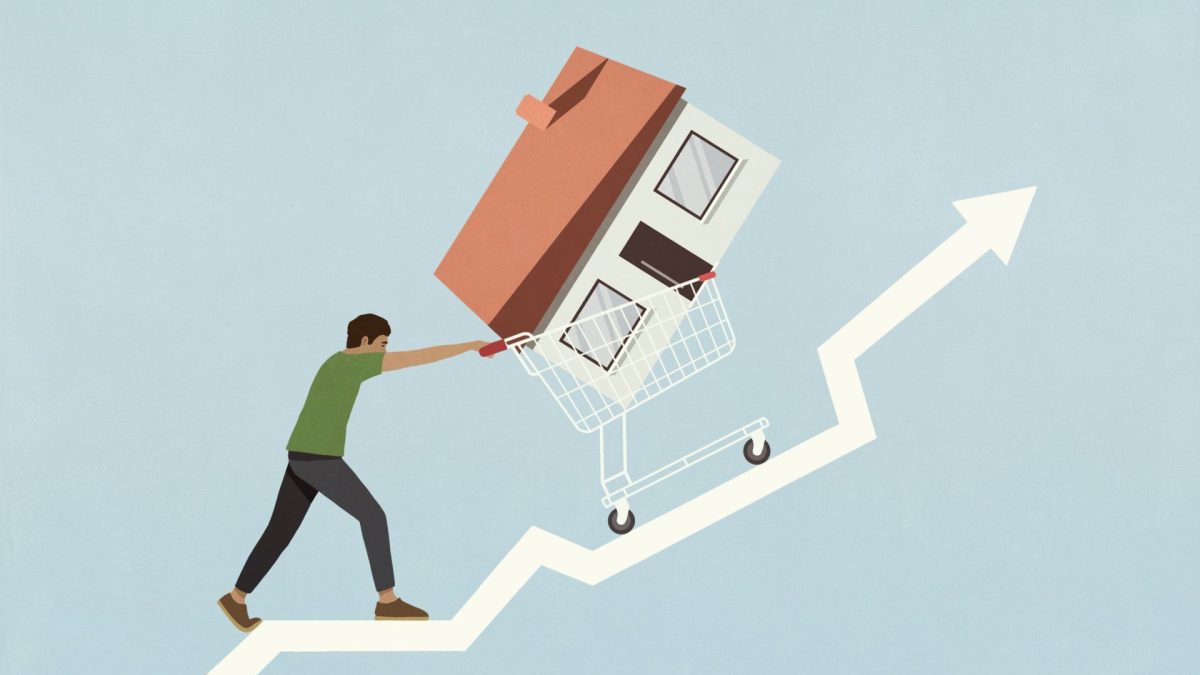
Want to understand what’s really going on in Britain, and how we can fix it?
Join Vicky Spratt’s subscriber-only newsletter, The State We’re In, where she breaks down the big issues shaping the country. You can sign up to get it sent straight to your inbox, every single week, here.
Whether you are a homeowner, a would-be homebuyer, a private renter or someone who, you know, just uses electricity in your home, it’s a fairly stressful time at the moment. This is because even though Donald Trump has claimed to have reached an agreement with Iran (and that could change right after we hit publish on this newsletter), there is every indication that mortgage rates and bills will rise as a result of the unrest he has caused. By how much and for how long we don’t yet know.
Coming up in this week’s newsletter:
What do Britain’s energy costs have to do with mortgage rates?
Why is Britain’s housing market more exposed to external economic shocks than other countries?
And, seven new towns… coming soon to a location near you!
The US President has managed to crush the slow signs of consistent economic recovery that were being seen around the world for the first time since the horrendous combination of the Covid-19 pandemic and Russia’s illegal war with Ukraine caused inflation to soar.
New FeatureIn ShortQuick Stories. Same trusted journalism.
Unfortunately, when it comes to energy bills and mortgages, the UK is more exposed to the enormous economic shock generated by this war in the Middle East than either the US itself or our immediate European neighbours. Call it Trumpflation, if you like.
This is why Britain is so vulnerable
Let’s start with energy because, as I’ll explain in a moment, it is actually linked to what happens to the price of your mortgage.
Firstly, around 30 per cent of Britain’s electricity comes from gas-fired power plants. That’s higher than Germany (17 per cent) and France (3 per cent). Gas heats more than 70 per cent of homes in Britain.
Since the war with Iran began, wholesale British gas prices have jumped because the Strait of Hormuz, a key route for shipping, has been closed, and Qatar, which produced around a fifth of the world’s liquefied natural gas (LNG) – halted production before one of its major refineries, Ras Laffan, was hit by Iranian drones.
Added to this, Britain’s gas storage sites can only hold about 12 days’ worth of gas, compared with 90 in Germany and 100 in France. This makes us more vulnerable to price shocks.
It is thought that the average consumer’s energy bills could rise by anywhere between £300 and £2,000 by the end of the year, depending on what happens next with Iran and whether Britain’s Government offers some sort of price cap or funding cushion to protect people.
This brings us to mortgages.
If energy prices go up, it will contribute to inflation. And, when inflation goes up, the Bank of England either holds or increases the bank rate because this is one of the only tools it has to cool inflation. As we saw last week, the bank rate was held at 3. 75 per cent, which means mortgage rates won’t continue on their downward trajectory for a while.
But the Bank of England’s rate is just one way that mortgages in Britain are priced. Swap rates also play a part.
What is a swap rate? Essentially, this is the interest rate that your mortgage lender agrees to pay a fund or investor for the money they have borrowed to lend to you. Swap rates fluctuate when there is economic uncertainty because they price in expectations about what will happen to the Bank of England’s rate in the future.
And, because of all of the uncertainty surrounding Iran and energy, swap rates have spiked, causing mortgage rates to jump up to their highest level since February last year.
The average two-year fixed residential mortgage rate on Monday this week was 5.43 per cent, up from 5.35 per cent on Friday, and from 4.83% at the start of March.
As my colleague Callum Mason over on The i Paper’s money desk has reported, some lenders are even pulling new deals altogether because it’s so difficult to price mortgage lending due to the volatility with swaps.
This is serious. And yet, as we saw on Monday afternoon, things can turn on a dime right now for good as well as bad. As soon as Trump wrote on Truth Social that he had decided not to bomb Iran’s energy supplies after what he called “good” talks with the country’s new ayatollah, the price of oil came down, Sonia swaps seemed to calm down, too, and a frenzy in global financial markets seemed soothed, briefly, at least.
Sonia, just FYI, stands for Sterling Overnight Index Average, and this is the day-to-day price of mortgage lending, which particularly affects homeowners on standard variable rates.
But, regardless of what happens next, Britain’s immense vulnerability to global economic shocks has been exposed.
Is this how we can fix it?
Housing market expert and analyst Neal Hudson said: “Although Britain’s housing market is not quite as exposed [to global economic shocks] as it was back in the day – in the 1990s – when most people had variable rate mortgages, it is still exposed.”
This is because Britain, unlike Canada, the US, France, Belgium and Germany, favours short-term fixed-rate mortgages of two, three or five years.
The majority of mortgage holders in Britain today are indeed on a fixed-rate deal, but it’s also true that they have fixed for a shorter period than other borrowers around the world.
In France, Belgium and Germany, it’s common to see 20-year fixed-rate mortgages. Similarly, in America and Canada, fixes can even go up to 30 years. In 2022, when Vladimir Putin invaded Ukraine, inflation rose, and interest rates went up, these countries tended to be less affected by mortgage rate rises as a result.
“Even though a lot of people are on fixed rates today, they are fixed for relatively short periods,” Neal added. “This means that people are insulated from short-term rises during their fix but quickly exposed again when that runs out.”
This, as he explains, has an impact on people who need to remortgage, as well as the new-buyer market.
Why, you might reasonably wonder, don’t mortgage lenders in Britain just offer longer-term fixed rates?
It’s a good question. And one I asked several years ago during a “Chatham House rules” round table with representatives from major mortgage lenders, high-street banks and a government minister. The answer? It wouldn’t be as “competitive”.
1.5 million homes pledge at risk
None of the volatility caused by Trump over the last month is good for the Labour Government’s housing plans. More broadly, housebuilding and construction have struggled since 2020. This is because inflation has pushed up building and labour costs, and because Covid disrupted supply chains just as they were recovering from Brexit.
All of this, combined with the fact that builders know the demand for any homes they build will be affected by interest rates, which are at the mercy of geopolitical stability (or the current lack thereof), could seriously threaten Labour’s call for a major housebuilding drive to hit a target of 1.5 million new homes by 2029.
Indeed, Chancellor Rachel Reeves and her housing minister colleagues will be very unsettled by data from research company Glenigan, which shows that UK construction starts – that’s sites where new housing has begun to be built – plummeted by 39 per cent between December and the end of February 2026.
Reeves is banking on a housebuilding boom to drive economic growth, and Trumpflation will not help her in that endeavour.
Once again, though, it’s hard not to look at this situation and ask why no lessons were learned by the British state in 2022? Once again, Britain is presented with a lesson in the need for more stable mortgage lending and greater energy security. Will we learn it this time?
Housing crisis watch
After a long wait, housing and planning minister Matthew Pennycook today announced Labour’s plan for seven new towns across the country.
I’ve visited two of the proposed locations at Tempsford in Bedfordshire and Crew’s Hill in Enfield, north London.
This is an ambitious attempt to boost housebuilding as well as bring new infrastructure to England. Though, as explained above, new economic headwinds are coming simultaneously from America and the Middle East which could jeopardise even the best-laid plans. Read my report about the announcement here.
What I’ve been reading and watching…
If you haven’t watched Channel 4’s Tony Blair documentary series yet, do it immediately. Like him or loathe him, Blair was undeniably one of the most effective prime ministers in British history. In the series, you get a sense of the discipline and determination of New Labour in the early days of government as well as the conflict felt by those around Blair when it came to Iraq. He, for his part, stands by his decision to stand with George W Bush and invade, but what the series carefully delves into is how little room for manoeuvre the UK has when our most powerful ally decides to do something. There are particularly poignant parallels with Sir Keir Starmer’s Donald Trump predicament, and the criticism he has faced for not joining US strikes on Iran.
I really enjoyed this profile of Reform UK’s leader, Nigel Farage, by Henry Mance in FT Weekend magazine. There is a very real risk that Farage is not held to account for his record – Brexit, which, as Mance notes, has cost us all rather a lot.