
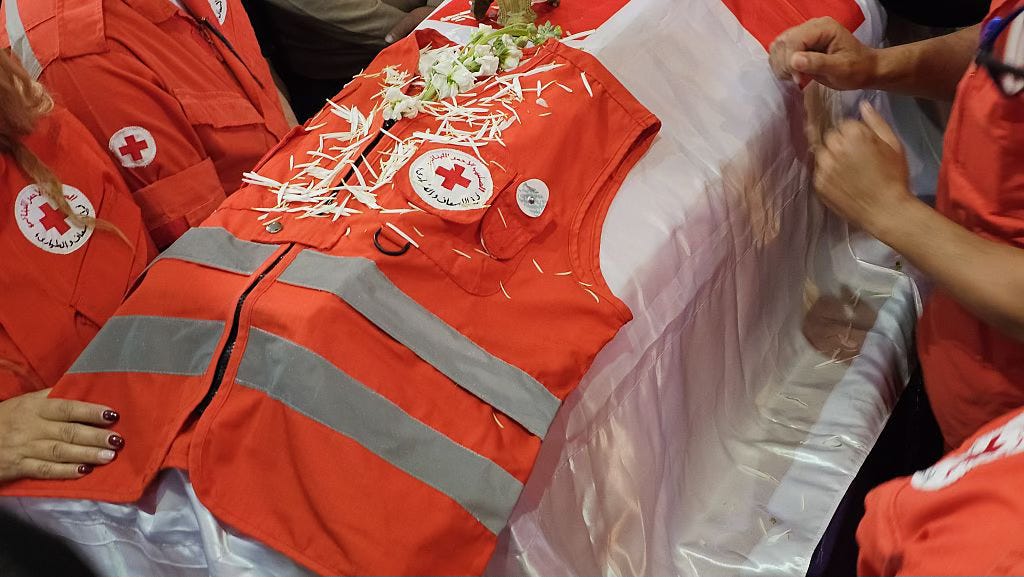
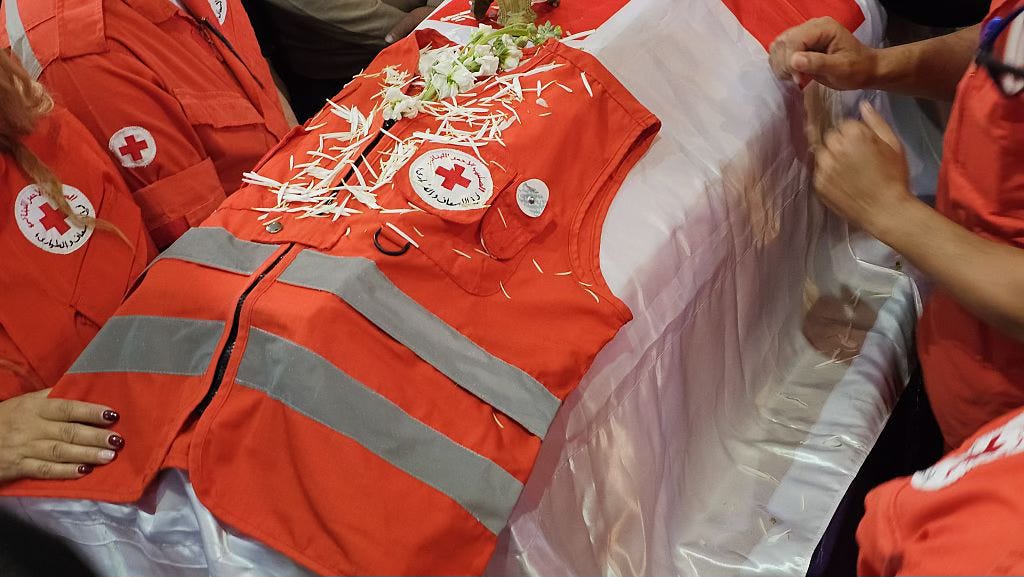
 Israeli bombs have been killing civilians in southern Lebanon, including Yousuf Assaf, a paramedic with the Lebanese Red Cross, seen here being laid to rest, in Tyre, Lebanon, on March 11. (Mohamad Zanaty/Anadolu via Getty Images)
“Death to the Jews! Death to the Jews!”
That’s what the marching band was playing over the loudspeakers in an outdoor market in southern Lebanon when I was there more than 10 years ago. As we walked through aisles lined with spice barrels filled with orange powders and greenish crushed leaves, I’d been wondering what the loud music was about, so I asked my friend (whom I’ll call Rami to protect his identity).
Rami and I had driven with our Swedish friend Eva to the town of Tyre (Sur in Arabic), where he was from. About 20 miles from the Israeli border, you could see the other country’s rocky hills from the beach there.
On the ride south from Beirut, we’d blasted Florence and the Machine’s “Dog Days Are Over,” practically yelling out the lyrics, and, in the backseat, I bathed in the near-blinding sunlight on a warm and blue-skied day. The song would become a joyous reminder of a day spent with two friends in a stunning, ancient city. But it would also become a reminder of something else, something dark and unsettling.
I was in Lebanon to report on Syrian refugees — women mainly, and their experiences with sexualized violence during the war. I’d also been to a meeting with United Nations Relief and Works Agency for Palestine Refugees in the Near East (UNRWA), an agency that works on behalf of the refugees. It was basically impossible to escape the pain of the Palestinians while in Lebanon. We’d passed more than one refugee camp that had been established in the late 1940s. Places packed with people who are largely unable to work freely — Lebanon requires “foreigners” to have work permits, which are extremely difficult to obtain and which basically nobody gets. (I’ve put “foreigners” in quotes because many people of Palestinian descent were born in Lebanon yet they remain “foreign” in the eyes of the Lebanese state. See: the humanitarian disaster that Trump’s fight to ban “birthright citizenship” in the U.S. would unfurl if he won.)
But back to Tyre with its Phoenician and Roman ruins.
Actually, back to our car ride.
I have always loved surreptitiously taking photos of things I’m not supposed to — mainly out car windows. Which is something I did without thinking as we rode. I pulled my camera up briefly and snapped a picture of a guard tower along the highway. Bad idea. Very, very bad idea.
An officer emerged from the checkpoint and made us stop. When he approached the car, my friend in the passenger seat put her hands up and said, “Swedish! Swedish!” I know we’d discussed my pretending to be Italian if we were stopped, but I can’t remember if I said, “Italiano!” I do remember deleting the photo and handing him my camera, which he soon gave back to me. We went on our way.
The reason my friend Eva had reacted that way and why I may have claimed I was Italian is because as we’d sped down that sunny highway, Rami described how we were entering a “red zone” — a place considered Lebanon’s most under threat from attack by Israel or Syrian militants or from violence in general. It is an area effectively controlled by Hezbollah militants.
“We’re going into Hezbollah territory?!” I sputtered. “We can’t do that!”
I felt genuinely afraid.
“I’m Jewish!” I said. “I’m American — and queer!” Jesus, I said, with no actual irony.
Rami assured me all would be fine. And it was. More than fine. We went and toured a Roman hippodrome as he told us about what it had been like in previous years when Israel had attacked their city. The fear. The ruins. The people killed. Then we went to his parents’ apartment and sat on their enormous roof deck drinking espresso from delicate Lebanese-looking Chinese-made cups (the same ones I later bought in the market), with pale Eva and I clustered under a shade and eating from tray after tray of highly pigmented vegetables and fruit. Rami’s mother had gone to town for us. We laughed together for hours.
But then came the market, and the sick feeling I got when I found out what the music was about. Tyre brought up so many conflicting, deep emotions, as does the war now raging in the city. Israel has been pummeling the area with bombs, and Hezbollah has been launching rockets back at Israel.
Today, the Israel Defense Forces ordered the evacuation of Tyre.
The part of me that was scared in the market — of being a Jew among Hezbollah fighters, among people who hated people like me so much that they would play marching music about killing us — sympathizes with Israel wanting to rid the region of men whose goal in life is to eradicate Jews. The rest of me wonders about Rami and his family. Are they safe? Has their neighborhood been hit? Have they already evacuated? Will they be packing up and leaving today? More than 1,000 people have already been killed in the past three weeks in Lebanon, according to the country’s health ministry. More than a million have been displaced.
I remember Rami’s parents’ generosity so fondly. I remember that day as one of the best in my life, spent with friends, singing and laughing in a beautiful place. My feelings are heavy this morning as I sip espresso from one of the cups I got while there and listen to “Dog Days Are Over.” In the end, however, I can’t help but empathize less with the country indiscriminately bombing southern Lebanon in an attempt to rid the region of murderous men and more with the individual citizens of Tyre, with the families trying to live their lives free of violence, most of whom never asked for war to come, yet again, to their city.