
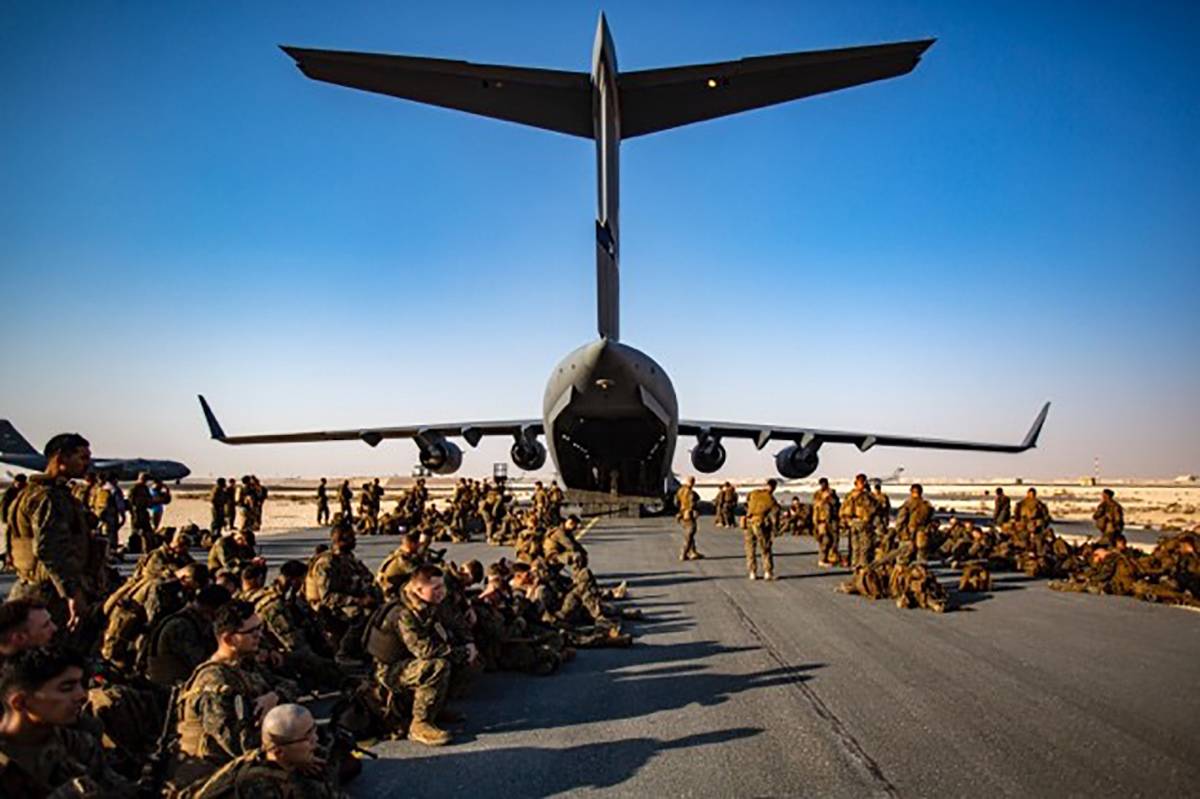
Terry Gerton We’re going to dig into what’s happening in the Middle East right now. The Pentagon has ordered additional Marine Expeditionary Units and naval forces towards the Middle East as tensions with Iran escalate. From a strategic standpoint, what do you think we’re trying to signal by moving the Marines offshore right now?
Col. William Dunn Well, there’s a couple of signals that are coming out. The first and most important one is those two Marine Expeditionary Units are going to give the commander flexibility to operate in a myriad of missions. It also signals the potential, in my opinion, that there may be a leaning towards putting some boots on the ground. What I would suspect if I was — you know, I was a new commander — what I would be preparing for is to put some boots on the ground, potentially in the island chains that are around Iran. Now that’s just a guess. The commander will figure out what he wants to do with those Marine Expeditionary Units. The fact that there’s two, to me, is a very big signal because that is the jewel of the military. They are able to go anywhere and adapt to multiple mission sets. So when you bring in two to one location, that is a big signal. In the planners, both the enemy planners and our planners will see that as a strategic shift in my mind.
]]>
Terry Gerton Walk us through how a deployment like this is developed. What are the mechanics of it? Who requests it? Who approves it? What’s the civil-military collaboration in making a decision to move organizations like MEU so quickly to a theater of operations?
Col. William Dunn Well, the MEU will typically work up about six months, and usually it’s right on six months but it could be a little bit different. So the MEU will come together six months before deployment, it’ll get certified, and once it’s certified to deploy, it will leave. It’ll usually go on three ships, and that’s called an ARG, an amphibious ready group, and together the ARG and the MEU will head out to where there’s a hot spot, or if they’re just doing a normal training deployment, to put forward presence for the United States. Once the MEU gets in theater, that allows the combatant commander the flexibility to use that MEU where he or she may need to put that force at a specific time. My MEU, at one point, we were doing a training mission in Jordan; we were ordered to immediately back load on the ship, go to Libya, go off the coast of Libya to prepare for a mission. While we’re doing that mission, we got another order that said immediately get as many people as you can into Kuwait, you’re going into combat in Iraq. That is how fast a MEU deployment can go. And with the V-22, this is another interesting point. The V-22 is almost, as long as they have refueling capability, able to put Marines anywhere at any time. So even though the ships that are sailing into the Arabian Gulf may not be there for a period of time, once you get into a range and you have refueling capability, you can move those assets in and put them where you need at the place and time of your choosing.
Terry Gerton So when people hear crisis response and they’re thinking about military deployments, they often think of special operators like the Navy SEALs or the Army Rangers. Help us understand the difference in capability between an MEU and those kinds of organizations.
Col. William Dunn Well, there’s a lot of differences and what I would say the biggest difference is the Marine Corps Expeditionary Unit is self-sustaining. It has its own aircraft. It has its own logistics. It has its own fuel capability. So it can go anywhere and operate and self-sustain for a period of time. When you’re sending in the Rangers or you’re sending in the SEALs, typically we work with those entities quite a bit. On my deployment, we worked with the SEALs and some of the higher-tier elements of the Army almost on a daily basis during our deployment. So we work together very well with those units. And the biggest difference is we will bring our own aviation with us and our own logistics support. So, we can go, we could deploy, we can sustain, and then we have the capability to command those fires ashore, and so we’re bringing an entire package where if you bring in an element of a SEAL detachment, it’s going to have some amazing warriors. I mean, obviously they’re some of the best in our country. But they’re going to need some sustainment, they’re going to need additional support. That support is often provided by the Marine Expeditionary Units.
Terry Gerton I’m speaking with retired U.S. Marine Corps Col. William Dunn. He’s a combat veteran and a national security expert. Col. Dunn, you mentioned your own experience commanding a MEU, and you hinted a little bit at how you think these units might actually be deployed. Assuming that they will be put on the ground, what are the special capabilities that they have when it comes to the mission of protection of shipping and deterrence in the theater?
Col. William Dunn Well, it depends what mission they’re going to be given. And I know that’s a hard thing to say, right? It depends. But the reality is the infantry Marines will not necessarily be specifically supporting ships, but the aviation units most likely will. We also have the ability to take a ship. You can do a visit, board, search and seizure with a MEU. We’ve done them in the past. And you can basically go capture a ship with the team that’s on the MEU, and that’s going to be Marines and sailors from the specific MEUs. The other thing that it’s going give is this capability to put out Cobras, Hueys, Joint Strike Fighters, V-22s and CH-53s that can do a heavy lift, move people around the battlefield. One of the missions we did — we didn’t do this with a MEU, but you can do this with a MEU, it’s called aeroscout — where you basically put an attack team in the back of your aircraft and you send out assets, they go find a target and then you can swoop down and do a direct action on that target pretty rapidly. So it gives us an amazing capability. The biggest thing though is it’s going to give flexibility to the commander. Another mission that they do is tactical recovery of aircraft and personnel. So if an airplane gets shot down in Iran, we will have the ability to go in rapidly and get that individual out and protect and save those aviators, if they’re able to survive the mishap or the shoot-down.
Terry Gerton You’ve talked a lot about the flexibility that a MEU gives a combatant commander. At the same time, in real-time combat ops, we want to be careful about escalation and notification so that we don’t, you know, perhaps drive unintended consequences. How do military leaders balance speed and surprise with the need to notify allies, manage risk and avoid sending the wrong message?
]]>
Col. William Dunn If I’m doing a mission as a new commander, I do not want anyone to know what I’m doing except for my commanders. You do not want to get that information out. You want to keep secrecy to the highest level possible. That said, if you’re operating in a combined force where we have other assets in the area, you have to let them know so they don’t end up engaging our own Marines or our own aircraft. So it’s a delicate balance. The escalation piece is a grave concern of mine. When you put anyone on the ground, a conventional force on the ground, whether it’s for a short period of time or a long period of time — and that’s going to be determined, you know, what’s short and what’s long, it depends how many people are shooting at you. So if you put Marines on the ground on an island chain or on one of the islands, Kharg Island, for instance, say you put Marines on the ground there, they have to be sustained, even though they can sustain themselves for a period of time, but you have to protect them as well. And now you have a target for the enemy. The drone threat is significant. We have not solved that completely yet. And if you put Marines on the ground, they will definitely be susceptible, in my opinion, to drone attacks, as well as some of their missiles in other assets that the Iranians have. So it’s not a cakewalk, but if I was the Iranian military, I would be afraid that the Marines are coming. Because they are coming in, and they will come in hard, and they know how to fight, and they have trained for this and understand the environment. You know, Iran planning is not new. We’ve been planning for this for decades and we know how to fight this mission. I just am always concerned about mission creep and I’m always concerned about boots on the ground because … I know that one of the MEU commanders very well. So praying for him and his Marines and sailors, but it’s a concern.
Terry Gerton If you step back from this specific crisis, what does this deployment tell us about how the U.S. military is designed to respond to fast-moving, fast-developing threats? And what should our listeners watch for to understand whether this kind of force posture is working as you’ve just suggested it should?
Col. William Dunn Well, the first thing the listeners I hope they understand is this should be the expectation. The expectation is our military needs to be the best in the world. We have to keep the best and brightest people in the seats of the aircraft, in the command and in the leadership roles, across the entire military, regardless of your background. We only want the best, and the best should rise to the top. And then when we go in and fight, we should give the commanders every aspect in everything they need to execute their mission or their campaign. They need to be given the assets to protect lives and to protect our men and women on the battlefield. So the people listening should expect results, solid results. They should suspect we’re going to go in there and provide the commanders everything they need. But they also should be wary and concerned that even when we’re winning, even when we’re crushing, we’ve crushed Iran’s military, there’s still men and woman at risk every day that are putting their lives on the line. And even the simplest error, whether it’s a combat error against your enemy or from your enemy, or just a mishap, is very dangerous. And so I think we’re doing a great job, an amazing job over there, but we’re not out of the woods yet and there is a high risk, I believe, to our men and women over there.
Copyright
© 2026 Federal News Network. All rights reserved. This website is not intended for users located within the European Economic Area.