
Sign up for the Slatest to get the most insightful analysis, criticism, and advice out there, delivered to your inbox daily.
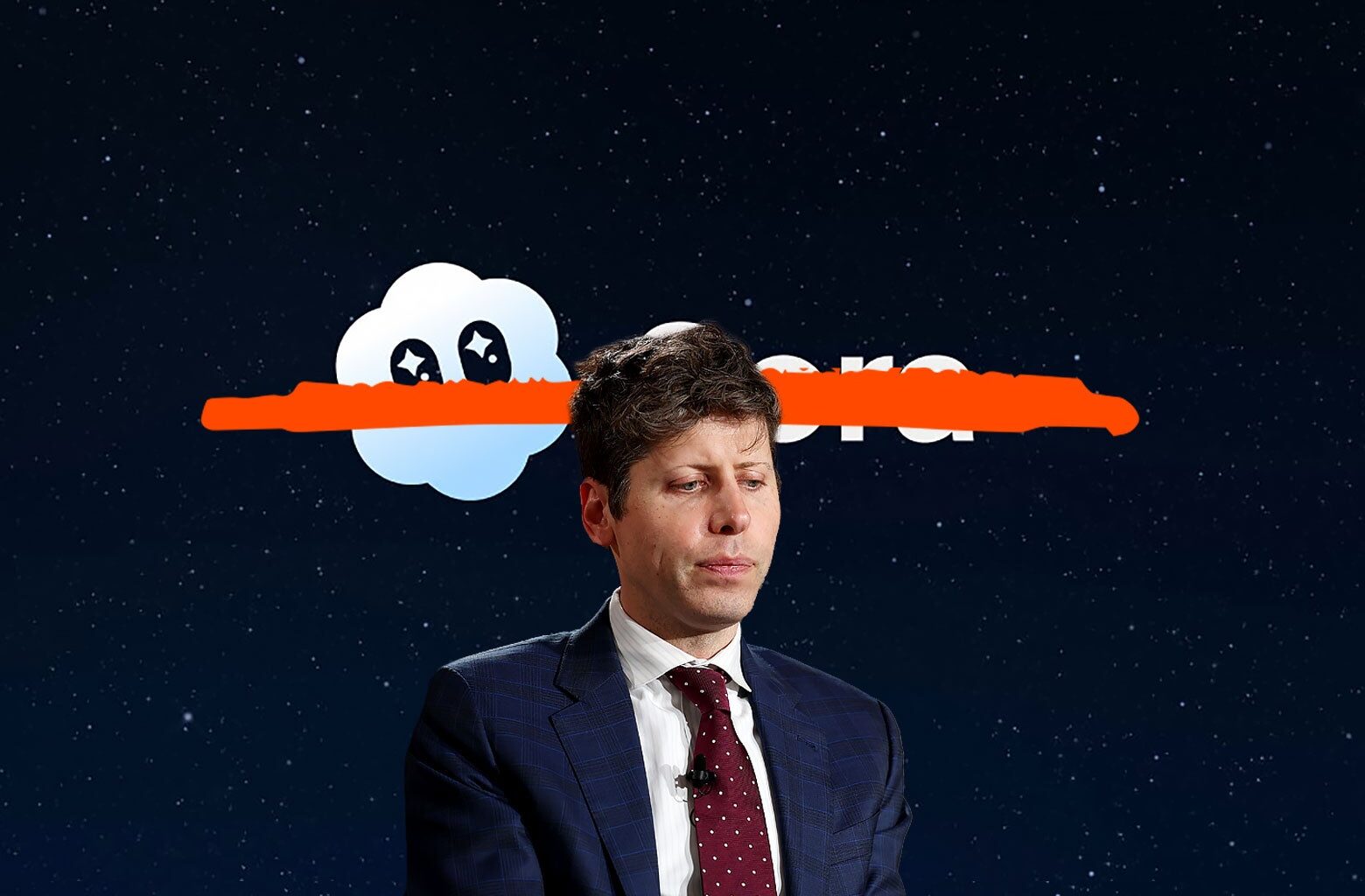
The A.I. bubble might finally be on the verge of popping. On Tuesday, OpenAI CEO Sam Altman informed his staff that the company would be shutting down its video-generation model, Sora—just six months after launching a dedicated mobile app, and just three months after inking a deal with Disney to license hundreds of its name-brand characters for virtual avatars. OpenAI also appears to be winding down ChatGPT’s video functionality and taking all its animation APIs offline. In their place arrives “Spud,” an upcoming model about which Altman has provided no real details but has promised will “really accelerate the economy.”
We’re saying goodbye to the Sora app. To everyone who created with Sora, shared it, and built community around it: thank you. What you made with Sora mattered, and we know this news is disappointing.
We’ll share more soon, including timelines for the app and API and details on…
— Sora (@soraofficialapp) March 24, 2026
“Spud” will be of no reassurance to Disney, which inked a billion-dollar deal with OpenAI in December to allow Sora users to generate likenesses of many characters. By all accounts, that was meant to be a friendship for the long haul, with a three-year contract and a planned Disney+ feature where subscribers could upload their Sora-Disney outputs. (At the time, an OpenAI executive heralded this as a cinematic sea change on par with the end of the silent-film era.) The termination seemed to surprise many at Disney, whose tech team apparently just learned of this “strategy pivot” on Monday night. In a statement to the Hollywood Reporter, Disney said that it “respects OpenAI’s decision” and “will continue to engage with AI platforms.”
Let’s be blunt. A highly capitalized A.I. startup that bails on one of its most prominent creations and largest corporate deals so soon after hyping them up for months on end is not in a good position as a business—especially at a moment when it plans to pursue an initial public offering, and thus expose itself to more financial scrutiny. And yet, it’s only one of OpenAI’s many recent troubles—and a sign that the A.I. bubble, while far from bursting outright, is wobbling and weakening as we speak. In other words, the one industry that’s keeping up the country’s growth on paper is closer to giving way and bringing about an all-around slowdown in economic activity, one that’ll make the current moment feel like a cakewalk by comparison.
Disney isn’t the only partner OpenAI is now holding at a robotic arm’s length. Throughout the year, several high-profile OpenAI commitments have sputtered, thanks to the company’s newfound frugality as well as an increasing sense of dissatisfaction from its business pals. In September, OpenAI announced a massive Texas data-center buildout in partnership with Oracle and SoftBank—only to declare it was pulling back on those expansion plans earlier this month. Nvidia, which agreed in September to provide OpenAI with a blitz of its all-powerful computing chips, stated this month that it would likely not go forward with those plans. In October, Walmart agreed to integrate ChatGPT into its chatbot-powered online shopping pilot, but ditched that experiment last week when the model consistently failed to improve store sales. Figure AI, which sent one of its humanoid bots to walk alongside first lady Melania Trump at the White House on Wednesday, cut off its collaborative efforts with OpenAI last month, as it preferred to utilize its self-developed models instead.
Today, I made the decision to leave our Collaboration Agreement with OpenAI
Figure made a major breakthrough on fully end-to-end robot AI, built entirely in-house
We’re excited to show you in the next 30 days something no one has ever seen on a humanoid
— Brett Adcock (@adcock_brett) February 4, 2025
Some may perceive this as mere growing pains for a now-decade-old Silicon Valley giant that experienced a massive growth spurt after ChatGPT’s takeoff. But the alarm bells are ringing within OpenAI’s offices too, which have been locked in “code red” mode since December. Fidji Simo, the company’s “CEO of applications,” hosted an all-hands meeting this month to inform workers that they would be doing away with “side quests,” closing down all sorts of frivolous projects in order to optimize OpenAI products for “productivity on the business front.”

Nitish Pahwa
The Most Powerful Tech Oligarch in America May Be Losing His Grip
Read More
Video generation was clearly viewed as one such distracting side quest, and it’s not hard to understand why. Not long after Sora 2 launched as a stand-alone, limited-access app in the fall, user growth went into total free fall, with downloads plunging by nearly 75 percent from their November peak. OpenAI employees reportedly realized they were deploying a lot of valuable computing power—and torching a lot of cash—to get very little in turn.
Sam Altman Is Finally Admitting Something No One Else Wants To
But the pivot away from Sora also represents a fundamental transformation for OpenAI as an enterprise. Ahead of the IPO, Simo wants her company to demonstrate that it’s capable of meeting practical, concrete use cases—and thus earn consistent revenue as a service. Rival firm Anthropic has outstripped OpenAI in this regard: While it doesn’t offer as wide a range of products as OpenAI, the tools available through its Claude assistant have earned the praise and appreciation of experienced coders, along with some valuable corporate contracts. Visual generations have been more of an invitation for lawsuits and regulations over existential matters like copyright protections, deepfake replications, and sexual abuse imagery. Coding and clerical tasks are far more straightforward and lucrative.
What that also means is a pullback from OpenAI’s nonstop-hype era, where it rode its early innovations toward rapid development of a whole bunch of goodies—Dall-E, GPT Pro—that were fun, certainly, but not applicable to everyday tasks or widely accessible, and not welcomed by the creative classes. (Those in Hollywood who do use A.I. tend toward software they’ve built in-house.)
As a result, a leading driver of A.I. spending is halting a lot of the planned investments and infrastructure initiatives that it used to announce on a weekly basis. And that means an increasingly fragile tech bubble is getting ever so closer to breaking altogether.
Sign up for Slate’s evening newsletter.