
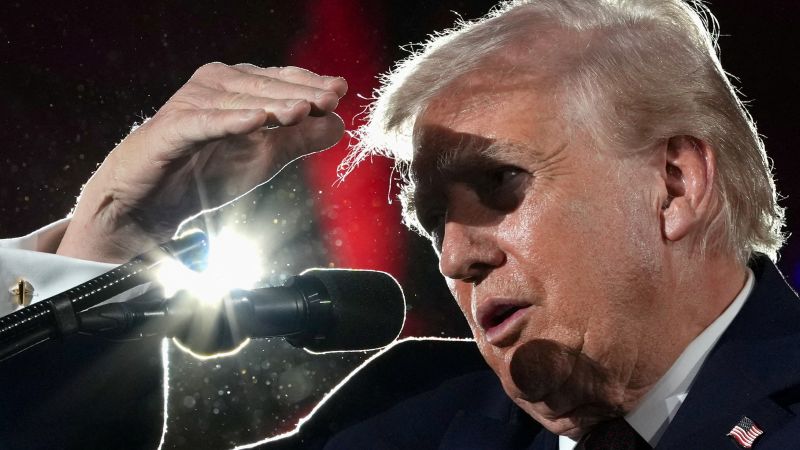
Iran doesn’t seem to be susceptible to the art of the deal.
President Donald Trump is desperate to sell the story that the Islamic Republic is ready to end the war.
But there’s no public sign yet from Tehran that it’s poised to help him walk back a crisis that he triggered by obliterating his own previous diplomatic effort nearly four weeks ago.
“They want to make a deal so badly, but they’re afraid to say it because they figure they’ll be killed by their own people,” Trump told members of Congress on Wednesday evening. “They’re also afraid they’ll be killed by us,” he said, in his latest puzzling comment on the conflict.
The disconnect casts doubt on Trump’s claims this week that a breakthrough could be imminent, even as momentum inexorably grows toward a dangerous escalation of the conflict — with thousands of US troops on their way to the region.
Any decision to send them into action would represent a huge risk for Trump because it could result in significant American casualties. It would invite far worse economic shockwaves than those already caused by Iran’s closure of the Strait of Hormuz. And a prolonged war could consume the president’s second term and legacy after he won power adamant that he’d end wars, not start them.
The need for talks could therefore hardly be more urgent.
But hopes for diplomacy are darkened by this question: Is it already too late, more than three weeks into the showdown, to negotiate a way out?
Trump has always prospered by reshaping public perceptions of reality. But real substance is needed if he is to build an off-ramp that preserves his own credibility while avoiding concessions to Iran that would mock his declarations of victory. The moment also calls for something else alien to the president’s life philosophy — providing an enemy with a face-saving exit rather than insisting on complete surrender to his demands.
Trump also doesn’t have much time. The political, economic and geopolitical stresses of the war build every day. The moment is approaching when he will face the conundrum that has led predecessors astray from Vietnam to Iraq: whether to intensify a war in a quest for a way out.
Iran has lost much of its leadership and military industrial complex, but for all the destructive potential of the US military, it might welcome the chance to draw a US president into a bloodier fight.
Trump’s erratic approach to the war this week — making dire threats to obliterate Iranian power plants, then pulling back and proclaiming imminent potential breakthroughs — is typical of a political method that operates at the extremes. Yet his apparent leaning toward military force before dangling diplomacy also reflects a grim reality: The omens for a peace deal are poor.
Aaron David Miller, a former US Middle East peace negotiator, said that “the Iranians are going to demand a price that Donald Trump is not prepared to pay, and that leaves him with the reality of having to mount a major operation, not just to open the straits — but to keep them open.”
Miller told Isa Soares on CNN International that the war is now an international crisis. “This war of choice that Trump waged has now become a war of necessity.”
Expecting negotiating dexterity now from the administration would be a stretch: It’s never really settled on a firm justification for the war, and has also failed to identify a clear exit strategy. Trump’s son-in-law Jared Kushner and special envoy Steve Witkoff’s pre-war negotiations with Iran failed. And their other ventures in Ukraine and Gaza have not yielded significant and long-term progress.
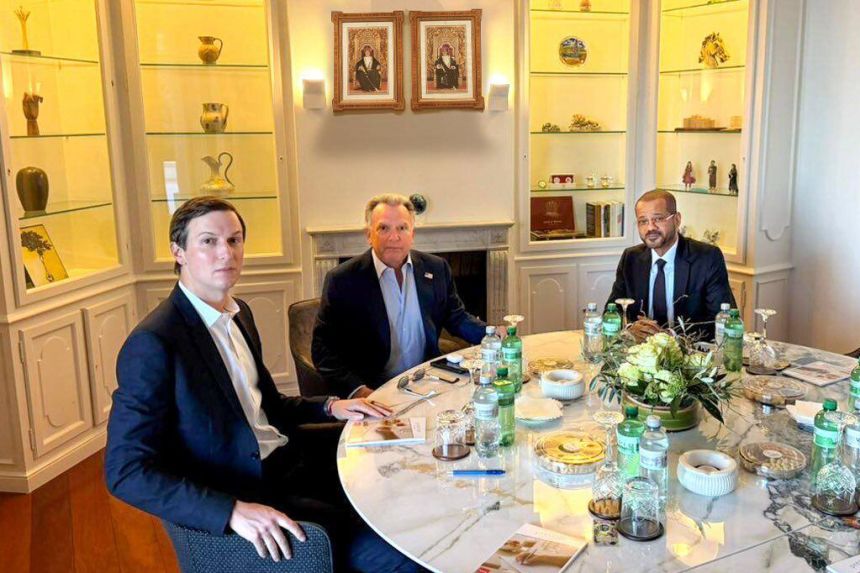
Vice President JD Vance is being mentioned as a possible principal if rumored peace talks go ahead, perhaps under the auspices of Pakistan or Turkey. His past advocacy for non-interventionism may be attractive to the Iranians, but it would put a potential 2028 presidential candidate in a political vise. And a change of personnel won’t ease mistrust exacerbated by a US attack while previous peace talks were ongoing.
Trump seems keener than the Iranians to talk, in a reflection, perhaps, of pressure on a president who didn’t prepare his country for war and is now facing polls that register broad public disapproval.
Iran’s Foreign Minister Abbas Araghchi said on Wednesday that the US had sent multiple messages to Tehran but denied negotiations were happening. White House press secretary Karoline Leavitt, however, pointed to productive talks.
Peace negotiations are often preceded by posturing as each side cultivates its political case. But here, the differences are enormous and genuine.
An Iranian official told Press TV that Tehran demanded a complete halt to aggression and assassinations. It wants concrete undertakings to ensure the war doesn’t resume and the payment of war reparations to Iran. The official called for an end to Israel’s assault on Hezbollah in Lebanon. And in a maximalist requirement Trump could never accept, he asserted the right to exercise sovereignty over the Strait of Hormuz. This would give the Islamic Republic a stranglehold on 20% of the world’s oil supplies and the global economy.
A US 15-point plan is believed to include prohibitions on Iran having a nuclear weapon, the handing over of its enriched uranium stockpiles, an end to regional proxy groups and the reopening of the Strait of Hormuz. It is a measure of how the war has slipped beyond Trump’s control that the Strait — which was open to all tanker traffic when the conflict began — has now become a key US demand in negotiations.
Iran has shown in the past that it is willing to talk about its nuclear program; it made a deal with President Barack Obama to freeze the program that Trump tore up. But it would require in return huge sanctions relief that might enable the shattered Islamic Republic to rebuild its military capacity.
The details of negotiations are not the only impediment to progress. There’s a more fundamental disconnect: Both sides in the war think they are winning. Leavitt rebuked Iran for failing to understand “they have been defeated militarily.”
It is almost certainly true that thousands of US and Israeli air strikes have devastated Iranian armed forces and leadership, and have damaged the repressive security state that keeps the regime in power.
But Trump’s repeated claims of victory suggest a misunderstanding of how his adversaries view the conflict. This may in turn weaken his negotiating position in talks. For Iran’s regime, survival in any form would represent victory. It can’t win a conventional battle. But it is seeking to impose so much pain on the US and the world that Trump has no option but to retreat.
Trump’s incessant claims of victory lead to another inconsistency in his messaging: If the US has already won, why is it still fighting — and sending thousands of US Marines and airborne troops to the Middle East?
All wars look intractable before diplomacy begins. The art of compromise requires first identifying the narrowest of spaces where enemies can meet.
There are perhaps a few weeks when this will be possible as US ground forces that might be used to eliminate Iranian coastal installations overlooking the Strait of Hormuz assemble. The clock is also racing for another reason — the last oil and gas tankers that left the Persian Gulf before the war erupted will soon reach their destinations. From then on, the strangulation of supplies will worsen the energy crisis and the economic knock-on effects.
Trita Parsi of the Quincy Institute for Responsible Statecraft believes Iran, like Trump, does have an incentive to end the war, and that diplomacy therefore has a chance. “But Trump is going to have to give something to end this war, and that’s a very different position to be in compared to where he started off,” he said.
Parsi pointed out that the US had already made one important concession — lifting sanctions on Iranian oil that was already at sea in a bid to ease the global energy crunch. This would have been inconceivable before the war, but is now precedent that might frame future peace talks.
It’s not much to build on, but it’s something.
Unless US and Iranian officials make a genuine connection soon, the war could spiral disastrously. If it’s already passed the point at which diplomacy can act as a brake, the consequences are too horrible to contemplate.