
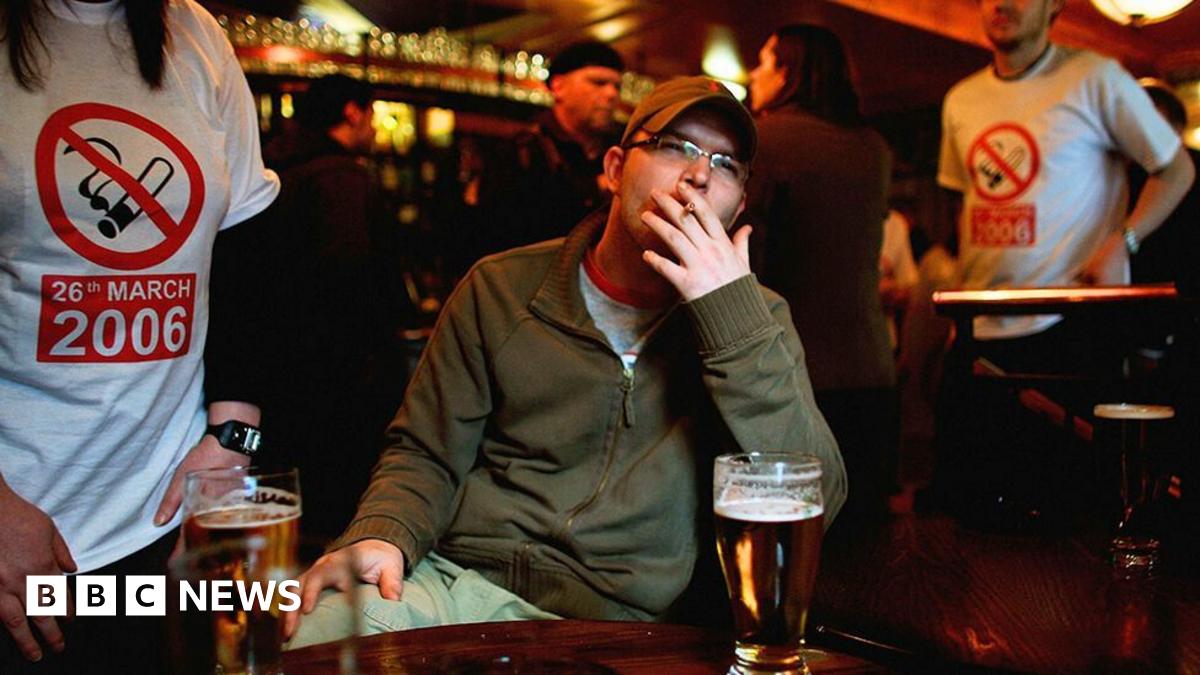
Behind the bar, Carol Graham says the ban did not convince her to quit.
She remembers the legislation as the “end of an era”.
“I thought people would just stop going to pubs, that they wouldn’t get the business and were going to close – and a few did,” she says.
Attempts to legislate against smoking did not end with the ban, which was soon followed by the requirement for cigarette packets to have graphic health warnings on them.
In 2013, the Scottish government set a target of achieving a “tobacco-free” Scotland by 2034 in which no more than 5% of the population smokes,
A bill making its way through the UK Parliament will make it illegal for people born on or after 1 January 2009 to ever buy cigarettes, as well as introducing restrictions on the advertising and sale of vapes.
Simon Clark, director of the smokers’ rights group Forest, campaigned against the ban 20 years ago.
He says that while most smokers have adapted to the ban, “the war on smoking has gone far enough”.
“Government has a duty to educate people about the health risks, but beyond that politicians and anti-smoking campaigners should butt out,” he tells BBC Scotland News.
Dr Garth Reid of Public Health Scotland disagrees.
He describes the ban as a “landmark” policy, adding: “There are people now who have absolutely no memory of having restaurants and bars and buses that there was smoking in.
“So it’s profoundly changed the social norms and that helps to protect the country in terms of people not starting smoking.”
However, he notes that more than 8,000 smoking-related deaths continue to be recorded in Scotland every year.