
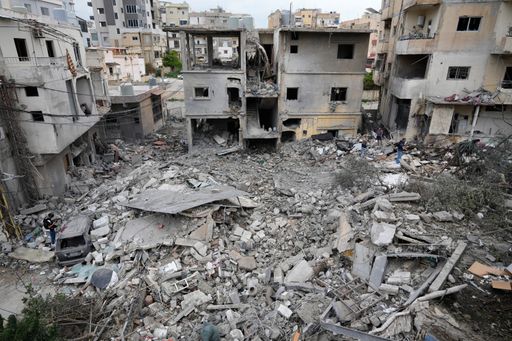
Israel has created a refugee crisis on a scale that matches or exceeds some of the largest displacements in the history of the modern Middle East, displacing a staggering six million people in the region since October 2023.
In two and a half years, the multiple wars waged by Israel have forced three million people in Iran, two million in Gaza and one million in Lebanon to abandon their homes and hearths.
The figure equals the entire population of Singapore.
But what distinguishes the current displacement crisis is its speed, geographic spread and apparent strategic intent, experts say.
The UN Office for the Coordination of Humanitarian Affairs (OCHA) says that nearly the entire population of 2.1 million in Gaza has been displaced, with large areas rendered uninhabitable by indiscriminate bombing for months on end.
In Lebanon, more than one million people – or one in every five people – have fled the Israeli invasion during the last couple of weeks.
The 3.2 million figure for the internally displaced people in Iran is likely to continue rising as hostilities persist in a “worrying escalation in humanitarian needs”.
Zahide Tuba Kor, a scholar of Middle Eastern studies, tells TRT World the Israeli aggression to forcibly displace a large number of people from their ancestral lands is “absolutely a calculated policy of demographic engineering”.
Israel’s small population and vast territorial ambitions arising out of the “Greater Israel” vision spanning the Nile to the Euphrates require the removal of existing inhabitants to maintain a Jewish-majority democratic state, she says.
“Even if all the Jews of the world were to settle in that land, they would remain a minority,” she says.
Drawing a direct line to the 1948 ethnic cleansing – known as the Nakba – that left more than 700,000 Palestinians homeless, she notes that demography drove Israel’s 2005 disengagement from Gaza under former prime minister Ariel Sharon.
“The primary reason… was demography, i.e., the rapid population growth and the concern for protecting the Jewish character of the state,” she says.

Related
Owen Schalk, a Canadian researcher and political commentator, agrees with the view that the displacements in Gaza and Lebanon amount to both “calculated demographic engineering” and “ethnic cleansing”.
“This genocidal expansionism fits with the Greater Israel ideology that is popular in the Israeli government,” he says.
Schalk points to the scale of violence in Gaza, where the International Court of Justice, the International Association of Genocide Scholars, a UN commission and numerous human rights organisations have found plausible grounds for genocide accusations.
Senior Israeli officials have openly discussed annexing Gaza, he says, adding that the pattern repeats in Lebanon, where homes are looted, towns are destroyed, and infrastructure is bombed.
Israeli Defence Minister Israel Katz has said that the one million displaced Lebanese would not be able to return to their homes until the so-called safety of Israel’s northern residents is guaranteed.
Israeli Finance Minister Bezalel Smotrich went one step further, calling for the outright annexation of southern Lebanon.
The self-defence claim
Nasir Qadri, an international law practitioner and critical legal scholar at Koc University in Istanbul, frames the forced displacements as a “patterned reconfiguration of space”.
Civilians are moved at scale, infrastructure needed for return is degraded, and strategic zones are declared off limits for indeterminate periods, he tells TRT World.