
Amid an active trade war with the United States and economic uncertainty on the horizon, the Ford government is painting a pessimistic outlook of the province’s economy — as it increases Ontario’s deficit by more than 75 per cent.

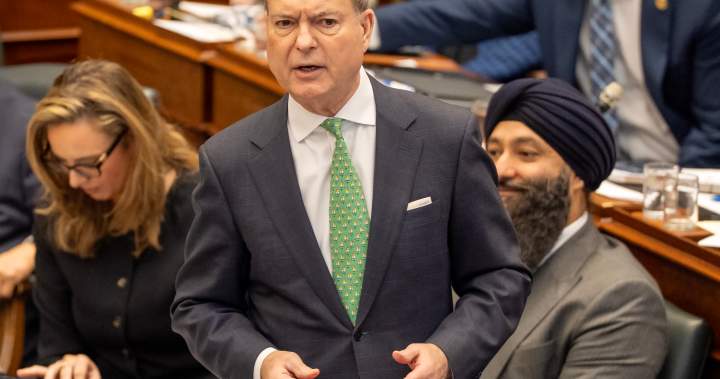
As Finance Minister Peter Bethlenfalvy tabled the 2026 provincial budget at Queen’s Park on Thursday, he warned that geopolitical change has “reached our shores,” requiring the province to spill more red ink.
Bethlenfalvy’s budget shows that Ontario’s deficit will grow to $13.8 billion in 2026-27, nearly doubling what the government projected in 2025.
The province will also delay its plans to balance the budget by a year as officials with the Ministry of Finance conceded that Ontario’s economic activity has slowed down in the government’s eight years in office.
Instead, the province will now run a $6.1-billion deficit in 2027-28 — a 31 per cent increase from its past projections. It is now planning to post a $600-million surplus in 2028-29.
Story continues below advertisement
Overall government spending is up about four per cent from $234.6 billion to $244.2 billion. The health sector will cost the government $101.2 billion this year, with education the next highest at $40.8 billion.
The financial plan doesn’t include any details of Premier Doug Ford’s idea of building a convention centre in Lake Ontario or expanding Billy Bishop airport.
His idea of tunnelling under Highway 401 is mentioned in the document, but without price details. Officials would only say work on the $9.1-million study announced last year is underway.
Despite the growing debt and grim outlook, Bethlenfalvy appears to be diverting from other provinces and is offering tax cuts instead of increases.
He has defended his deficit as “one of the lowest rates in the country.”
The opposition, however, said the Ford government has turned Ontario “into a have-not province” through poor spending choices and high debt.
“The [Progressive] Conservatives love to pretend to us that they’re prudent fiscal managers, but this budget is telling us something else,” NDP MPP Jessica Bell said.
“They are on track to have a $500-billion deficit. That is very concerning. We would like to see this government really look at what they’re spending the money on to see we’re really getting bang for our buck.”
Story continues below advertisement
Small businesses receive tax break
While the Ford government’s budget last year — hot on the heels of its “Protect Ontario” election campaign — focused heavily on manufacturing and large-scale industries, its latest plan pivots slightly.

Get breaking National news
Get breaking Canada news delivered to your inbox as it happens so you won’t miss a trending story.
A small business tax break is being introduced to try to reduce the trickle-down effect of United States President Donald Trump’s tariffs on main street businesses in Ontario cities.
As part of its 2026 budget, the province is lowering the small businesses tax rate by 30 per cent — from 3.2 per cent to 2.2 per cent. Officials estimate it will give business owners $5,000 in tax relief.
The province said the three-year discount, which would cost the province $1.1 billion, would help 375,000 small businesses.
The Canadian Federation of Independent Businesses had been critical of the government’s $5-billion Protect Ontario Account for focusing on large companies with at least $2 million in annual revenue.
Story continues below advertisement
Alongside the small business tax cut, the province is refocusing that fund to zero in on future industries as opposed to protecting existing companies hit by the trade war.
The $5 billion was set aside in 2025 to offer companies cash injections to stabilize businesses hit hardest by tariffs.
The fund, however, failed to have the desired outcomes.
For example, while tariff-battered Algoma Steel received $100 million from the government, the provincial cash still wasn’t enough to prevent 1,000 employees from being laid off.
Other than Algoma, ministry officials could not provide details on how many companies were helped, how much money they received and how many jobs were saved.
The government will now redirect $4 billion of the remaining money in the fund into a new investment fund for “economy-enabling investment opportunities” in industries that the province wants a slice of.
Industries include artificial intelligence, defence advanced manufacturing, life sciences, biotechnology and the critical mineral sector.
While the budget was light on details, the province said it would provide seed funding and work with a “general partner” to attract additional money from pension and private sector funds in an effort to “reduce exposure to external economic uncertainty.”
Ontario Liberal MPP Stephanie Bowman branded the plan a “budget of broken promises” to voters.
Story continues below advertisement
“They’re not protecting, they’re pretending,” she said.
Bowman said the government had had more than enough time to deliver on its promises.
“In 2018, they promised a middle-income tax cut to families, to fix hallway health care, and create 300,00 manufacturing jobs,” she said.
“That tax cut isn’t in this budget, hallway health care is worse than ever, and there are 9,000 less manufacturing jobs in Ontario today. This is the eighth year in a row where the Conservatives have delivered a budget of broken promises.”
Alongside increasing debt, the budget’s economic indicators suggest Bethlenfalvy was not only managing expectations when he said there would be “tougher times” ahead.
Ontario is now projecting the unemployment rate will increase to 7.4 per cent in 2026, dropping slightly to 6.9 per cent in 2027. It should fall again to 6.4 per cent in 2028.
Story continues below advertisement
Those figures are slightly higher than last year’s projections, suggesting the government is concerned more people will either lose their jobs or have difficulty finding employment.
If the projection comes to pass and 7.4 per cent of the population is unemployed this year, that would mean more than half a million people in the province without a job.
Job creation numbers are also expected to decrease compared with previous budgets. In 2027 the province is expecting 58,000 new jobs to be created in Ontario, down from the previous projection of 74,000.
The number of new homes set to be built in the province over the next few years has also cratered further.
To deal with the potential effects of a slowing economy, the province is setting aside $3 billion in a reserve budget and a contingency fund to deal with unexpected costs.