
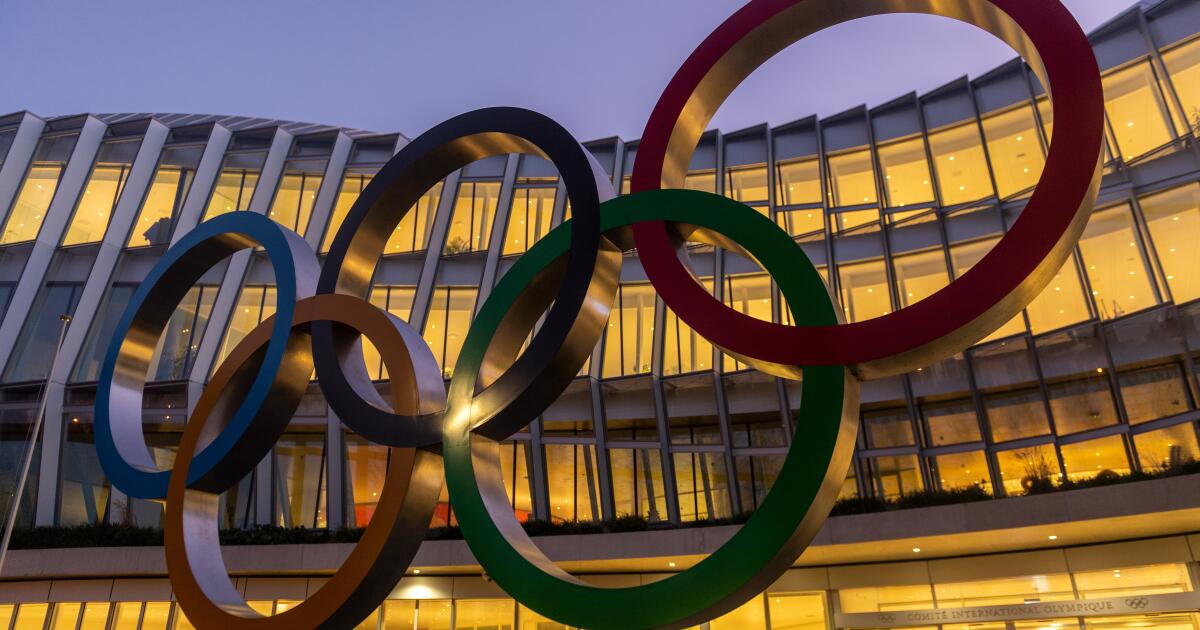
Transgender women athletes will be excluded from the Olympics beginning with the 2028 Los Angeles Games after the International Olympic Committee implemented a new eligibility policy on Thursday.
Eligibility for women’s competition will be determined by a one-time mandatory genetics test, according to the IOC. The test requires screening through saliva, a cheek swab or a blood sample.
No transgender woman competed at the 2024 Paris Summer Games, and it is unclear if any trans women currently compete at an Olympic level. Weightlifter Laurel Hubbard of New Zealand was the last to do so, competing in the 2021 Tokyo Olympics without winning a medal.
The new eligibility policy is not retroactive and does not apply to recreational sports programs. The IOC said in a statement that it “protects fairness, safety and integrity in the female category.”
“Eligibility for any female category event at the Olympic Games or any other IOC event, including individual and team sports, is now limited to biological females.”
Until now, individual sports federations have determined whether transgender women were allowed to compete in women’s categories, with the IOC providing recommendations. Sports that placed restrictions on transgender athletes included track and field, boxing, swimming and rugby.
A 2023 systematic review of the literature on sports participation published in the National Library of Medicine cautioned against imposing blanket restrictions on transgender athletes.
“Reasonable accommodations for the inclusion of trans people are sport specific and could be based on the range of competitive advantages and abilities that are already accepted in the cisgender population,” the review stated.
The IOC Executive Board nevertheless approved the new policy after 18 months of study. It mirrors the guidelines approved in June by the World Athletics Council, which will determine eligibility for the female category through screening for the SRY gene.
The IOC policy leans on scientific research that considers the presence of the SRY gene fixed for life and represents evidence that an athlete has experienced male sex development. Athletes who screen negative for the SRY gene will be eligible to compete in women’s sports.
SRY (which stands for sex-determining region Y gene) is found on the Y chromosome. In the cell, it binds to other DNA, leading to testis formation, according to the National Library of Medicine. Even men who lack Y chromosomes still have a copy of the SRY region on one of their X chromosomes, which accounts for their maleness.
Jane Thornton, the IOC medical and scientific director, last year presented to the executive board findings from a two-year study that transgender athletes born with male sexual markers retained physical advantages for several years, even those who had received treatment to reduce testosterone.
Kirsty Coventry, a former gold-medal Olympics swimmer from Zimbabwe, was elected a year ago as the first female president of the IOC. She campaigned on the importance of protecting the women’s category.
“At the Olympic Games, even the smallest margins can be the difference between victory and defeat,” Coventry said Thursday in a statement. “So, it is absolutely clear that it would not be fair for biological males to compete in the female category.”
Los Angeles LGBT Center Chief Executive Joe Hollendoner takes a different view, pointing out that the policy subjects all female athletes to a physical examination and genetic testing.
“The IOC’s policy doesn’t address a rampant problem,” Hollendoner said in a statement. As the host city of the 2028 Games, Los Angeles has a responsibility to lead with its values and uphold the law.
“We encourage city and state leaders to affirm their commitment to inclusion and ensure that all athletes are treated with dignity and equity. Failure to act risks reinforcing a broader effort to exclude trans people from public life — including sport.”
The new policy aligns with President Trump’s executive order banning transgender athletes from participating in women’s or girls’ sporting events in the United States. White House Press Secretary Karoline Leavitt expressed delight at the new IOC eligibility policy.
“You cannot change your sex,” she wrote on X. “President Trump’s Executive Order protecting women’s sports made this happen!”