
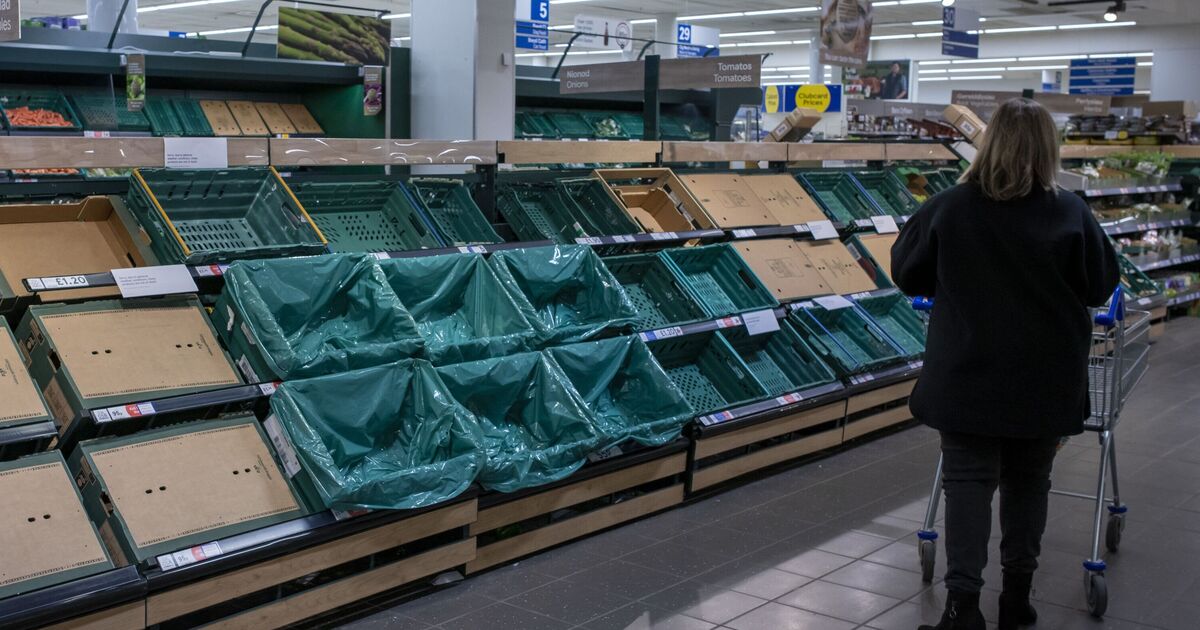
Urgent food shortage warning has been issued (Image: Getty)
A food shortage warning has been issued as customers are likely to experience hiking prices and a lack of products due to supply fears caused by the impact of the Middle East war.
A major food supplier has said the next six to twelve months will ‘make Covid look like a tea party’, as supply fears grow because of the blockage of major trade routes amid the conflict.
In Australia, shoppers could pay significantly more for milk and face empty shelves if the global shipping disruptions are not resolved within weeks, according to the head of one of the country’s biggest dairy cooperations.
Ensure our latest news headlines always appear at the top of your Google Search by making us a Preferred Source. Click here to activate or add us as Preferred Source in your Google search settings.
Read more: UK running company collapses into administration – ‘world class events’
Read more: UK pandemic slogan may have cost lives as bombshell Covid report released
It is reported that everyday staples will increase in price over the next year.
The CEO of dairy farmer cooperative Norco, Michael Hampson, said: “If it isn’t resolved promptly, as in the next week or two, the fallout for this event is going to make Covid look like a tea party.
“We won’t be worried about running out of toilet paper – we’ll be worried about not having food.”
Although he claimed that milk shortages were unlikely at present, the boss noted that consumers should expect to pay more for milk in the short term.
Hampson added that primary producers are already facing longer term problems, including paying more than twice as much for fertiliser than before the crisis.

Toilet paper could be in short supply (Image: Getty)
Many companies are also facing rapidly increasing fuel costs and struggling to obtain diesel deliveries.
In the food sector, the Australian Restaurant and Cafe Association has urged businesses to introduce a temporary surcharge on all meals, including takeaways.
The proposed addition would see an extra $5 added to the bill for every $100 spent.
According to experts, prices are also likely to hike in the UK. Food costs could continue to ramp up in the coming months, with the British Retail Consortium’s (BRC) latest figures showing food inflation at 3.5 per cent.
Despite an increase in prices, it has been reiterated that there is not a concern of shortages coming to the UK and most disruption is temporary.
The country largely relies on imported produce and a ‘just in time’ supply model, hence minor delays can rapidly create shortages and price spikes.
The current global instability caused by the ongoing conflict has increased the cost of transport, fertiliser and food production.
The BBC report that these higher costs ripple through the supply chain and will eventually reach shoppers, but the fear of empty shelves is not an issue at present.