
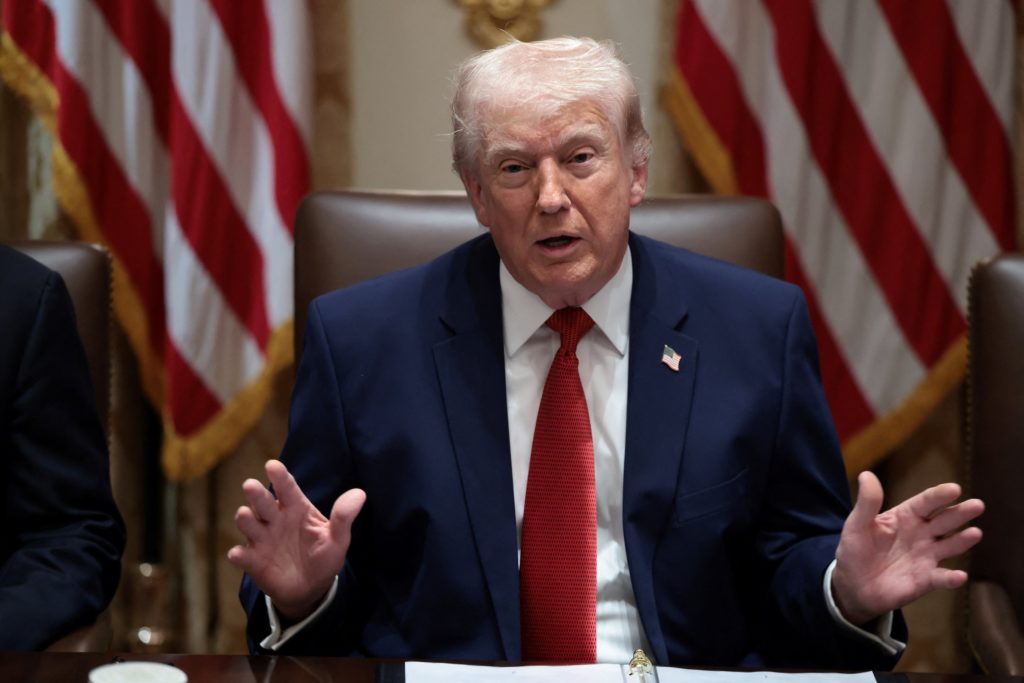
Earlier this week, President Trump said Friday was the deadline for Iran to open the Strait of Hormuz or face a resumption of attacks on energy infrastructure. Late Thursday, Trump said he’s extending his deadline until April 6. The extension came after a Cabinet meeting that included an update on the war. Lisa Desjardins reports.
John Yang:
Welcome to the “News Hour.”
Late today, President Trump said on social media that he’s extending his ban on bombing Iran’s power plants by 10 days until April 6. Early this week, he said tomorrow was the deadline for Iran to open the Strait of Hormuz or face a resumption of attacks on energy infrastructure, which is illegal under the Geneva Convention.
Today’s extension came after an hours-long Cabinet meeting that included an update on what U.S. officials say are ongoing negotiations with Iran.
Lisa Desjardins has our report.
Lisa Desjardins:
Today in the Middle East, still more civilians paying the price of war. Emergency workers rushed to help an elderly woman in the Arab-Israeli town of Kfar Qasim. She had just been spared from an Iranian missile fragment, its impact in printing a crater and flipping cars.
That strike, part of the Tehran regime’s ballistic attack on Central Israel today, engulfed cars in the town of Ganei Tikva in flames. Rescue workers putting out the fire revealed charred husks of vehicles. Iranian missiles also obliterated a home nearby in Tel Aviv, a fragment landing in a family’s living room.
Israeli rescue services reported one death and 25 injuries from Iranian and Hezbollah attacks today, as Israel last night killed the head of Iran’s navy, Alireza Tangsiri, along with other senior naval commanders.
Israeli Defense Minister Israel Katz:
Israel Katz, Israeli Defense Minister (through interpreter):
Last night, in a precise and lethal operation, the IDF thwarted the commander of the Revolutionary Guards navy, Alireza Tangsiri, along with senior naval command officials,the man who was directly responsible for the terrorist operation of mining and blocking the Strait of Hormuz, and navigation was blown up and neutralized.
Lisa Desjardins:
This as the Strait of Hormuz remains in Iran’s grip, causing hundreds of billions in economic blowback and preventing a fifth of the world’s seaborne oil and natural gas supply from transport.
The U.S. today continued its bombing, releasing video of strikes targeting Iranian military capabilities. At the White House, a rarity, a public briefing by special envoy Steve Witkoff during a Cabinet meeting with President Trump.
He said Iranian officials rejected key demands, including about its nuclear stockpile.
Steve Witkoff, U.S. Special Envoy to the Middle East: Throughout our meetings with the Iranians, we heard the following from them. The Iranians have the inalienable right to enrich. Then we heard they possessed enough 60 percent enriched material, 460 kilograms, to make 11 atomic bombs.
Lisa Desjardins:
Even so, Witkoff conveyed a belief that Iran may be at a pivot point for a deal with Trump.
Steve Witkoff:
Your indications that you are willing to listen to peace proposals have been well received. We have delivered that message, sir, along with the 15 points for peace. Finally, we have told Iran one last day. Don’t miscalculate again.
Lisa Desjardins:
Trump told the room that Iranians made a goodwill gesture.
President Donald Trump:
They said, to show you the fact that we’re real and solid, and we’re there, we’re going to let you have eight boats of oil., eight big boats of oil. This was two days ago. And they’ll sail up tomorrow.
Lisa Desjardins:
And he conveyed his sense of the state of play.
President Donald Trump:
And they will tell you, we’re not negotiating. We will not negotiate. Of course, they’re negotiating. They have been obliterated. Who wouldn’t negotiate? They are begging to make a deal. We will see if we can make the right deal.
Lisa Desjardins:
But, yesterday, Iran’s foreign minister publicly denied any direct negotiations.
Abbas Araghchi, Iranian Foreign Minister (through interpreter):
Over the past few days, our American counterparts have begun sending messages through others, other countries that are our friends. If there are messages through others to which we respond with our own position and demands, that is not called conversation, nor negotiation, or anything. This is simply sending messages through others.
Lisa Desjardins:
Pakistan has emerged as a key mediator in this conflict.
Tahir Andrabi, Spokesperson, Pakistani Ministry of Foreign Affairs: Pakistan has, ladies and gentlemen, actively engaged with the regional actors to de-escalate the situation, seize hostilities, and move towards a peaceful settlement.
Lisa Desjardins:
But, for now, the war, its issues and its grief continue.
For the “PBS News Hour,” I’m Lisa Desjardins.