
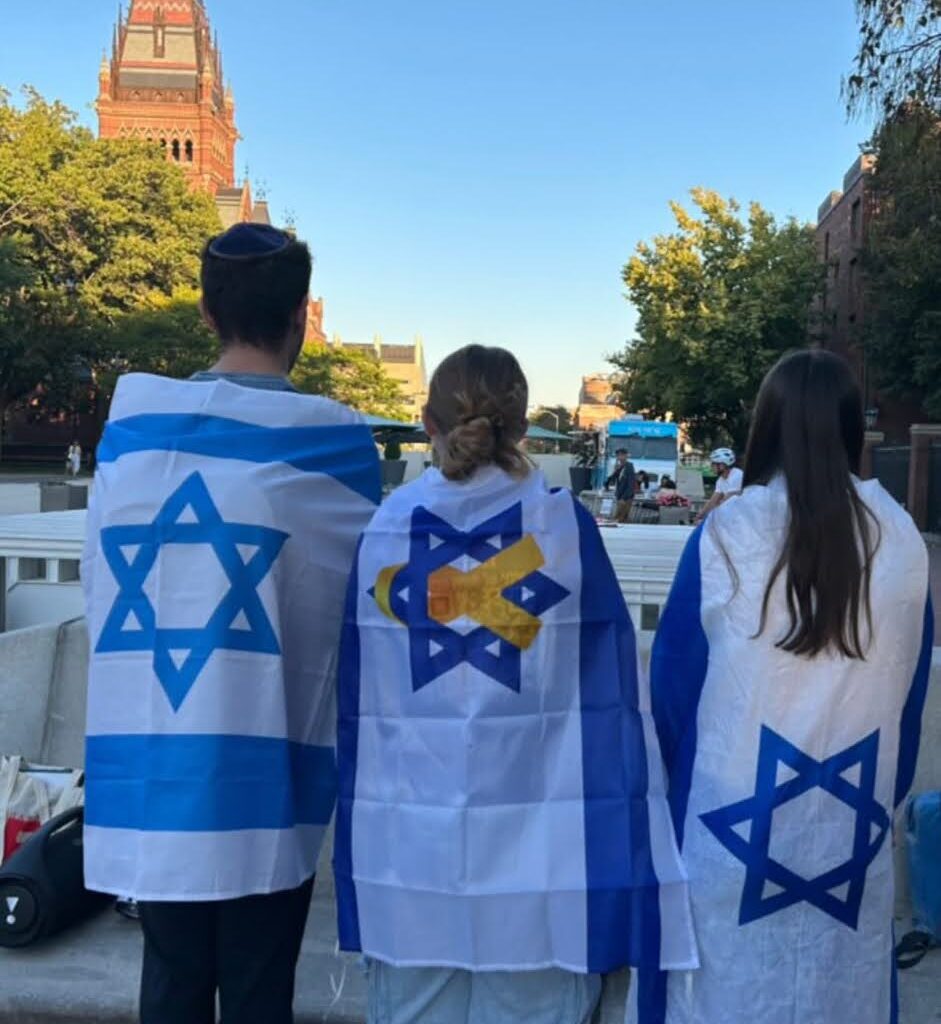
The first time I was asked to share my “October 7th story,” I cried. It was June 2024, and I was at a training session for counselors at a Jewish summer camp in Northern California. Just months after Oct. 7, it was inevitable that the war would come up in conversation with our campers, and we had to be prepared to talk about it.
Sitting around with about two dozen other staff members, we were instructed to explain how we related to our Jewish identity lately by choosing a “David card” from a deck featuring cartoon depictions of stick figures and Stars of David. I chose a card depicting an iMessage exchange, with little stars in lieu of words, and that was when I began to cry.
Just a few months after I graduated high school, I boarded a flight from Newark Liberty International Airport heading to Tel Aviv, Israel. My plan was to spend a year learning Jewish texts in a predominantly-Israeli seminary just outside of Jerusalem.
Oct. 7, 2023, was a Jewish holiday called Simchat Torah, where we celebrate the completion of the annual cycle of reading from the Torah. Like on most Jewish holidays, among particularly stringent religious sects, the use of technology, like cars or cell phones, is prohibited. In Israel, this festival is observed for one day; outside of Israel, it is observed for two.
On Oct. 7, I was at seminary. When the holiday ended that night, my Israeli roommates and peers rushed home to their families, leaving me almost completely alone. My parents were back in the States, so between the time difference and the extra day of the holiday, it would be another 31 hours before I could speak to them.
That night, I couldn’t sleep. The villages that were attacked were so similar to the one I was in, with yellow gates and limestone buildings. I laid awake, terrified that at any moment, someone might enter my room and I would be next.
At 2:12 a.m., I got a text. It was from my mom. After the first day of the holiday ended in the States, she had turned on her phone — despite the rabbinic prohibition — to message me: “Available if you need to talk. Love you lots.”
I didn’t respond right away. I didn’t want to make her anxious by admitting I was still awake. The next morning, I texted her my plans for the day. Though it was 10 a.m. in Israel and 3 a.m. in New Jersey, she called immediately.
“Why are you still up?” I asked her. At that moment, I realized that she was just as anxious as I was. While I laid awake the night before, scared that something would happen to me, she laid awake scared that something did.
Sitting in that circle of future coworkers, reliving that shared anxiety, I couldn’t stop crying.
***
The last time I was asked to share my “October 7th Story,” I cried again. It was Nov. 2025, and I was participating in the First-Year Religious, Spiritual, and Ethical Life Fellowship through the Presidential Initiative on Interfaith Engagement. After ten weeks of learning how to listen generously across our differences, we students were asked to put our skills to the test through a conversation about the Israel-Palestine conflict.
We were split into pairs. Rabbi Getzel Davis, the fellowship’s director, gave us a deceptively simple prompt: for the next five minutes, tell your partner the story of how you arrived at the beliefs you hold today.
This time, I didn’t cry as I spoke. Instead, I fumbled. I tried to compress everything into five minutes — just to get to Oct. 7, I felt like I had to provide so much context and justification. I spoke quickly, afraid of leaving something out, unsure what even counted as relevant.
Only after the session had ended, after everyone had dispersed to their dorms and their dinner and their homework, did I cry. I felt as though I had to summarize twenty years of lived experience in five minutes, and that it simply wasn’t possible.
Later, speaking on the phone with Israeli friends, I thanked them for understanding me without needing an explanation.
***
Our grandparents know exactly where they were when John F. Kennedy was shot. Our parents know exactly where they were when the second of the Twin Towers fell. And so too, every Israeli knows exactly where they were on Oct. 7, 2023 — we all have our “October 7th story.” Though I keep saying I was asked to share mine, in truth, no one meant for me to recount a single day. Not at camp. Not in the RSEL fellowship. I imposed that on myself. I was so focused on trying to tell a story about one moment that I forgot that my story spans a lifetime.
My story begins when I am born as an Israeli citizen. It follows me through to kindergarten, when my family spends a sabbatical year in Israel; through twelve years of school in the States, where I practice my Hebrew to the rhythm of children’s nursery songs and generic Israeli pop; and through sweltering summers spent wandering through Jerusalem’s busy markets and tight streets with family.
My story progresses as I board a plane for my first gap year, and as I spend a month pouring over pages of the Talmud in seminary. It continues as, on Oct. 5, 2023, my dad reassures me as I struggle to adjust: “Everything will be fine.” On Oct. 6, when I have brunch with a friend; we speculate over barriers to peace between Israelis and Palestinians — not realizing how relevant our discussion is about to become. And on Oct. 8, when I get that text from my mom in the middle of the night in the aftermath.
My story advances on Jan. 2, 2024, when I begin interning at a peacebuilding organization in Jerusalem. And on Mar. 3 of the same year, when I un-enroll from college in the States because it feels like no one there is ready to talk to each other yet. Instead, I sign up for Israeli National Service, Sherut Leumi, because somehow it feels like there is more nuance there.
In a second gap year, in National Service, my core beliefs are challenged again and again. My story continues through close bonds formed with my Israeli peers; through a weekend spent with a family in the Gaza Envelope; through the heroes and hostage families that I got to interview through my work in National Service; through weekly hostage and anti-war protests.
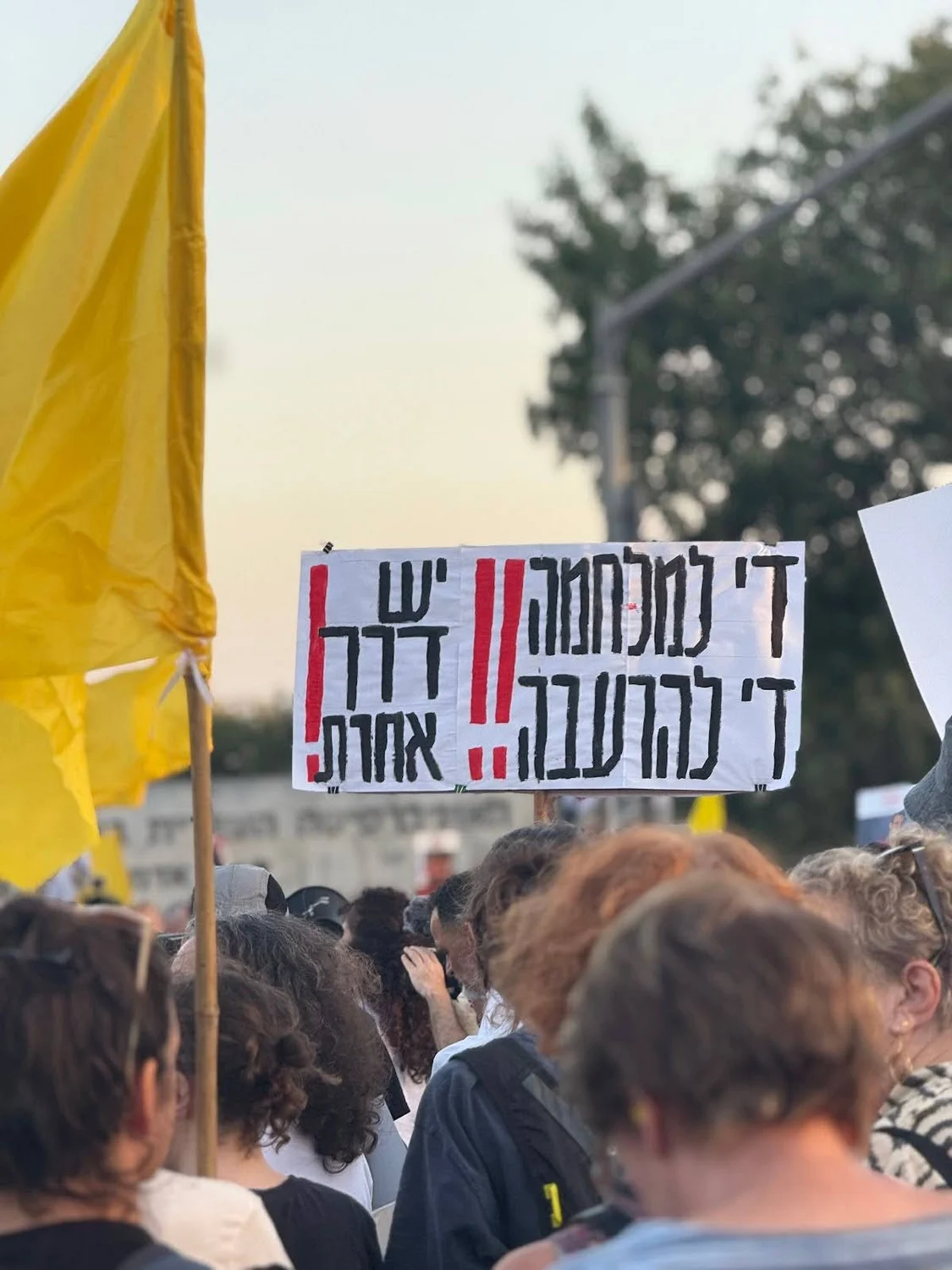 A sign raised at a protest in Givat Ram, Jerusalem in August 2025. The sign translates to: “Enough to war! Enough to starvation! There is another way!” | By Courtesy of Sarit O. Greenwood
My story follows me to summer camp again and then back to the United States, to a college campus riddled with accusations of antisemitism — but also a campus with the most beautiful Jewish community, interfaith engagement, and intellectual vitality.
“October 7th” is not just something that happened to me on one day. It is inseparable from twenty years of my life: my family, education, language, community, and identity. I cannot begin to explain what that day meant without the before. And the story would be incomplete without the after.
This is not my “October 7th story.” It is the story of realizing that one day does not define me.
—Magazine writer Sarit O. Greenwood can be reached at [email protected].