
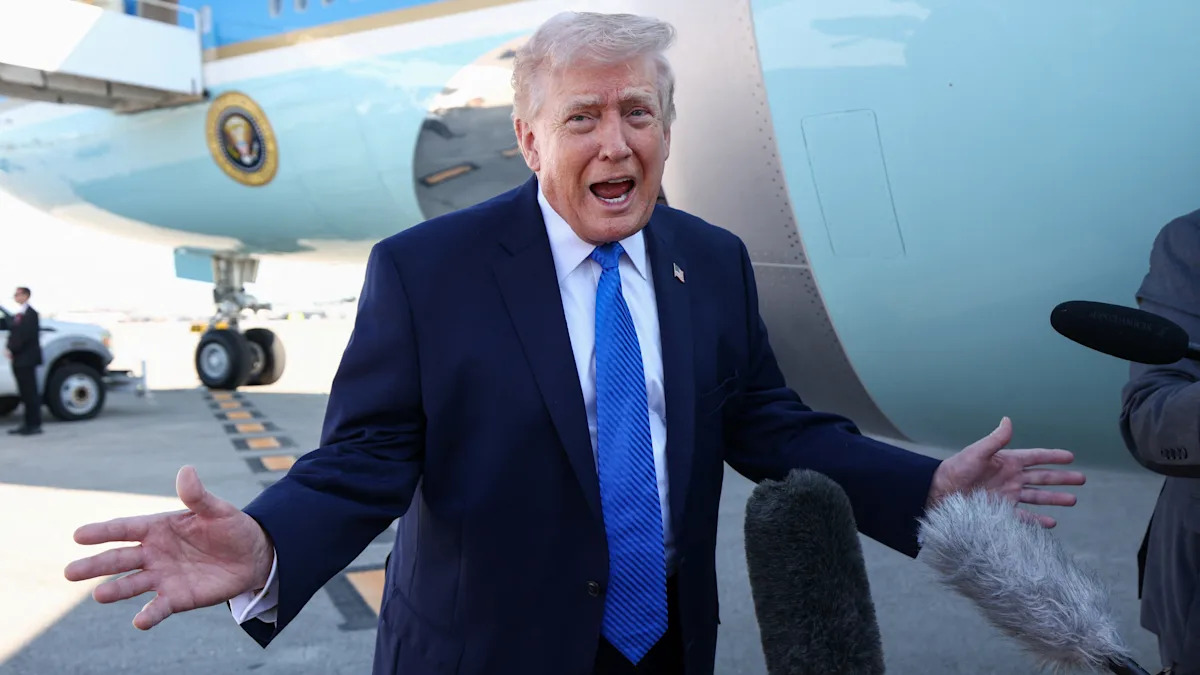
President Trump on Thursday warned Iran to “get serious soon” about negotiating an end to the war — then gave the regime 10 additional days to reopen the Strait of Hormuz, claiming the extension came at the “request” of the Iranian government.
“They better get serious soon, before it is too late, because once that happens, there is NO TURNING BACK, and it won’t be pretty!” Trump wrote overnight on social media.
Later, during his first White House Cabinet meeting since the start of the conflict, the president repeated his claim that Iranian leaders are already negotiating with the U.S., even though they have refused to say so.
“They’ll tell you, ‘We’re not negotiating,’” Trump said. “Of course they’re negotiating. They’ve been obliterated.”
Trump added that if Iran doesn’t make a deal, “we’ll just keep blowing them away, unimpeded, unstopped.”
A few hours later, Trump announced on social media that he was “pausing the period of Energy Plant destruction by 10 Days to Monday, April 6, 2026, at 8 P.M., Eastern Time” because “talks are ongoing and… they are going very well.”
Trump’s comments came a day after the Iranian regime publicly rejected a 15-point peace plan proposed by the U.S. — but privately signaled some openness to talks, according to reports.
The New York Times reported earlier this week that the U.S. had sent Iran a 15-point plan to end the war, citing “two officials briefed on the diplomacy.” The officials said the plan — which reportedly addresses maritime routes as well as Iran’s nuclear program and ballistic missiles — had been delivered by Pakistan.
The U.S. and Iran have sent conflicting signals about possible talks. On Saturday, Trump threatened to “hit and obliterate” the country’s power plants within 48 hours unless the Islamic Republic of Iran agreed to fully reopen the Strait of Hormuz, a critical oil shipping route in the Persian Gulf.
But on Monday morning — roughly 12 hours before his previous deadline — Trump said he had delayed his strikes on Iranian energy infrastructure for five days, claiming that the U.S. and Tehran had launched “VERY GOOD AND PRODUCTIVE CONVERSATIONS REGARDING A COMPLETE AND TOTAL RESOLUTION OF OUR HOSTILITIES IN THE MIDDLE EAST.”
By Thursday, Iran had let 10 ships through the Strait of Hormuz in what Trump characterized as a “gift” ahead of talks; most were Pakistan-flagged oil tankers. But the president would not say whether he would extend his Friday deadline in the absence of a full reopening.
“If it’s not going along, maybe not,” Trump said. He added that Iran still had “a lot of time” to comply because a day “in Trump time” is “an eternity.”
It is unclear who the U.S. is talking to, or what might come of such conversations. Top diplomats from several Middle Eastern countries have been pushing for deescalation, and Iran’s foreign minister has been communicating with his counterparts in the region.
The officials who spoke to the Times about the Trump administration’s 15-point plan to end the war said that Pakistan’s army chief, Field Marshal Syed Asim Munir, has emerged as the key interlocutor between Iran and the U.S., and Pakistan’s prime minister has said his country is ready to “facilitate meaningful and conclusive talks” to end the war.
In a series of defiant, taunting statements issued on Wednesday, Iranian military spokesman Ebrahim Zolfaghari accused the United States of “negotiating with yourselves” as “you flee from the prolongation of war.”
“The power of our armed forces grow stronger with every passing moment,” Zolfaghari said. An unnamed Iranian official told state-run TV that Tehran would not allow Trump “to dictate the timing of the war’s end.”
Yet behind the scenes, Iranian officials are reportedly considering meeting with U.S. negotiators in Pakistan over the next week.
“They’re talking to us, and they’re making sense,” Trump said on Tuesday, adding that both Vice President JD Vance and Secretary of State Marco Rubio had gotten involved.
Meanwhile, Israeli Prime Minister Benjamin Netanyahu reportedly ordered a 48-hour campaign of attacks to destroy as much of the Iranian arms industry as possible ahead of any deal.
So is the war about to end — or not? Here’s everything you need to know to make sense of what’s happening in the Middle East.
New waves of attacks
A new barrage of Iranian strikes showed that the regime is still capable of inflicting damage on its Gulf neighbors.
Iran’s military said Wednesday that it had fired cruise missiles at the U.S. aircraft carrier Abraham Lincoln, according to the semiofficial Mehr news agency. Israeli authorities said Iranian missiles hit Tel Aviv and other parts of the country, injuring six and damaging at least three residential buildings. A volley of six Iranian ballistic missiles killed six Kurdish fighters and wounded 30 others, according to the government of Iraq’s semiautonomous Kurdish region. In Bahrain, an Iranian missile attack killed a Moroccan contractor working for the Emirati armed forces and injured five Emirati service members. And the Kuwaiti army said on social media that it faced multiple drone and missile attacks.
At the same time, the Israeli military released a flurry of new evacuation warnings for southern Lebanon on Tuesday — hours after Israel’s defense minister said his country plans to control more territory there. According to the New York Times, the statement “suggested Israel was laying the groundwork to remain in large parts of Lebanon.”
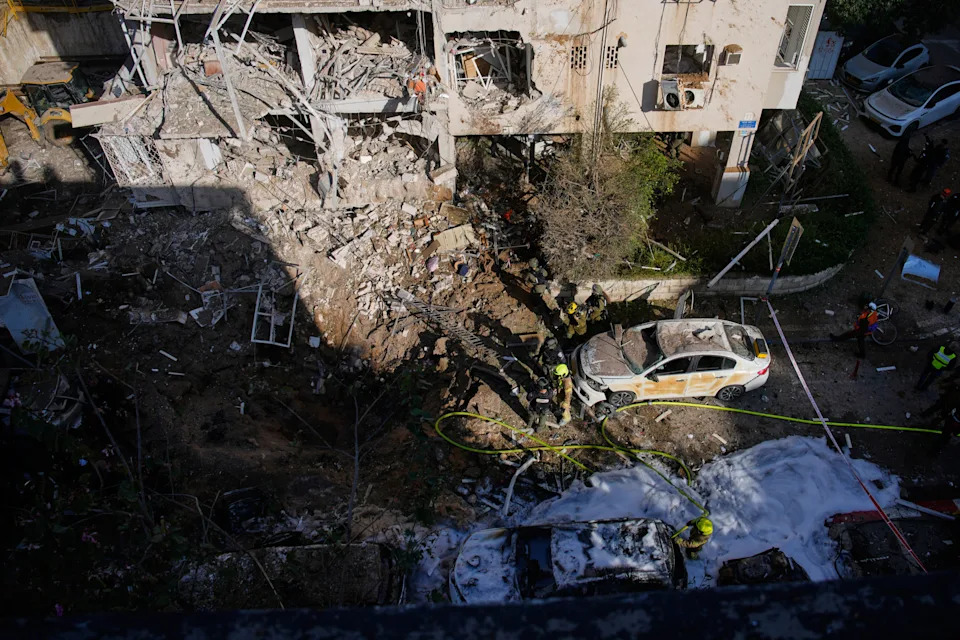
Israeli security forces and rescue team respond at the site of an Iranian missile strike in Tel Aviv.
(Ohad Zwigenberg/AP)
Hostilities between Israel and Hezbollah, an Iranian-backed militant group in Lebanon, have flared up intermittently since 1982, and the outbreak of the Gaza war in October 2023 led to another round of fighting. A ceasefire had been in place since November 2024, but Hezbollah launched several rockets into northern Israel after the U.S. and Israel struck Iran on Feb. 28. Israel has been conducting retaliatory strikes on Hezbollah targets in Lebanon ever since.
On Tuesday, Israeli military officials said a woman was killed and two others were injured in northern Israel due to rocket and drone fire from Lebanon.
What Trump is saying about a possible deal
Speaking to reporters in Florida, Trump insisted on Monday morning that “we are in the throes of a real possibility of making a deal” and that Iran wants one “very badly.”
“If I were a betting man, I’d bet for it,” the president added. “But again, I’m not guaranteeing anything.”
When pressed for details, Trump said that his Middle East special envoy Steve Witkoff and his son-in-law Jared Kushner had launched “very, very strong talks” on Sunday with a respected Iranian leader, whom he did not name. (He did say that it was not Iran’s new ayatollah, Mojtaba Khamenei.) Talks would continue on Monday, Trump said, with “major points of agreement.”
As for the terms of a possible deal, the president said that the U.S. would demand an end to Iran’s nuclear capabilities. “We want to see no nuclear bomb, no nuclear weapon,” Trump said. “Not even close to it.”
Trump also said it would be easy for the U.S. to retrieve Iran’s stockpile of enriched uranium. “If we have a deal with them, we’re going down and we’ll take it ourselves,” he vowed.
During an event in Tennessee later on Monday, Trump said that the U.S. had been negotiating with Iran for a long time. He predicted that a deal was close.
“They want peace,” Trump said. “They’ve agreed they will not have a nuclear weapon, you know, et cetera, et cetera, but we’ll see.”
Witkoff, the White House special envoy, said during Thursday’s Cabinet meeting that he and Kushner are trying to convince Iran “that this is the inflection point with no good alternatives for them other than more death and destruction.”
Witkoff said there were “strong signs” that peace was a possibility and that “Iran is looking for an off-ramp.”
Rubio will travel to France on Friday to discuss the war with his counterparts from the other G7 nations.
Asked earlier this week if he trusts the Iranians his administration claims to be talking to, Trump alluded to receiving a “gift” that signaled they were “dealing with the right people.”
“They gave us a present, and the present arrived today,” Trump said, cryptically. “It was a very big present worth a tremendous amount of money. And I’m not going to tell you what that present is, but it was a very significant prize.”
The president went on to say the gift was “oil- and gas-related” rather than “nuclear -related.”
Trump said Thursday that the gift was allowing 10 oil tankers to pass through the Strait of Hormuz ahead of possible talks.
What Iran is saying about a possible deal
Tehran appeared to reject Trump’s claim that the two countries were making progress toward ending the war, which is now in its fourth week.
On social media, the speaker of Iran’s parliament denied that direct talks had taken place. “No negotiations have been held with the US,” Mohammad Bagher Qalibaf wrote. “and fakenews is used to manipulate the financial and oil markets and escape the quagmire in which the US and Israel are trapped.”
Citing the country’s foreign ministry, the state-run IRNA newspaper published a similar claim on Monday, arguing that “remarks by the U.S. president are part of efforts to reduce energy prices and buy time to implement his military plans.”
The paper added, however, that “there have been initiatives by regional countries to de-escalate tensions.”
Prior to Trump’s remarks about a deal, Iranian Foreign Minister Abbas Araghchi acknowledged that he’d talked by phone with his Turkish counterpart over the weekend. Turkey has previously served as an intermediary between Tehran and Washington.
Iran’s semi-official news agency, Tasnim, which is close to the country’s paramilitary Revolutionary Guard, also insisted that no direct talks had taken place even though “messages have been sent to Tehran by some mediators.” It characterized Trump’s comments as “psychological warfare” and claimed the tactic would not help the Strait of Hormuz return to prewar conditions or bring calm to energy markets.
And Iranian officials said in comments carried on state television Wednesday that the regime would not end its attacks unless the U.S. paid war reparations and recognized Iranian control over the Strait of Hormuz.
On Tuesday, Iran announced that a hard-line former deputy commander in the Revolutionary Guard, Mohammad Bagher Zolghadr, had taken over as the country’s top security official after an Israeli strike killed his predecessor Ali Larijani last week.
What other countries are saying about a possible deal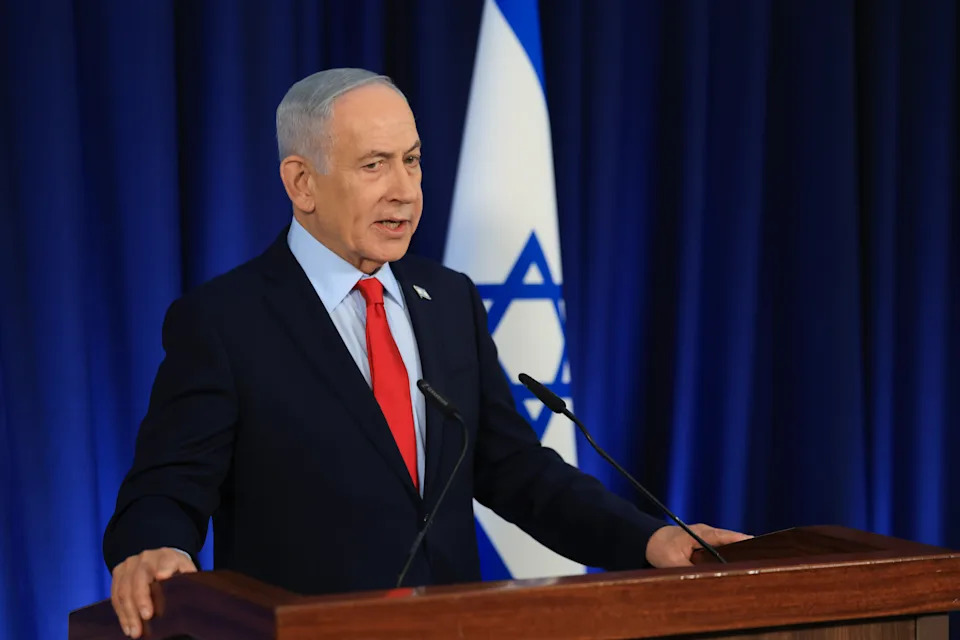
Israeli Prime Minister Benjamin Netanyahu speaks in Jerusalem on March 19.
(Ronen Zvulun/Pool via AP)
In a video statement on Monday, Netanyahu said he had spoken to Trump, who told him that the U.S. might be able to leverage U.S.-Israeli military achievements to “realize the objectives of the war in an agreement” with Iran.
But Netanyahu said that Israel would continue to strike Iran and Lebanon in the meantime. Israel later said it was not part of any possible talks between the U.S. and Iran, as did Qatar.
Egypt’s foreign ministry said in a statement that it had been making “constant efforts and communications with all concerning parties” in recent days to avoid “reaching to the point of no return.”
“Egypt welcomed statements made by US President Donald Trump,” the government said. “Egypt stressed the importance of seizing this opportunity and building upon it to prioritize dialogue, stop the escalation, and ultimately end the war.”
The office of Egypt’s top diplomat, Badr Abdelatty, said that he had spoken in recent days with Witkoff, Aragchi and the foreign ministers of Turkey, Pakistan, Oman, Saudi Arabia, UAE, France and Cyprus. The top Turkish and Pakistani diplomats also spoke on Monday, according to the Pakistan foreign ministry.
An Egyptian official told the Associated Press that Washington and Tehran exchanged messages over the weekend through Egypt, Turkey and Pakistan.
“This is the top priority right now,” the official said.
British Prime Minister Keir Starmer told senior lawmakers on Monday that his government was aware of talks between the U.S. and Iran and that the priority was to achieve “a negotiated agreement which puts tight conditions on Iran, particularly in relation to nuclear weapons.”
How markets reacted to the news
Stocks and bonds climbed on Monday after Trump said the U.S. had started productive talks to end the war with Iran. The price of Brent crude, the international oil benchmark, briefly dropped from $114 to $96 a barrel — then rose to roughly $100 after Iranian state media denied any direct negotiations.
On Tuesday, oil prices resumed their rise and stocks fell in the absence of any concrete developments toward peace. The Philippines declared a national energy emergency, saying that high oil prices were threatening its energy security.
On Wednesday, the renewed prospect of negotiations sent oil prices down sharply. But a lack of progress on Thursday triggered another oil spike, and Wall Street suffered its worst day since the start of the war.
Oil and gas prices have skyrocketed in recent weeks because Iran has effectively closed the Strait of Hormuz, a narrow, winding waterway along the country’s southern coastline that connects the Persian Gulf to the rest of the globe.
The strait is considered the world’s most vital shipping lane because one-fifth of our oil flows through it. But Iran has been threatening to attack ships there, and the country’s new leader has vowed to maintain the blockade. U.S. officials say Iran has also been booby-trapping the strait with mines.
As a result, almost no non-Iranian ships have been risking the journey — and the supply of Gulf oil has plummeted.
U.S. issues security alert for Americans abroad
The U.S. State Department issued a worldwide security alert on Sunday, urging Americans abroad to exercise increased caution after recent threats from Iranian officials and affiliated groups.
“Periodic airspace closures may cause travel disruptions. U.S. diplomatic facilities, including outside the Middle East, have been targeted,” the warning continued. “Groups supportive of Iran may target other U.S. interests overseas or locations associated with the United States and/or Americans throughout the world.”
On Friday, a top Iranian military spokesman threatened to pursue U.S. and Israeli officials beyond active conflict zones. “From now on, based on the information we have about you, even parks, recreational areas and tourist destinations anywhere in the world will no longer be safe for you,” he said.
The State Department urged Americans to follow the guidance in security alerts issued by the nearest U.S. Embassy or consulate, especially in the Middle East.