
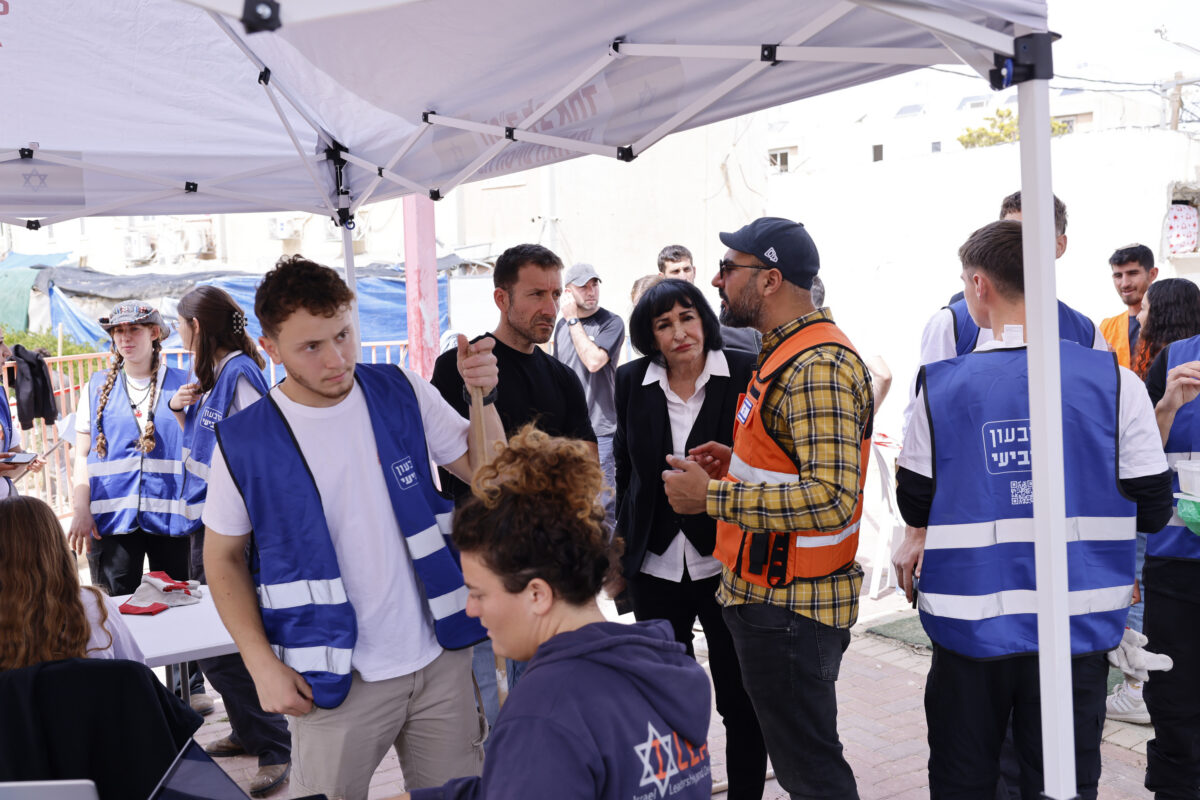
Itzik Shmuli, the head of UJA-Federation of New York’s Israel Office, has spent the past week crisscrossing Israel, visiting the sites of major Iranian and Hezbollah strikes, speaking with survivors and local government officials from the southern towns of Arad and Dimona to the northern city of Kiryat Shmona and the Upper Galilee.
“Some of our ability to have a finger on the pulse when things are really at a dizzying pace is to be on the ground,” Shmuli told eJewishPhilanthropy this week, shortly after his stop in the North and just before a visit to Beit Shemesh in central Israel.
“In crisis, the ability to respond quickly is critical. It’s very hard, but we are trying our hardest to do it,” he said. “In recent weeks, what gives me meaning is being a father to children at a time like this and the fact that I’m part of UJA.”
Since 2021, Shmuli, a social activist and former Israeli welfare minister, has served as the Israel representative of the New York federation — by far the largest and wealthiest Jewish federation — which has long supported a host of Israeli communities and organizations, but has become a critical lifeline for many of them in the wake of the Oct. 7 terror attacks and the past two-plus years of war.
“We are more than two years in this loop of going from emergency to emergency,” he said in a phone interview on Wednesday, which was interrupted by two rounds of air-raid sirens.
In the current emergency, Shmuli said, UJA-Federation of New York has four primary focuses in Israel: emergency aid to the municipalities hit by Iranian and Hezbollah attacks and their displaced populations; supporting Holocaust survivors, elderly citizens and people with disabilities; increasing mental health services; and improving public bomb shelters.
“We are supporting nearly 500 organizations, and we try to be in touch with them daily. We are also in contact with the [Israel Defense Forces’] Home Front Command and government ministries, to try to understand the chaotic reality that we are living in,” he said. “We are trying to find where the weak points are, where we can play a role, what’s relevant for philanthropy.”
Shmuli stressed the importance of Israeli civil society, which he said has emerged as a critical component of Israel’s national security. “It’s often the first one there and the last to remain,” he said. “Civil society is on the front lines.”
Reflecting on his recent visit to Dimona, after it was hit by an Iranian missile, wounding dozens and leaving hundreds homeless, Shmuli said he was struck by how many volunteers and nonprofits had turned out to help.
“On one side of the street, you see the destruction. And on the other side of the street, you see this [organization’s] tent and that [organization’s] tent. There were thousands of volunteers, all in their T-shirts, from this nonprofit and that movement and that youth group. It was Israel at its absolute best,” he said.
Shmuli said that he had specifically visited with local pre-army preparatory programs, known in Israel as mechinot, whose participants were among the first to arrive.
“You hear from [Dimona Mayor] Benny Biton, that they all got here an hour after the missile fell,” he said. “And there was nothing too little for them to do and nothing too big for them to do.”
The Israeli government drew significant criticism for its slow and often poorly managed response to the Oct. 7 attacks, both militarily and to the humanitarian crisis that emerged from it, particularly as it relates to evacuations. Asked how the challenges from the current war and the government’s ability to address them differ — or don’t — from previous rounds of fighting over the past two years, Shmuli said that while there have been some improvements in the state’s response, much of the work is still falling on civil society.
“There are challenges from the past two years that haven’t seriously changed. There are vulnerable populations that need help in order to stay strong. There’s the challenge of displaced people, the stress on the local governments, which are expected to do more and more,” he said. “There are also constant challenges… The war didn’t create the disparities in Israel, but it does expose and exaggerate them.”
Shmuli added that the current conflict follows more than two years of war, amid a “tsunami of trauma and burnout,” especially for children and teenagers. “There’s really strong resilience, but this doesn’t come without a cost,” he said. “The population hasn’t had much time to recover and to take a breath.”
While he said the government has improved some of its disaster response efforts, “it’s not enough — and it’s slow.”
Shmuli noted that UJA-Federation of New York was actively looking to address this issue and was partnering with Tel Aviv University’s Institute for National Security Studies think tank, the Israeli Volunteering Council, the IDF Home Front Command and other bodies to develop a better, integrated system for disaster response.
“We need to ask ourselves how a government that goes from emergency to emergency, how we can make that government perform better on the ‘day after,’” he said. “How can we create a system to support the Home Front Command and others to work with civil society? How can we have one big picture so we know how to get the resources to the right place?”
In the current war, Shmuli said that the New York federation is working to prop up the communities that have been attacked, particularly the cities that were already weak before the war.
“More than 45 communities have been hit in the past four weeks. We don’t go to all of them. It depends on the size of the strike and the ability of the local government to handle it,” he said, noting that several of the strikes specifically hit “neighborhoods that were already on a lower socioeconomic level.”
The current war has so far displaced roughly 5,000 people, 30% of them minors,” Shmuli noted. “We are trying to create a routine for them, within the hotels [to which they have been evacuated], to create educational frameworks.”
Nationwide, the federation is providing support for elderly and disabled Israelis, with a particular emphasis on Holocaust survivors. “Half of them don’t have bomb shelters,” he said. “And among the older population, the level of stress is much greater.”
The federation is working with the welfare ministry to open elderly citizens’ clubs in fortified spaces to prevent loneliness. “Just sitting at home with the TV and all of the booms — their mental health is not going to do well,” Shmuli said.
The organization is also working to increase mental health services across the country, with a particular emphasis on the Arab community, which is often underserved.
Finally, he said, the federation is funding projects to renovate bomb shelters, where Israelis are spending more and more time. “We’re not building bomb shelters, that’s the state’s job,” he said. “But there are existing shelters that you can easily make more comfortable or more functional.”
Shmuli stressed that these efforts were in addition to — not instead of — the work that the federation was doing in Israel before Feb. 28, when the U.S. and Israel first launched the war against Iran.
“We received calls from organizations that we support, worried that we would lose sight of them. We told them we weren’t leaving them. We weren’t switching priorities, we were adding,” he said.
Shmuli heaped praise on his American colleagues, whom he said were stepping up to support Israel even as the number of requests has grown.
“We put our needs on the table for the federation, and the answer we get is ‘YES,’ in all capital letters,” he said.
“I don’t see any erosion in that support,” he said. “American Jewry is showing up.”