A falling stock market and rising gasoline prices arising from the war against Iran sent consumer sentiment back to its lowest level since December, the University of Michigan said on Friday.
The university’s consumer sentiment index dropped back to 53.3 from 55.5 in the final estimate for the month. The expectations index, a measure of future sentiment about the economy, fell to 51.7 from 56.6, a monthly drop of 8.7%.
Sentiment fell across age groups and political affiliations.
“Consumers with middle and higher incomes and stock wealth, buffeted by both escalating gas prices and volatile financial markets in the wake of the Iran conflict, exhibited particularly large drops in sentiment,” Joanne Hsu, surveys director, wrote in an analysis. “Overall, the short-run economic outlook plunged 14%, and year-ahead expected personal finances sank 10%, while declines in long-run expectations were more subdued. These patterns suggest that, at this time, consumers may not expect recent negative developments to persist far into the future.”
Inflation expectations rose as prices for many necessities, such as electricity and food, continue to rise.
“Year-ahead inflation expectations climbed from 3.4% in February to 3.8% this month, the largest one-month increase since April 2025,” Hsu added. “The current reading exceeds those seen in 2024 and remains well above the 2.3-3.0% range seen in the two years pre-pandemic. Long-run inflation expectations inched down to 3.2%. In 2024, values ranged between 2.8% and 3.2%, while in 2019 and 2020, they were consistently below 2.8%.”
That presents a dilemma for the Federal Reserve, as it holds interest rates steady and expectations of future cuts get pushed back later into the year. But along with concern about inflation, the Fed has to worry about a weakening labor market. Next week, the Labor Department will issue its monthly jobs report for March, following an unexpected loss of 92,000 jobs in February.
“Where does the price of oil go, if it goes higher from the Middle East uncertainty and volatility?” Joe Davis, chief global economist at mutual fund giant Vanguard, wrote Friday. “And what history shows, and what is very clear, is the rise of oil clearly is a headwind to growth – which is non-sensational – and will boost the prices, hence inflation, for investors.”

Sign Up for U.S. News Decision Points
Your trusted source for breaking down the latest news from Washington and beyond, delivered weekdays.
By clicking “Sign Up”, you will receive the latest updates, including emails, from U.S. News & World Report and our trusted partners and sponsors, and you agree to our Terms and Conditions & Privacy Policy.
“It tends to have small effects if the increase in price is short-lived and if it’s not too high,” Davis added. “We would only see material impacts on our economic outlook, which generally is tilting above expectations. We would only change that assessment if oil prices were well above $100 a barrel of oil and stayed there for at least two or three months. That’s when you start to see the drag of growth start to affect business decisions.”
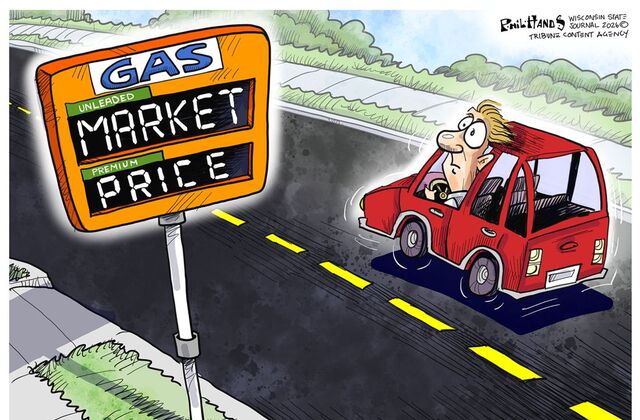
Friday morning, a barrel of Brent crude that serves as an international benchmark, was trading slightly above $110, after two Chinese ships were blocked from passing through the Iran-controlled Strait of Hormuz. Meanwhile, average national gas prices are running about $4 a gallon.
President Donald Trump has said Iran is negotiating with the U.S. and has paused a threat to hit Iranian energy sites until April 6. The two sides appear far apart, but there continue to be reports that they are talking.
The Best Cartoons on the Economy