
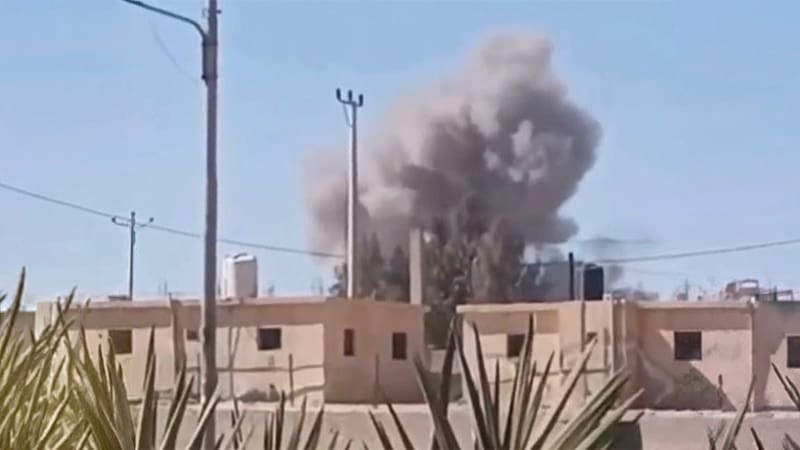
Eid al-Fitr should be a time of joy, but for Jordanians, and for so many others across the region, this year it was accompanied by air raid sirens, missiles, and drone strikes. For the Hashemite Kingdom, the Iran war is the latest in a long string of security threats and challenges. Jordan’s reaction to the conflict therefore needs to be seen within a broader temporal and geographic context, as the kingdom confronts challenges from adversaries and allies alike.
Since the 2011 Arab uprisings, the Jordanian state’s security concerns escalated with the civil war in Syria, the insurgency in Iraq, and the rise of the so-called Islamic State (IS). Israel’s 2023-25 war in Gaza only made matters worse. Now, in 2026, yet another war is underway, as missiles crisscross Jordanian airspace in salvoes between Israel and Iran, while Iran sends drones to hit targets in Jordan.
Once again, Jordan has found itself wedged between belligerents in a war not of its own making. And once again, the kingdom has attempted to defend itself while avoiding getting dragged into war and trying not to alienate key allies or trigger domestic opposition.
Jordanian Tensions with Iran
For decades, Jordanian policymakers have largely seen Iran as a malign influence in regional affairs. Even so, they were not looking for yet another war in the region. As is so often the case, the current conflict puts Jordan in an awkward position. The Hashemite regime is a fan of neither the Islamic Republic nor its regional allies such as Hamas, Hezbollah, or the Houthis. Amman had nevertheless hoped that diplomacy would prevail, especially as many Jordanians see this confrontation as a war by, and for, Israel.
The Hashemite regime has consistently regarded Iran’s Axis of Resistance as a significant external security threat. This threat was heightened during the 2011-2024 Syrian civil war, as Iran’s Islamic Revolutionary Guard Corps (IRGC) forces at times deployed in Syria close to the Jordanian border. The Jordanian regime worried about multiple threats—al-Qaeda, IS, Iran, Hezbollah, the IRGC, and cross-border smuggling (especially of Captagon pills). The December 2024 collapse of the Assad regime in Syria and the damage inflicted on Hamas, Hezbollah, and Iran by Israeli attacks during the Gaza war meant that Jordan’s security concerns persisted but shifted in focus and degree. The Hashemite regime welcomed the weakening of the Axis of Resistance, to be sure, but it opposed Israel’s war in Gaza and Israel’s expansion of that war to Lebanon, Qatar, Syria, and Yemen.
Amman had hoped that diplomacy would prevail, especially as many Jordanians see this confrontation as a war by, and for, Israel.
In June 2025, the war expanded further as Israel and Iran launched barrages of missiles and drones against each other. Many of these crossed Jordanian airspace as the so-called 12 Day War expanded. With US assistance, Jordanian forces shot down Iranian missiles crossing over Jordan, leading to widespread domestic anger and charges that Jordan was, in effect, helping to protect a State of Israel that was at that same moment killing large numbers of Palestinian civilians. The Jordanian government insisted the operation was about Jordanian, not Israeli, security, but domestic tensions remained. The incident also highlighted the kingdom’s relative weakness; showed that its airspace could be violated with relative impunity; and demonstrated that it needed the help of a controversial ally, the United States, to deal with the issue at all.
The 2023-2025 Gaza war, and the 2025 intercepts of Iranian missiles bound for Israel, triggered large-scale protests in the kingdom—the largest since the 2011 Arab uprisings. These diverse protest movements called for abrogating the kingdom’s peace treaty with Israel and ending the alliance with Washington, including the stationing of US and other Western forces in the country. US President Donald Trump and Israeli Prime Minister Benjamin Netanyahu made an already delicate situation worse when they launched their surprise attack on Iran on February 28, 2026.
This time, far more missiles and drones were fired across Jordan, with some hitting the kingdom itself. Twenty-eight Jordanians were injured by falling debris as drones and missiles were intercepted. Iran also attacked US forces at Jordan’s Muwaffaq Salti air base. The United States even scrambled to replace a high-tech radar system in the kingdom that was apparently destroyed by Iranian fire.
The US-Israeli attacks on Iran, and Iran’s widespread counterattacks, including against Jordan, have reignited domestic debates and protests in the kingdom–but this time in an explicit wartime setting, with restrictions on voicing dissent. Technically, Jordan has remained neutral in this war and is not an active participant. But working alongside allied forces based in the kingdom, jets from the Royal Jordanian Air Force have engaged and destroyed incoming drones. Jordan has emphatically condemned the Iranian attacks against the Hashemite kingdom as well as against its Gulf Arab allies.
In response, Iran has condemned Jordan and even filed a protest at the United Nations, accusing the kingdom of “facilitating hostile acts against Iranian territory” as Iran issued further threats. As Iranian strikes had already hit Jordan, the idea of increased attacks had to be taken very seriously indeed. Jordan, for its part, maintained its stance that it is neutral and not a belligerent in this war. And yet all of this began with a surprise attack on Iran by Jordan’s alleged “peace partner” in a frigidly cold peace (Israel) and its largest ally and source of economic and military aid (United States), putting the kingdom in a deeply insecure position.
Problems With Allies and “Peace Partners”
During the first Trump administration, among Jordanian officials and the broader public there was a widespread sense that the kingdom had lost influence with the United States, despite the fact that Jordan had not actually done anything to trigger any rift. Rather, the problem lay squarely with the United States. To be clear, US aid to the deeply aid-dependent Jordan had not actually declined. Many US policy professionals, both military and civilian, still regarded Jordan as an essential regional ally, and a strong supporter of the United States. The question was whether any of the political appointees in the first Trump White House shared these positive views.
In addition, Israel under Netanyahu had always treated Jordan with a certain amount of disdain, even as Israel regarded it as a vital “peace partner” in the region. But Netanyahu too seemed to doubt whether Jordan was particularly useful to Israel anymore. The cold peace between the two countries, in short, had grown steadily colder throughout the Gaza war. But with an Iran war added to the mix, some Jordanian policymakers seemed to regard both Israel and Iran as the main agents of chaos in the region. For some, Israeli bombings of Gaza and across the region as well as the continuing exploits of Iran and the Axis of Resistance represented two main sources of regional havoc, with jihadist groups such as IS and al-Qaeda adding a third. But a fourth line of challenges came from a less expected source—the return of Donald Trump to the White House.
For Jordan, the arrival of the second Trump administration to power brought a series of blows to the regime and society.
For Jordan, the arrival of the second Trump administration to power brought a series of blows to the regime and society, starting with the US withdrawal of funding from the United Nations Relief and Works Agency (UNRWA) and followed by the dismantling of the United States Agency for International Development (USAID). Arguably no country in the region relied more on UNRWA support for Palestinian refugees or on USAID development projects. Trump also ignored the US-Jordan Free Trade Agreement when he targeted Jordan (along with so many other countries), with high tariffs. Trump also continued the Biden administration’s policies of enabling Israeli attacks on Gaza, to the horror of all Jordanians.
In addition to the moral anguish of watching Palestinian suffering while being unable to stop it, the Gaza war also reignited the long feared al-watan al-badil idea—that Israel would try to make Jordan the “alternative homeland” for the Palestinian people. Trump, of course, found a way to turn these anxieties into full-bore panic, by openly calling for the expulsion of the entire Palestinian population from Gaza to Egypt and Jordan. This would of course amount to ethnic cleansing and cause profound demographic change in Jordan, which would be an unmitigated disaster for Palestinians and Jordanians alike. Thus, when Jordan suddenly returned to the Trump administration’s radar, it was only as a potential destination for an ethnic cleansing project. All this disruption occurred before the United States and Israel launched the 2026 war against Iran. The war has undermined security in Jordan, Lebanon, and the Gulf, but for Jordan it is also still connected to the kingdom’s fears over the future of Gaza and the occupied West Bank.
Weathering the Latest Storm
Jordan long ago established a pattern of reliance on powerful Western allies and, whenever possible, on wealthy Gulf Arab states. During the current Iran war, Jordan has activated its various defense and security agreements with its Arab allies among the Gulf Cooperation Council (GCC) countries in the face of Iranian missile and drone strikes. But at least some Jordanians were now also questioning whether the United States was the kingdom’s major source of insecurity, not security. The presence of US and other Western military forces and bases in Jordan had always been seen by the regime as vital to national and regime security. But now Jordan, like many of its Arab Gulf allies, was under attack precisely because it hosted those bases. On the one hand, US forces and missile defense systems were helping to protect Jordan. On the other hand, their very presence also made Jordan an Iranian target. Jordanian officials have made clear, in both the current war and previous crises, that Jordan cannot become the battlefield between Israel and Iran.
Some Jordanians have urged the kingdom to diversify its list of allies by drawing closer to other middle and global powers such as European states, Russia, or China. Others see no alternative to the US alliance and instead urge that all efforts should be focused on placating the mercurial American president and on reestablishing Jordan’s identity as an indispensable source of pro-US moderation in the region, precisely because the region is again at war. After all, Jordan has weathered such crises before, including its marginalization by the United States and Gulf Arab monarchies after the kingdom chose to remain neutral in the 1991 Gulf War against Iraq. But earlier episodes did not include missiles flying across and into Jordan. Meanwhile, the kingdom remains wedged between crises to its west and east.
Jordanians in general tend to be deeply sympathetic to the suffering of the Iranian people, even as most oppose the Iranian regime. But they also sympathize profoundly with the Palestinian people in the face of Israeli attacks, and citizens and government officials alike fear that this latest war is not just about targeting Iran, but also about realizing Israeli ambitions in the region more broadly. At the levels of state and society in Jordan, the war with Iran is a disaster that threatens to get even worse. The kingdom remains caught between fears of potentially radical Israeli actions against Palestinians in Gaza and the occupied West Bank, on the one hand, and Iran’s widespread attacks across the region, on the other. This includes fears that Jordan will become a more frequent and direct target of Iranian attacks.
Jordan has made clear its support for its Gulf allies in the face of Iranian aggression, but like most of those allies it simply wants the war to end. Most urgently, all Jordanians want to see a halt to the barrages of Israeli and Iranian drones and missiles soaring across and into Jordan, in a war ignited by the kingdom’s own supposed “peace partner” in league with the kingdom’s largest ally.
The views expressed in this publication are the author’s own and do not necessarily reflect the position of Arab Center Washington DC, its staff, or its Board of Directors.
Featured image credit: Screencap/X