
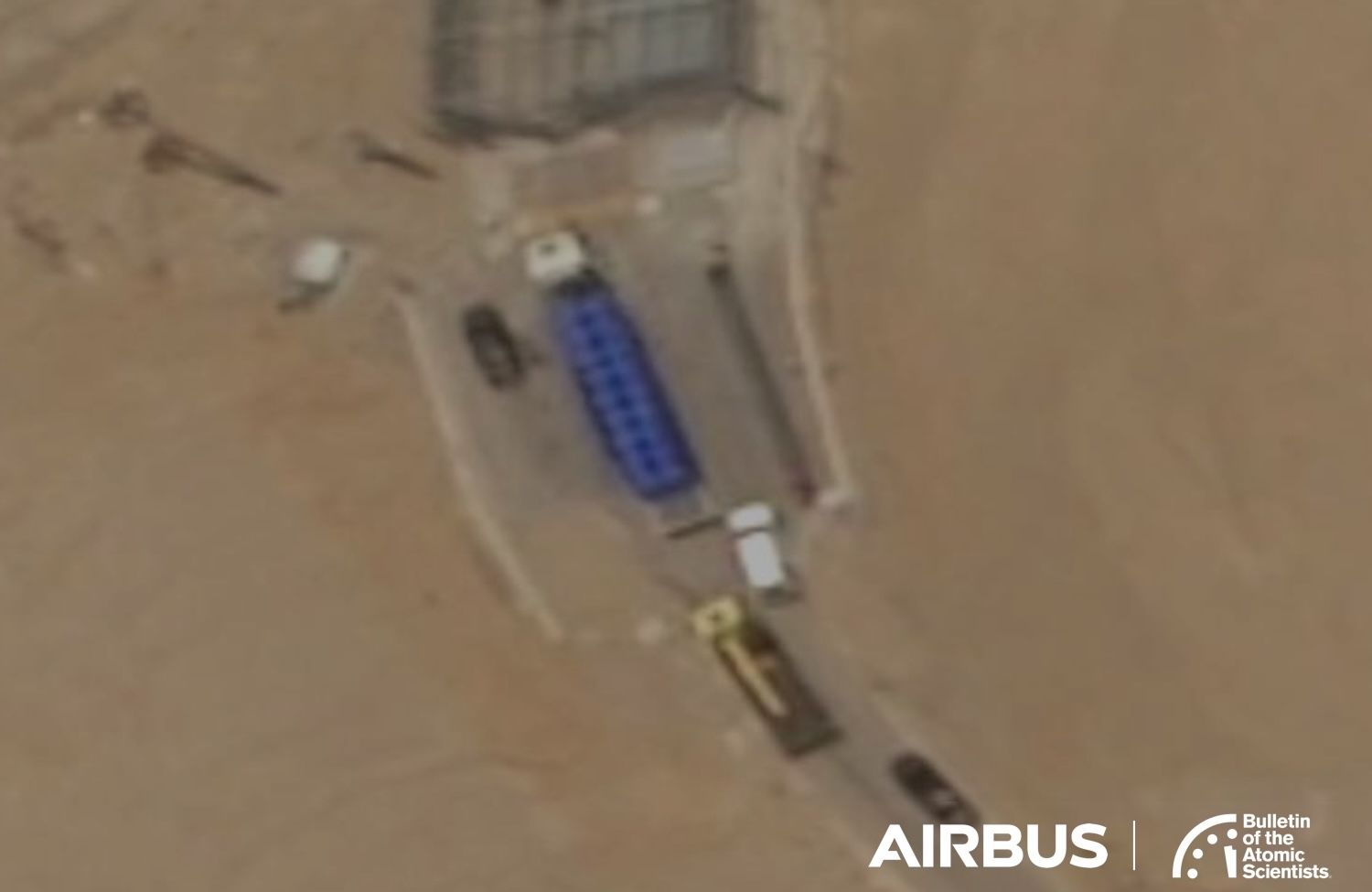
Working with a team of visual investigators that included the Bulletin, the French newspaper Le Monde has analyzed a previously unreported satellite image of the Iranian nuclear site at Isfahan, showing a large truck loaded with containers. In a Le Monde article published Saturday, experts said they could not be certain what the containers held. But the timing of the image, the type of load, and other indirect evidence suggest that Iran may have placed a significant quantity of highly enriched uranium—possibly all of its inventory—at the facility ahead of the June 2025 strikes by Israel and the United States against Iranian nuclear sites.
The International Atomic Energy Agency (IAEA) has mentioned the possible presence of highly enriched uranium at the Isfahan nuclear complex several times—a presence implicitly acknowledged by Iran’s own recent declarations. The IAEA has made multiple requests but was unable to access the underground tunnel complex at Isfahan, which was spared during Israeli and American military strikes in June. The satellite image could be the first publicly available evidence of the presence of highly enriched uranium at Isfahan.
According to Le Monde investigators, who have reviewed many satellite images of the entrance to Isfahan and other Iranian nuclear sites, it is the first time they have seen this type of convoy at the facility. Le Monde informed the Bulletin about the image on March 19. What follows is a detailed visual and technical analysis supporting my assessment that the cargo may have been highly enriched uranium.
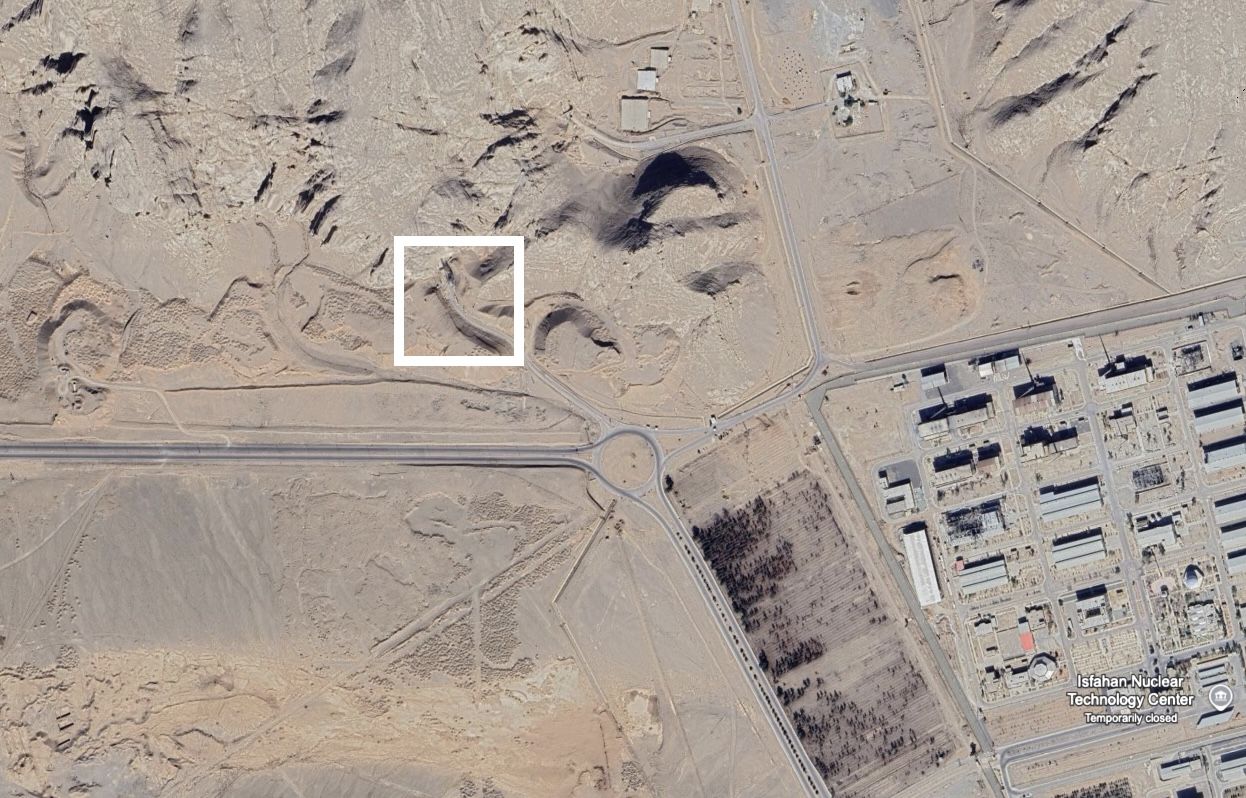 South tunnel entrance of the Isfahan underground complex near the Isfahan Nuclear Technology Center, Iran. (Bulletin / Google Earth)
The context. In June 2022, Iran turned off IAEA surveillance cameras at key nuclear sites in Iran, including monitoring devices at Natanz and Fordow. The shutdown was a direct retaliation for a resolution passed by the IAEA board of governors that criticized Iran for not explaining the presence of uranium traces at three sites it had not declared to be part of its nuclear program. Then, in February 2023, Bloomberg reported that IAEA monitors at Fordow had detected traces of uranium enriched to 84 percent of uranium 235, a fissile isotope that can be used in nuclear weapons, just 6 percent shy of weapon-grade level.
The IAEA never confirmed the report, saying that it was talking with Iran about recent findings there. Iran denied it, and cameras were gradually restored to operation at Iranian nuclear facilities in May 2023.
The last confirmed physical visit by IAEA Director General Rafael Grossi to the Natanz Fuel Enrichment Plant (FEP) and Fordow Fuel Enrichment Plant (FFEP) occurred on November 15, 2024. Since then, the IAEA has relied on its own estimates, based on Iran’s declarations, intelligence from member states, and high-resolution commercial satellite imagery.
In its latest comprehensive assessment from May 2025, the IAEA said it had lost “continuity of knowledge” about Iran’s uranium stockpile when it turned off on-site cameras and that this knowledge gap was irreversible. In that same report, the IAEA estimated that, as of mid-May 2025, Iran had 408.6 kilograms of uranium hexafluoride (UF6), enriched up to 60 percent uranium 235 (called highly enriched uranium or HEU), 274.5 kilograms enriched up to 20 percent (called low-enriched uranium or LEU), 5,508.8 kilograms enriched up to 5 percent, and 2,221.4 kilograms up to 2 percent.
Then, in a confidential letter of June 12, the IAEA informed member states that Iran had significantly ramped up production of enriched uranium, estimating that Iran’s total stockpile now included 440.9 kilograms of up to 60-percent HEU, 184.1 kilograms up to 20 percent, 6,024.4 kilograms up to 5 percent, and 2,391.1 kilograms up to 2 percent. On the same day, the IAEA’s board declared Iran in breach of its non-proliferation obligations. Not only had Iran concealed information about activities at its nuclear facilities, the agency reported; Iran had also reportedly obtained highly confidential documents from the agency and member states for several years, allowing it to know the agency’s assessment of Iran’s nuclear program equipment.
The next day, Israel attacked Iran, targeting military leaders, nuclear scientists, and nuclear facilities. The attack reportedly caused significant damage to the Natanz nuclear facility, Iran’s main enrichment site.
On June 20, the former commander of Iran’s Revolutionary Guard, Mohsen Rezaei, said that the enriched nuclear material had been moved to secure locations. “We will not give up its position.” On June 22, the United States launched air strikes against Iran’s main nuclear sites at Natanz, Fordow, and Isfahan—10 days after Israel first attacked.
After the US strikes, Defense Secretary Pete Hegseth told reporters that no intelligence suggested Iran had moved any of its highly enriched uranium ahead of the US strikes: “I’m not aware of any intelligence that I’ve reviewed that says things were not where they were supposed to be, moved or otherwise.”
Nine months later, the IAEA says it still does not know the location of Iran’s highly enriched uranium.
Visual analysis. The satellite image obtained by the Bulletin corresponds to the south tunnel entrance at the Isfahan underground complex in Iran (located at the longitude and latitude coordinates 32.585522° N, 51.814933° E). The very high-resolution image was taken on June 9, 2025, from one of the two Airbus Pléiades Neo satellites—advanced optical satellites with the highest resolution capacity currently available in the private sector.[1]
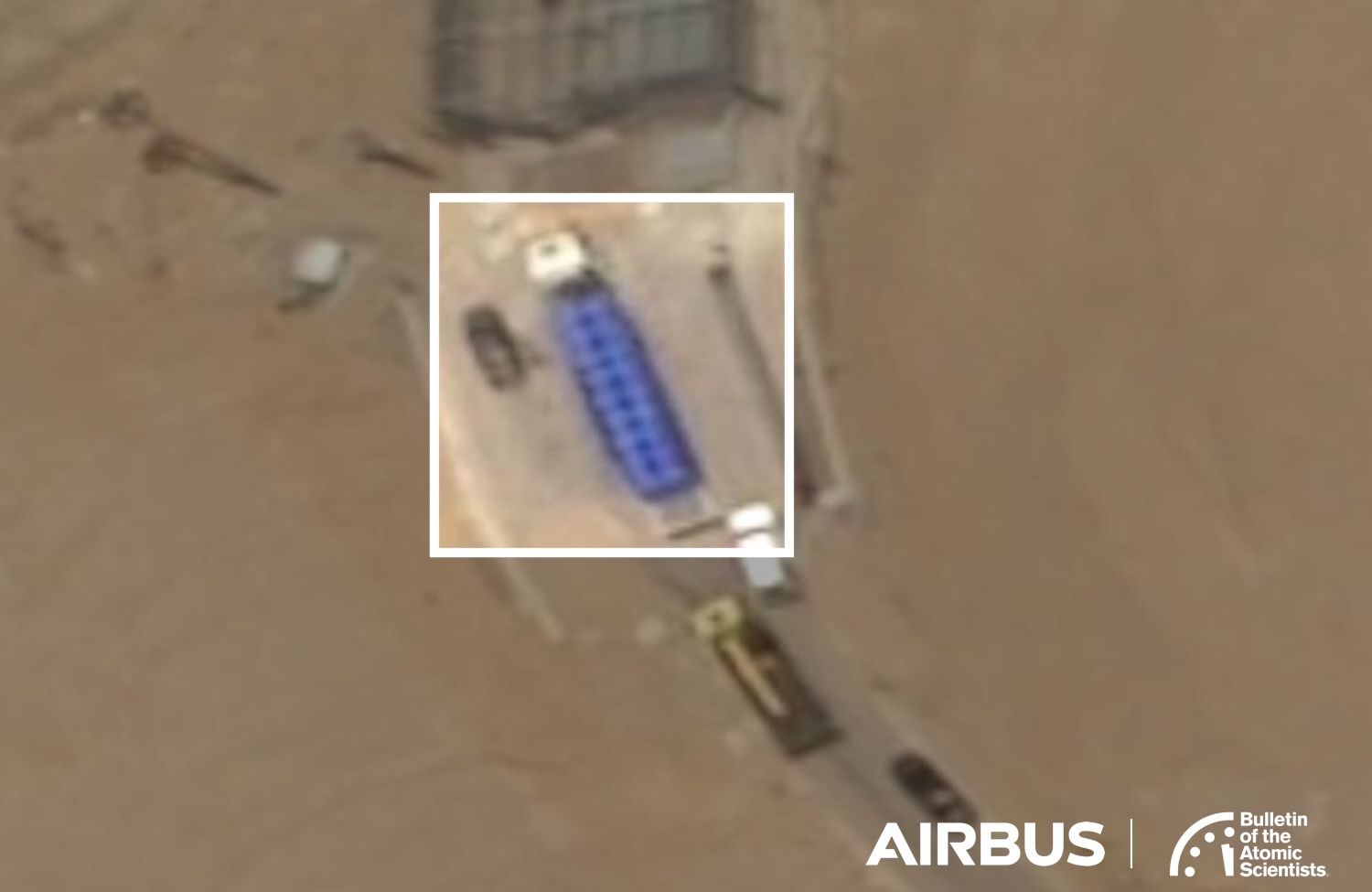 A very high-resolution satellite image shows a truck loaded with 18 containers likely transporting highly enriched uranium in front of the south tunnel entrance at the Isfahan underground complex in Iran (32.585522° N, 51.814933° E) on June 9, 2025. (Credit: Bulletin / Airbus Pleiades)
The image shows a flatbed or lowbed truck, probably with a platform about 13 meters long and 2.6 meters wide, with a white cabin and a load of 18 blue containers. The truck does not appear to be fully loaded, suggesting that the limiting factor may be the weight capacity of the truck, the number of containers available, or the quantity of material to be transported. The packages appear to be either cylindrical or possibly cubical, and to be around 120 centimeters in diameter or side, and at least as much in height.
A smaller truck is parked behind the flatbed truck and is apparently equipped with a yellow crane, suggesting that it is there to unload the containers. Three other small vehicles are nearby, with one white car seemingly maneuvering behind the truck.
There is no direct evidence that the flatbed truck in the image is arriving at the facility or preparing to leave. But several visual elements point to the probability that it is there to be unloaded. First, it faces the tunnel entrance. In that position, if the truck were to leave the facility for another location, it would have to drive backward for about 300 meters on a narrow and curved road up to the nearby roundabout. It seems highly unlikely that a truck driver would proceed with such a maneuver with a full load, rather than maneuvering first to arrive backward at the tunnel entrance to be loaded. Second, the crane truck is behind the flatbed truck, suggesting that it just arrived at the facility. Had it been loading the flatbed truck, it would most likely not have been placed behind the truck afterward, but instead, would have moved to the side to let the large truck leave first.
Also, in early June 2025, as the prospect of US air strikes against Iran’s nuclear facilities was growing, the Iranians would have had no interest in removing sensitive materials from a facility that allegedly was out of reach of the United States’ most powerful bunker-buster bombs.
Most likely hypothesis: highly enriched uranium
The visual analysis of the image alone cannot determine with certainty what was inside the 18 containers on the truck. Some satellite imagery experts preferred not to speculate on their contents, given the many possibilities. But several elements of indirect evidence, when considered together, point to the containers being filled with chemical products. In my assessment, the material seems most likely to have been highly enriched uranium (HEU) in the form of uranium hexafluoride (UF6),[2] and the quantity could be up to about 540 kilograms, more than previously reported by the IAEA and Iran.
Packages. The blue packages strongly resemble “overpack” containers used to transport radioactive materials. These containers—identified as Type B packages, as used for large amounts of radionuclides—are heavily shielded to withstand physical impact and high temperatures, as well as to protect against radioactivity, criticality risks, and dispersion during transport.
Of existing Type B containers specifically suitable for transport of enriched uranium, the VPVR/M transport packaging system best matches the visual signature of this image. This dual-purpose package, manufactured in the Czech Republic by ŠKODA JS a.s., is designed and licensed for the transport and storage of spent nuclear fuel from research reactors. This package has been widely used in the Russian Research Reactor Fuel Return (RRRFR), an initiative of the IAEA, the United States, and Russia, to transfer Russian-supplied highly enriched uranium research reactor fuel to Russia.
In 2004, the IAEA and the Czech government jointly procured 16 VPVR/M type, which are now owned and operated by UJV Řež, an engineering company offering services in the nuclear power industry. Iran could have acquired such packages via Russia, which could have reverse-engineered them while on Russian territory.
Each original VPVR/M package has a cask body size of 120 centimeters in width and 150 centimeters in height, or 150 centimeters in width and 215 centimeters in height when equipped with upper and lower shock absorbers. Its internal cylindrical cavity has an available volume of exactly 1 cubic meter.
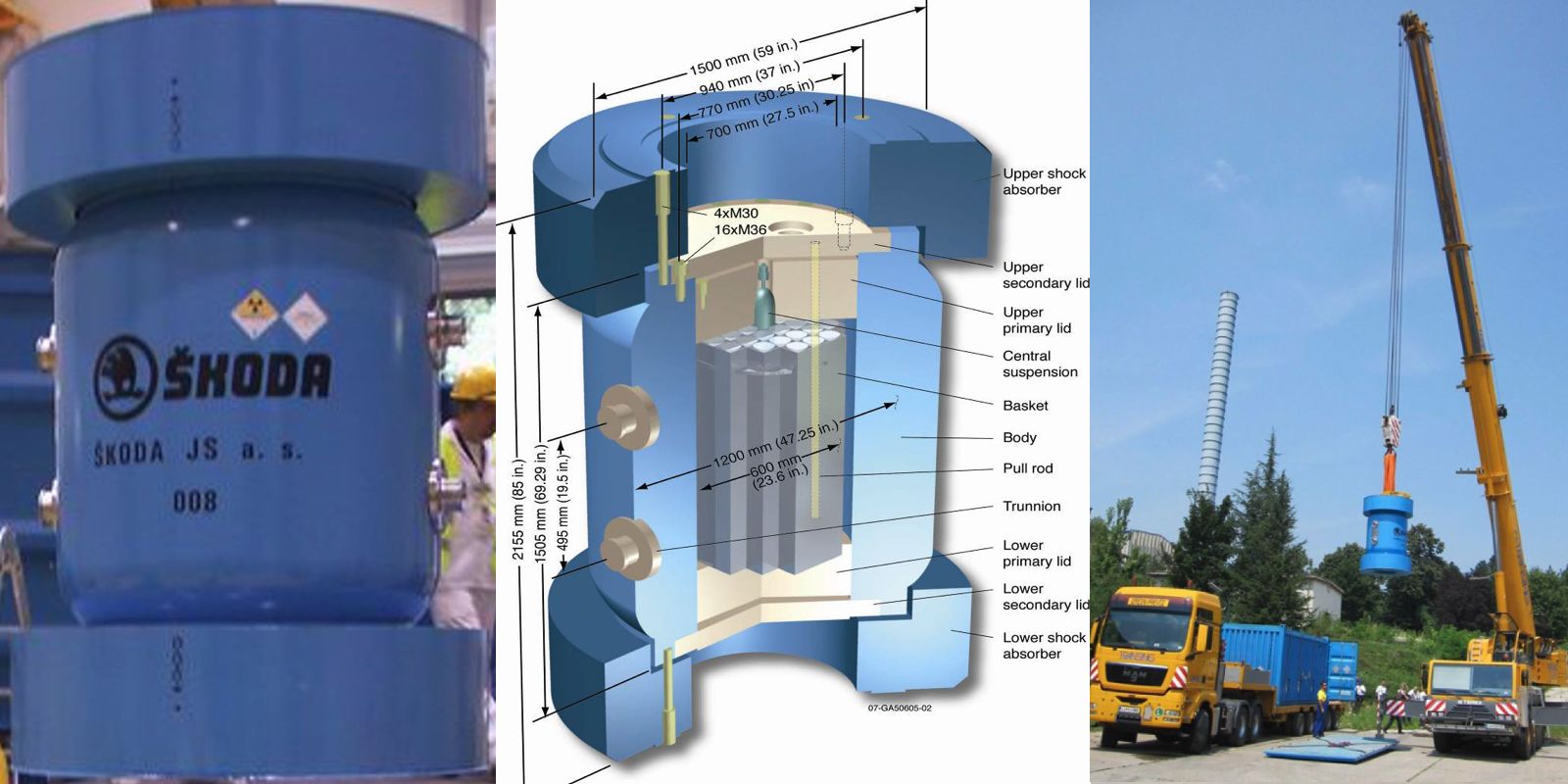 ŠKODA VPVR/M transport and storage cask, equipped with optional shock absorbers for transport. (Idaho National Laboratory)
Weight. The cask body is made of cast iron and weighs 10,700 kilograms when empty or 12,300 kilograms when shock absorbers are added. The package is operable by a truck crane. The total load for 18 of these packages would be 190 to 220 metric tons, depending on the cask configuration and without counting the payload. Several types of Chinese-manufactured multi-axle flatbed or lowbed heavy-duty trailers can carry 200 metric tons or more. The darker color on the sides of the truck in the image suggests it may be a multi-axle heavy-duty trailer. A similar package adapted for HEU, not spent nuclear fuel, could weigh significantly less.[3]
Product. Inside the cask, the cavity could receive cylinders filled with enriched uranium, possibly HEU, at anywhere between 20 percent and 60 percent of uranium 235. When UF6 is withdrawn from enrichment centrifuges, it is collected in desublimers, where it is first heated to around 60 to 70 degrees Celsius and then transferred either as a gas or liquid (depending on the design) to empty cylinders, where it solidifies when returning to ambient temperature. In this case, while the cask may be adequate for storage, the UF6 cylinders are not, meaning Iran would have to process them in a relatively short period of time.[4]
Volume. The VPVR/M cask is licensed to allow a maximum of 18 kilograms of fissile uranium 235. This corresponds to approximately 44 kilograms of UF6 enriched at up to 60 percent uranium 235 (30 kilograms of uranium mass), or 133 kilograms enriched at up to 20 percent (90 kilograms of uranium mass). To meet nuclear criticality safety, cylinders containing this quantity of UF6 enriched at up to 60 percent or 20 percent would need to have a minimum internal volume of 86 liters or 65 liters, respectively. Even a smaller transport cask with a smaller cavity could easily host these cylinders.[5]
Quantity. In total, a truck loaded with 18 VPVR/M transport packages filled with small canisters at the maximum allowed mass of uranium 235 in the form of UF6 could contain up to 534 kilograms of uranium enriched at up to 60 percent or 1,618 kilograms of uranium enriched at up to 20 percent. This is far more than the latest IAEA estimate before the June strikes of 184.1 kilograms of 20-percent uranium, but in the same order of magnitude as the 440.9 kilograms of 60-percent uranium reported by the IAEA. This calculation suggests that Iran could have transferred all of its stockpile of highly enriched uranium to Isfahan via the truck seen in the satellite image the Bulletin obtained.
Alternative hypotheses. There are several other hypotheses about the type of load on the truck shown in the satellite image. All are possible, but each appears less likely from a technical and strategic analysis.
Decoy with fake containers. The image could be a decoy intended to attract Western analysts of satellite images. But the timing of the image capture—three days before the Israeli strikes—strongly suggests that the operation was more a rush transfer than a planned disinformation campaign. Also, why would Iran want to attract attention to its allegedly most secure and therefore most valuable underground nuclear facility?[6]
Iran may have decided to use the truck at Isfahan in negotiations with the United States; once there, the uranium would be extremely difficult to seize. Iranians have used their enrichment program as a bargaining chip in the past, and could take a similar tack at Isfahan: “Look, we have highly enriched uranium already safely stored, and nobody can destroy it. And we could enrich it even further if we decided to.” But for such a strategy to work, the transfer would have to have been real, not a decoy.
Natural “yellow cake” or low-enriched uranium. The packages could contain either “yellow cake” in solid form or low-enriched uranium enriched up to 5 percent as gas. But in these cases, this material would not necessitate large shielding overpacks, as the image suggests. Moreover, in that case, the flatbed truck would have been likely fully loaded and doing several transfers, as Iran has significant amounts of this material.
It is also unlikely that the material comes from the nearby Isfahan conversion plant, which processed uranium hexafluoride enriched below 5 percent.[7] Only 1.5 kilometers separate the Isfahan nuclear technology center from the tunnel entrance; it is difficult to imagine that Iran would have used such a large flatbed truck to transfer material such a short distance.
Medical or industrial radioactive sources. The packages also resemble Type B containers used to transport cobalt 60, a high-intensity gamma radiation source used for industrial sterilization, food irradiation, and cancer treatment. In these containers, cobalt is generally packaged in the form of pencils in a stainless-steel capsule placed in a cavity. The figure below shows two examples of transport containers for cobalt 60 sources, which match the visual signature on the satellite image. However, these packages are not certified to transport enriched uranium, which is a fissile material and therefore imposes criticality safety requirements on its package design.
It seems unlikely that the containers on the truck contained medical radioisotopes, given that there would have been no evident strategic interest for Iran to store such material at Isfahan in June. Moreover, Iran would likely not have enough of this material to fill a whole truckload. France, a major user and producer of industrial and medical isotopes, plans to have used less than one cubic meter of cobalt 60 sources by 2040.
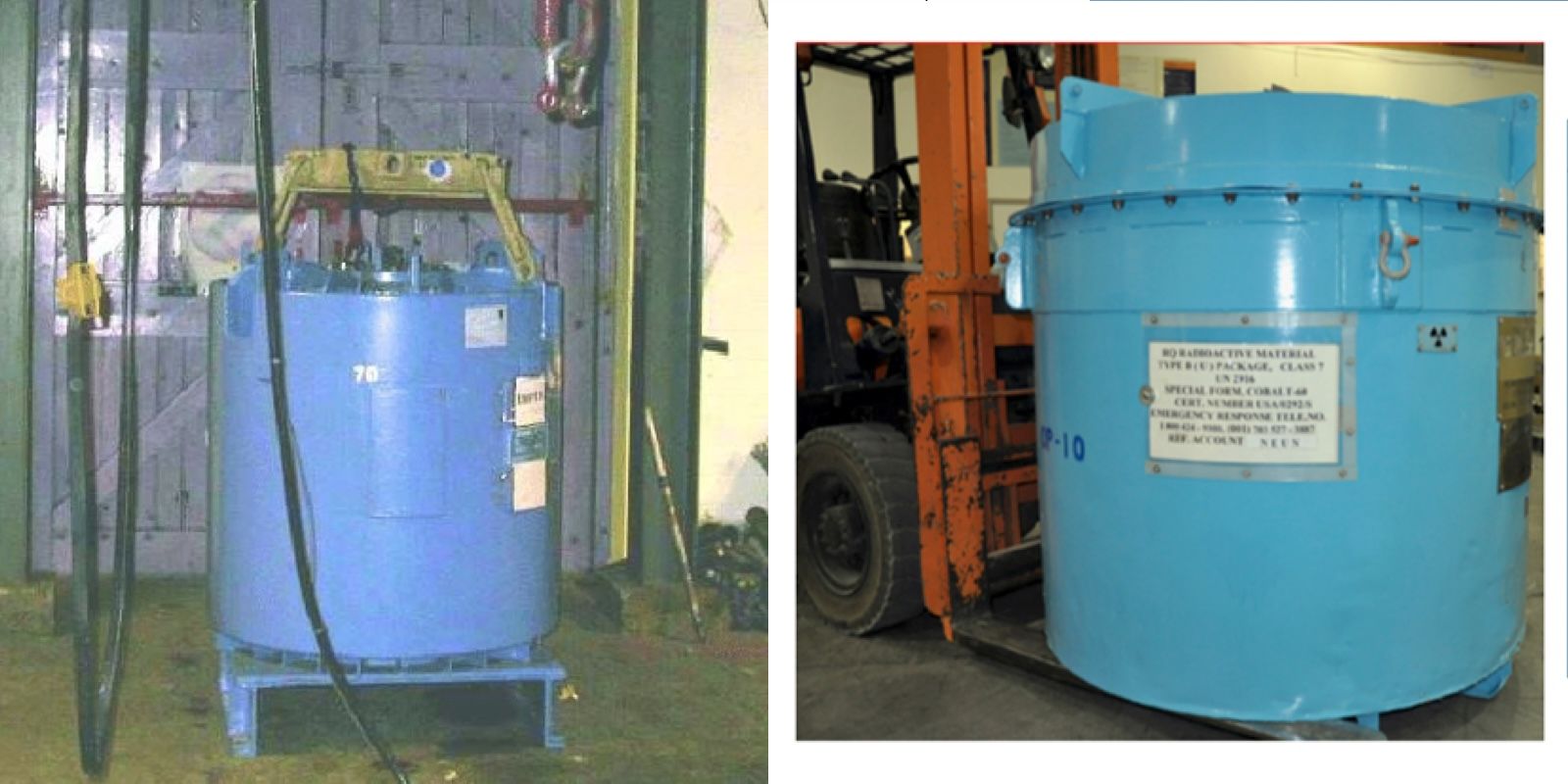 Type B(U) packages certified to transport cobalt 60 sources. (Meissner, Mehta, and Chmielewski 2008; FEMA, DOE/TEPP, 2010)
Conversion and purification chemicals. The packages could also be containers directly filled with gas or liquid commonly used with uranium. For instance, hydrogen fluoride (HF) or fluorine gas (F2) are both required in the conversion from uranium dioxide powder (UO2) or uranium concentrate (U3O8, or “yellowcake,” though it is not yellow but brown) into uranium hexafluoride (UF6) used to feed gas centrifuges for uranium enrichment. This hypothesis is compatible with an active enrichment program at Isfahan. However, HF and F2 gases are generally transported in a single large liquid gas tank container encased in a metal frame for handling, not in small containers as shown in the image.
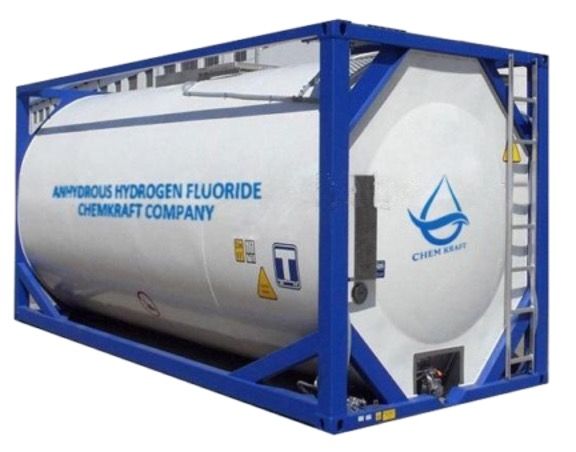 Hydrogen fluoride liquid gas tank container. (Chemkraft Chemicals Corporation, chemkraft.ir, Iran.)
The containers could also contain tributyl phosphate (TBP), a liquid used as a solvent for the purification of yellowcake or as an extractant for the separation of plutonium and uranium from spent nuclear fuel. However, because it is a highly toxic and flammable product, tributyl phosphate is generally transported in 200-kilogram iron drums that are smaller than the packages visible on the truck.
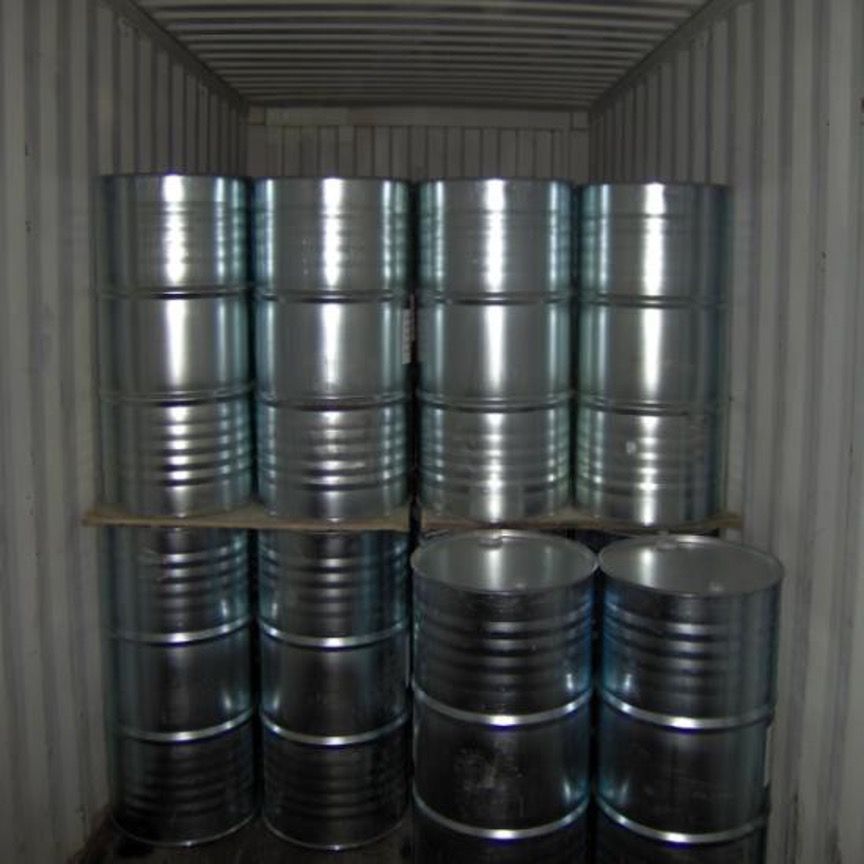 Tributyl phosphate transport drums. (Henan Foremost Chem Co.,Ltd., foremost-chem.com, China)
Construction material. The packages visible in the image show slight differences in shape, which could be the result of optical distortion or because the containers are not rigid. If the latter, the containers could be “big bags” filled with construction materials, such as sand or concrete. Iran has used such material to backfill tunnel entrances at its underground facilities, including at Fordow and Isfahan, to protect them from air strikes or delay a potential ground operation. But in these cases, Iran used dump trucks instead of small packages. Moreover, the packages in the image appear to be sealed at the top, whereas big bags are typically open with the material visible.
Why it matters. The visual and technical analysis suggests that Iran may have transferred a large portion—potentially all—of its stockpile of highly enriched uranium at 60 percent to Isfahan on June 9. If correct, this analysis would mean the enrichment vaults at Natanz and Fordow were probably empty before the June strikes, raising questions as to whether there is any enriched uranium “under the rubble” at facilities the Trump administration claimed it “obliterated” in June.
On February 6, the IAEA said it informed Iran that it had observed, through the analysis of commercially available satellite imagery, “regular vehicular activity” around the entrances to the tunnel complex at Isfahan. But on February 9, analysts reported that satellite imagery indicated all entrances to the Isfahan tunnel complex had been completely backfilled and buried with soil.
In June 2025, Iran informed the IAEA of the existence of a new enrichment facility located in the tunnel complex at Isfahan. The agency was supposed to visit the new facility when Israel started its strikes, but it still has not been able to. The agency estimates that Iran stores uranium hexafluoride enriched up to 20 percent and 60 percent uranium 235 at the Isfahan complex. It is unknown if part of that material could have been processed in the new enrichment facility.
Last week, the IAEA said it does not know the status of the new Isfahan enrichment facility—whether it contains nuclear material, its capacity, or whether it is operational. Iran has not provided the IAEA with access to this facility since it was first declared by Iran over eight months ago. “It is underground, but we haven’t visited it yet,” Grossi said. The enrichment facility at Isfahan could be only an “empty hall,” or it could include concrete pads, awaiting only centrifuges and material. But the facility could also already be operational, with personnel accessing it via shafts that are impossible to detect from commercial satellite imagery.
A simple cascade of about 200 Iranian IR-6 centrifuges would be enough to enrich 50 kilograms of uranium—enough for about a nuclear bomb—from 60-percent HEU to 90-percent weapon grade in about 10 days. The time would be even less if Iran were to already use its most advanced IR-9 centrifuges.
On March 9, the IAEA explicitly identified Isfahan as a primary storage site for Iran’s most sensitive nuclear material, with Grossi saying that the agency believes Iran had “a bit more than 200 kilograms, maybe a little bit more than that,” of uranium enriched to 60 percent purity stored in the site’s underground tunnel complex. Grossi added the rest of the material at Natanz and Fordow most probably is still there, probably destroyed in the June strikes.[8] The satellite imagery could be the first evidence of Iran transferring HEU from one of those facilities before the attacks.
Public statements from Iranian officials have indirectly confirmed the presence and value of the material at Isfahan. On March 15, Iranian Foreign Minister Abbas Araghchi said he had offered US negotiators in February to “down-blend” or dilute the enriched uranium in exchange for sanctions relief, effectively acknowledging that the material exists in a state and location that Iran can control. But on February 28, the United States cut short negotiations when President Trump ordered the strikes against Iran.
In recent weeks, there have been reports that the United States may be preparing a ground operation to neutralize the fissile material Iran possesses. Such a military operation would face enormous safety, tactical, and logistical challenges. However, the presence of Iran’s most sensitive material at a single location inside an undamaged facility would tremendously reduce the uncertainty in the planning of such an operation. Although there have been signs that the Trump administration may seek a way out of the war, the US military has continued to deploy US troops to the region.
Notes
[1] The image analyzed for this article had a resolution of 30 centimeters, meaning each pixel in the digital image corresponds to a 30 centimeter by 30 centimeter area on the ground. US military satellites are believed to have a resolution of 10 centimeters or better.
[2] A former member of the US administration and nuclear proliferation expert in Le Monde and David Albright, Sarah Burkhard, Spencer Faragasso, and others at the Institute for Science and International Security have made similar assessments. When contacted by Le Monde about this image, the IAEA declined to comment.
[3] Because highly enriched uranium in the form of UF6 is not significantly radioactive, the design of such a modified cask used by Iran would not necessarily require the same amount of shielding material and therefore could weigh significantly less.
[4] While UF6 is stable under controlled dry conditions, it becomes chemically unstable in the presence of moisture, reacting with water vapor in the air to form toxic and highly corrosive hydrogen fluoride (HF) gas and solid uranyl fluoride (UO2F2) aerosol particles. Although UF6 is commonly shipped from producers to enrichment facilities, its significant chemical instability does not make it the preferred choice for transport and storage because it requires specialized, heavily protected packaging, careful handling, and continuous monitoring.
[5] As enrichment level increases, the critical mass of uranium (the minimum amount needed to sustain a nuclear chain reaction) decreases. For 20-percent enriched uranium, the critical mass is roughly 400 kilograms, but it drops to roughly 42 kilograms for 60-percent enriched uranium. The allowed quantity of uranium inside the cask, therefore, remains subcritical.
However, filled UF6 cylinders must also meet nuclear criticality safety. Enriched UF6 gas typically contains impurities that are in the form of hydrofluoric acid gas (HF). HF can also be formed by the reaction of UF6 and moisture or residues inside the cylinder. To control for the generation of HF gas, a maximum hydrogen-to-uranium (H/U) ratio is used to fill cylinders, which roughly corresponds to the filling ratio. For highly enriched uranium, the H/U ratio must be below 0.1 for up to 60 percent enrichment and below 0.4 for up to 20 percent enrichment.
Solid UF6 has a typical density of approximately 5.1 grams per cubic centimeter, or 5.1 kilograms per liter. Cylinders containing 44 kilograms of UF6 enriched at up to 60 percent or 133 kilograms enriched at up to 20 percent should, therefore, have a minimum internal volume of 86 liters or 65 liters, respectively. In both cases, such cylinders would fit easily in the cavity of the cask, which has a volume of 1 cubic meter or 1,000 liters, or that of a smaller cask.
[6] A former senior Israeli intelligence official who worked on Iran for many years has made a similar assessment in Le Monde that a decoy is unlikely.
[7] This material was intended to be converted into uranium dioxide powder and then manufactured into fuel pellets at the reactor fuel manufacturing plant for the nearby Khondab (formerly Arak) heavy-water research reactor.
[8] Since the June attacks, Iran has not informed the IAEA of the status or movements of its HEU.