
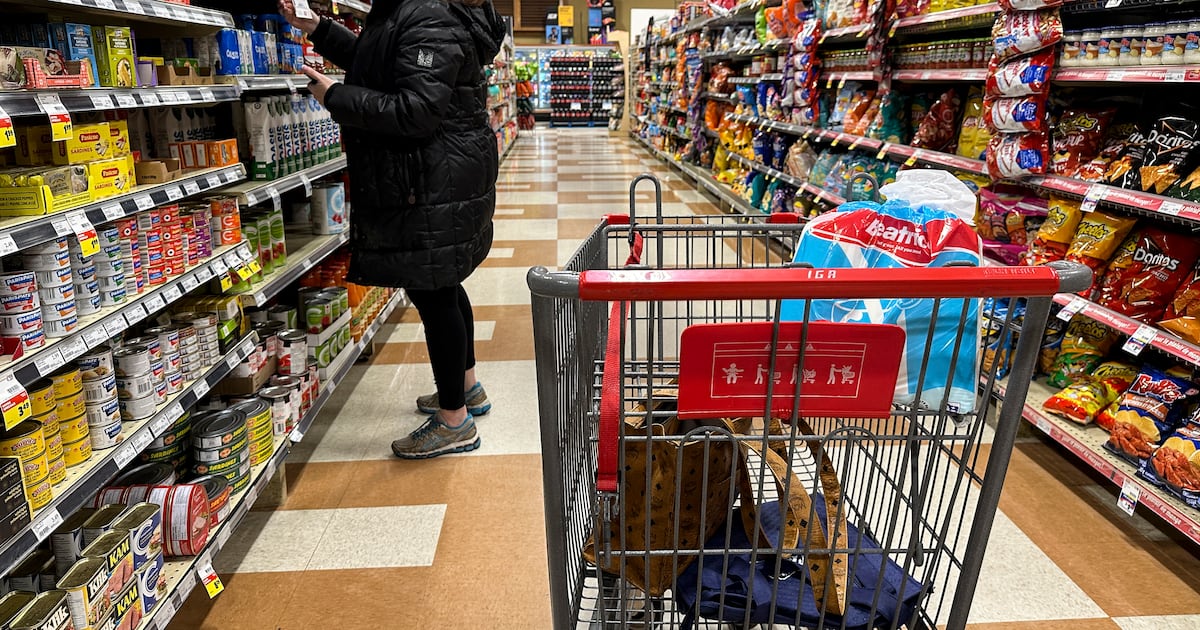
On Thursday, Toronto city council voted to move forward with a concept rarely seen in Canada, and meant to tackle skyrocketing food prices: not-for-profit, city-run grocery stores.
But critics believe Toronto is biting off more than it can chew by stepping into the business, against grocery store giants, with little experience and minimal supply-chain connections, in an industry that has razor-thin profit margins.
“Every dollar you put through into the till, there’s about four cents that’s coming back as profit for each one of the major retailers that’s out there,” said Neil Hetherington, CEO of Toronto’s largest food bank, the Daily Bread Food Bank, in an interview with CTV News Sunday. “That is a very slim margin, you are dependent on scale.”
He said the question now is whether the city can compete with established grocers.
“Can they match the purchasing power and efficiency of the for-profit sector and then deliver it without that profit motive to deliver food at a lower cost?” he added. “It it works out that they can deliver at lower cost, then yeah you would go for it, but obviously there’s some skepticism about that.”
Some of that skepticism also comes from Sylvain Charlebois, a researcher of food distribution and policy at Dalhousie University in Halifax, N.S.
“When you walk into a grocery store, typically when you grab a product — 70 per cent of that price represents the cost to produce the good in the first place. On top of that, you will have to pay for labour which is 15 per cent and then overhead costs which is five to ten per cent,” said Charlebois. “So the margins are really low and the government will have to consider that.”
Charlebois added that major grocers also have fostered relationships to create reliable supply chains that allow them to get some products in bulk at discounted rates — which Toronto won’t have the benefit of when it starts out with its own municipally operated grocery chain.
“The key to a successful grocery chain is to start slow, whether it’s a for profit organization or a not for profit organization,” said Charlebois. “You start slow with one store and you build your supply chain and your relationships up the food chain, accordingly to offer the best deals possible for your customers.”
Other Canadian cities watching closely
The idea is not new but has been gaining momentum since New York’s newly elected mayor, Zohran Mamdani, made a push for city-run grocery stores in his city — and the new leader of the federal New Democrats, Avi Lewis, has a platform that also includes a promise of a “public option for groceries.”
Toronto’s pilot project includes opening four not-for-profit, city-run grocery stores in downtown Toronto, North York, Scarborough and Etobicoke — where they would serve so-called “food deserts,” low-income neighbourhoods where grocery stores are also sparse.
An Ottawa city councillor says her staff have been asked to look into city-run grocery stores as one option among many to tackle the issue of food insecurity.
“The work that we’re doing is not on a specific solution, but rather a study to look at the different options that are available,” said councillor Marty Carr. “But certainly having Toronto come out early and establishing those four stores will give us an opportunity to look at — and see if that’s something feasible and if it works.”
While in Vancouver, councillor Pete Fry says they had a similar proposal presented to council “a couple of weeks ago” but it was dismissed by the current mayor.
Fry says now his focus is to support independent and co-op grocery stores that already exist.
“The real opportunity here in the City of Vancouver would be for us to support those existing supply chains, support those existing non-for-profit retailers and allow them to do what they already know how to do, rather than just step in and try and take over. And something that we have absolutely no expertise in,” said Fry.
“Grocery is a tough business, and it requires specialized expertise in logistics, supply chains, and retail operations that cities don’t have,” added Vancouver city councillor Sarah Kirby-Yung. “Our role at the municipal level is best focused on creating the conditions for businesses to succeed and for residents to have access to affordable options.”
The Toronto city councillor who put the motion forward, Anthony Perruzza, says the city would waive property taxes and development charges for the stores — and pass the savings down the customers.
The Toronto city councillor who put the motion forward, Anthony Perruzza, says the city would waive property taxes and development charges for the stores — and pass the savings on to customers.
The project is far from being complete — with city staff taking roughly a year to return to city council with a plan — and the financial impact report noting there is currently no money in the city’s current budget allocated to the city-run grocery stores.