
Israel Cannot Win the Narrative War, No Matter What It Does
There is a pattern so obvious that it should no longer be ignored, yet it continues to define how Israel is judged. Whatever choice Israel makes, it is condemned. Not sometimes. Not occasionally. Always.
A month into direct conflict with Iran, Israel remains on high alert. This is not a theoretical threat. Iran has openly declared for years that its goal is the destruction of Israel. Not negotiation. Not coexistence. Elimination. And unlike Israel’s targeted strikes on military infrastructure, Iran’s response does not distinguish between soldier and civilian. Its use of indiscriminate weapons makes one thing clear: everyone is a target.
Men, women, the elderly, babies. Jews, Muslims, Christians, Druze, Arabs, so called Palestinians. Iran does not differentiate. The objective is terror, pure and simple.
Faced with that reality, Israel does something that should be uncontroversial. It protects its citizens. All of them. That includes restricting gatherings during wartime. Limiting crowds to reduce the risk of mass casualties is not oppression. It is basic responsibility.
Yet when Israel imposed limits on gatherings, including during Ramadan, the reaction was immediate outrage. Holy sites were closed. Not just Al Aqsa for Muslims, but also the Church of the Holy Sepulchre for Christians and the Western Wall and Mount of Olives for Jews. This was not selective. It was universal.
But that is not how it was presented.
Riots broke out. Social media filled with accusations of “Zionist oppression.” The narrative was carefully trimmed. Only Muslims were said to be restricted. The full picture, that everyone was restricted for safety reasons, was conveniently ignored.
And then reality intervened.
A rocket struck just meters away from the Old City that same day. Imagine the alternative scenario. Thousands gathered. One rocket lands. The death toll would have been catastrophic. And what would the world say then? That Israel failed to protect worshippers. That Israel allowed a massacre.
This is the trap. If Israel restricts access, it is accused of oppression. If it does not, it is blamed for the consequences of an attack.
The same pattern appears again and again.
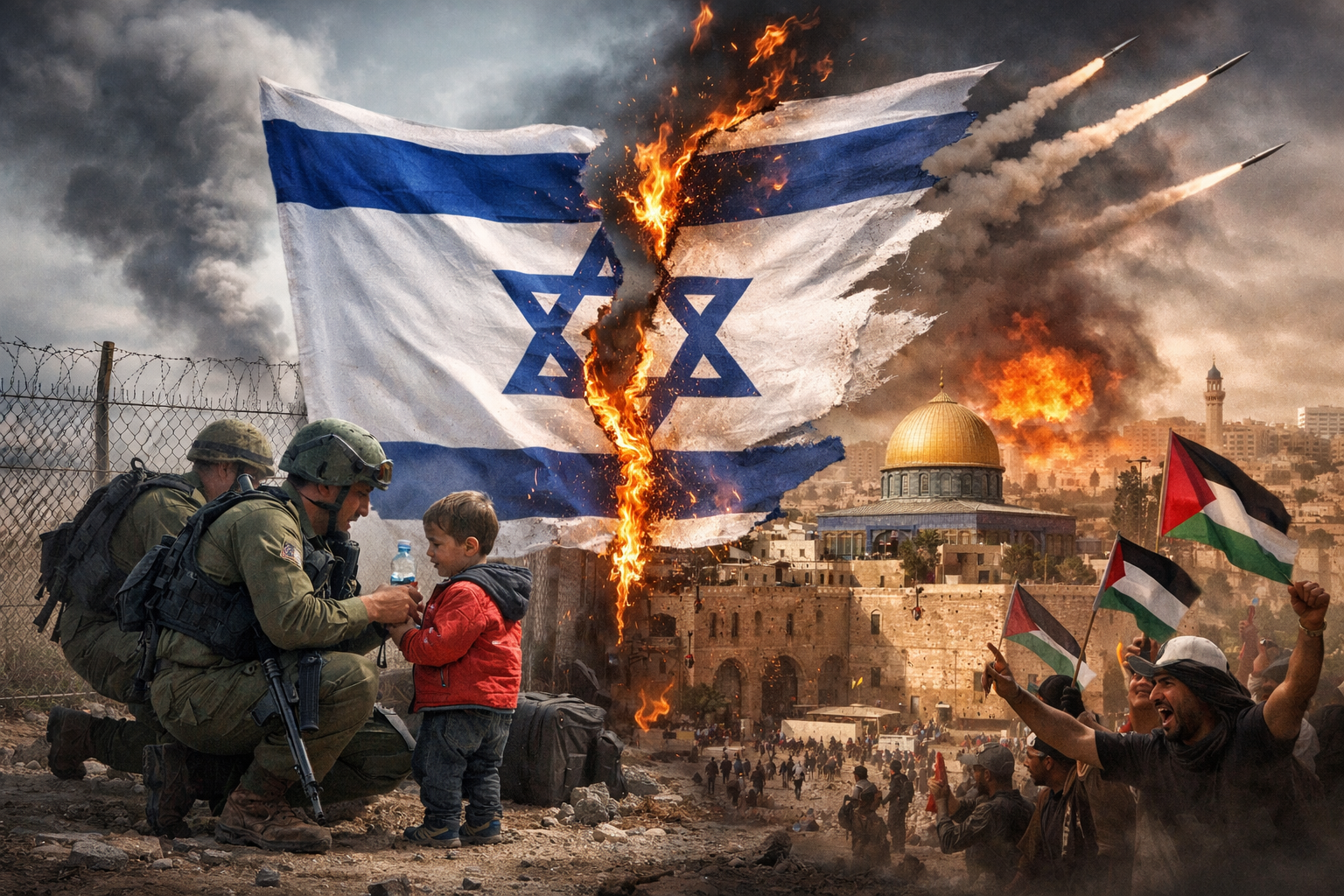
Take the case of the toddler who approached the Israeli border. A small child, alone, in a conflict zone. The implication is obvious. He was placed there deliberately, a pawn in a propaganda game designed to provoke a reaction.
Israeli soldiers did not shoot. They did not harm him. They did the opposite. They cared for him. They gave him food, water, and comfort. They handed him safely to the Red Cross. A video confirmed he was unharmed at that moment.
Yet the story that spread afterward claimed the child had been tortured. Cigarette burns were cited as evidence. Injuries that did not exist when he left Israeli custody suddenly became Israel’s fault.
Again, the facts do not matter. The narrative is predetermined.
This is not new. Golda Meir once said, “If Arabs loved their children as much as they hate Jews, there would be peace.” Harsh words, but moments like these force people to confront why such a statement still resonates.
Now, as Easter approaches, the same cycle repeats. Palm Sunday services in Jerusalem are restricted due to security concerns. Gatherings are limited where there are no adequate shelters. Clergy express outrage. Headlines accuse Israel of overreach.
But the question remains unanswered. What if there were no restrictions? What if hundreds gathered and a missile struck?
Would Iran hesitate because the victims were Christians? Of course not.
Israel operates in a reality where its enemies target civilians deliberately, while it is expected to prevent every possible tragedy without inconveniencing anyone. That is an impossible standard.
The uncomfortable truth is this: Israel is judged not by what it does, but by what people want it to represent. When it defends itself, it is aggressive. When it protects civilians, it is oppressive. When it shows restraint, it is weak. When it acts decisively, it is condemned.
There is no correct choice in the eyes of those determined to see Israel as wrong.
And until that changes, the real story will continue to be buried beneath outrage, half truths, and deliberate distortion.
Time To Stand Up for Israel
Time To Stand Up for Israel is an independent foundation dedicated to fighting misinformation, countering antisemitism, and providing clear, fact-based education about Israel. We do not engage in internal Israeli politics. We stand on two core principles: Israel has the right to exist. Israel has the duty to defend itself.
Support our work: Donate and/or subscribe at: www.timetostandupforisrael.com
CEO of Time to Stand Up for Israel, a nonprofit organization with a powerful mission: to support Israel and amplify its voice around the world. With over 200,000 followers across various social media platforms, our community is united by a shared love for Israel and a deep commitment to her future.
My journey as an advocate for Israel began early. When I was 11 years old, my father was deployed to the Middle East through his work with UNTSO. I had the unique experience of living in both Syria and Israel, and from a young age, I witnessed firsthand the contrast in cultures and realities. That experience shaped me profoundly.
Returning to the Netherlands, I quickly became aware of the growing wave of anti-Israel sentiment — and I knew I had to speak out. Ever since, I’ve been a fierce and unapologetic supporter of Israel. I’m not religious, but my belief is clear and unwavering: Israel has the right to exist, and Israel has the duty to defend herself.
My passion is rooted in truth, love, and justice. I’m a true Zionist at heart.
From my first breath to my last, I will stand up for Israel.