
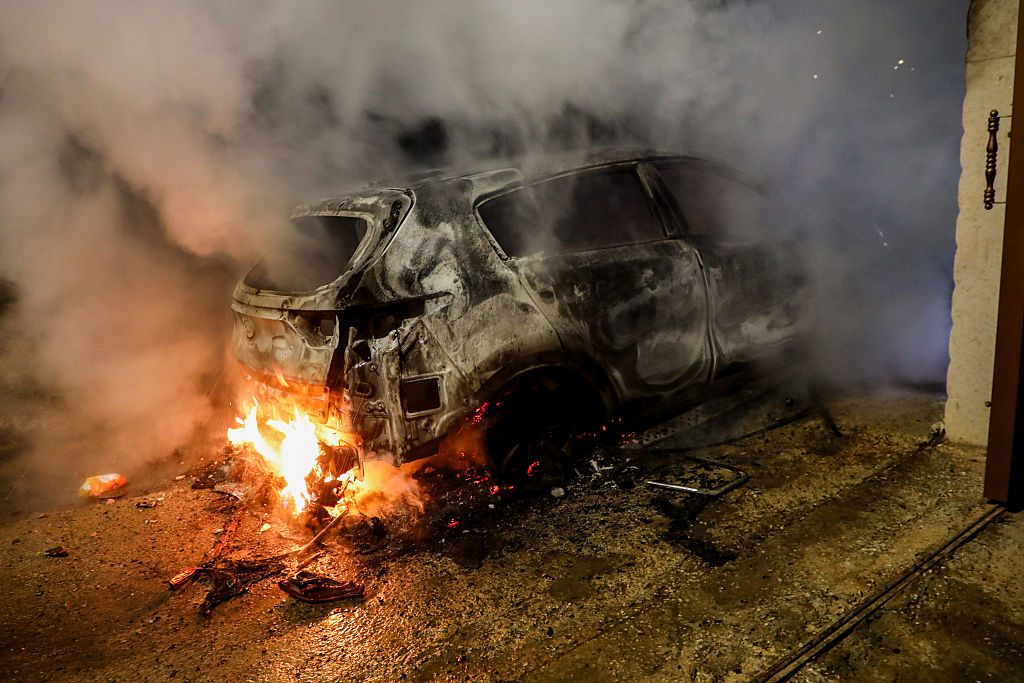
Some of the leading figures in Jewish philanthropy, as well as communal leaders and even right-wing Israeli commentators, are raising their voices in a rare chorus against the rise of violence by Israeli extremists against Palestinians in the West Bank, as the frequency and brazenness of the attacks prompted even those who once dismissed the issue as fringe and exaggerated to issue public condemnations and calls for action.
According to the IDF — technically the ultimate legal authority in the West Bank — the number of “severe attacks” by Israeli extremists, including shootings, arson and other acts of serious violence (as opposed to lesser crimes like stone throwing), has been increasing since the Oct. 7 terror attacks. There were 54 such cases documented in 2023, 83 in 2024, and 128 in 2025. The first three months of 2026 have also seen an overall increase in “events of Jewish nationalist violence,” which have so far left six Palestinians dead and dozens injured, according to IDF data. In January, 60 such incidents were recorded, followed by 71 in February and 100 so far in March.
Likely by design, this comes as Israel and the broader Jewish world are focusing their attention and resources elsewhere. Israel is currently fighting a war on two fronts — an air campaign against Iran and ground-and-air operations against the Hezbollah terror group in Lebanon — and is defending its military actions in the international arena. Jews abroad are both grappling with rising antisemitism, much of which is at least nominally connected to Israel and Zionism, and also rallying diplomatic and public support for Israel.
More than 3,000 Diaspora Jewish figures —donors, rabbis and organizational leaders, among others — have so far signed onto a letter to Israeli President Isaac Herzog calling on him to push the government to crack down on the violence.
“Israel’s security forces are clearly better able to protect Palestinian civilians in the West Bank, living under different levels of Israeli military and civil control, from Jewish terror. That they do not act decisively suggests a lack of directives from the government,” the TLI letter reads. “Mr. President, Pesach is upon us. As we have for millennia, Jews everywhere will reflect on the promise of freedom and responsibilities of power. We call on you to use your position to implore the government to put an end to the abomination of Jewish-extremist terror and the era of impunity for its perpetrators.”
The public letter was drafted by The London Initiative, a growing international network of liberal Zionists that launched last year. Signatories include philanthropic figures like Charles Bronfman, Angelica Berrie, Susie Gelman, Sally Gottesman, Marcia Riklis, Lisa Greer, Alan Solow, Michael Sonnenfeldt, Jeff Solomon, Jonathan Lopatin, Sandra Bernstein and Sarai Brachman Shoup, as well as heads of Jewish communal organizations, such as Union for Reform Judaism’s Rabbi Rick Jacobs and the United Synagogue of Conservative Judaism’s Rabbi Jacob Blumenthal, among many others. (Disclosure: this reporter is a member of TLI, but is not a signatory of the letter due to standing policies against joining political declarations of any kind.)
Herzog responded to the letter today, writing to the signatories that he shared their “conviction that these acts of violence stand in stark contradiction to the values upon which Israel was founded and to the enduring ethical tradition of the Jewish people. Our heritage emphasizes the sanctity of human life, and grounds it in a basic biblical tenet: ‘You shall love the stranger’ — a foundational moral principle that has defined the Jewish people across generations.”
Herzog added that in recent weeks he has “spoken with government security and law enforcement representatives and have demanded that they employ all available means to bring those responsible to justice and to put an immediate end to this unacceptable phenomenon. A nation governed by the rule of law cannot tolerate violence and vigilantism, this is not only a shameful crime against innocents, it also interferes with the unceasing efforts of military and security agents to contend with clear and present Palestinian terror threats in the region.”
If nothing else, all of these efforts are hampered by Israeli extremist violence against Palestinian civilians. The Israeli military has already diverted several hundred troops from Lebanon to the West Bank to address the issue. On the international stage, these attacks are being used to undermine Israel’s standing as a law-enforcing democratic society. For many of Israel’s supporters abroad, at a time when the country is facing growing challenges on the world stage, these attacks give ammunition to the Jewish state’s detractors.
A growing number of right-wing Israeli figures are also condemning the violence, including some voices from within the settlement community, who see these attacks as jeopardizing the overall movement.
Israeli Ambassador to the United States Yechiel Leiter condemned not only the violence but the “silence” of Israeli religious leaders on the issue. “It’s a handful of a few hundred people who are staining an entire enterprise — and everyone is silent,” he told the Ynet news outlet last week.
Israeli commentator Amit Segal — who less than a year ago dismissed allegations of Israeli extremist violence as a “scam” — published an extended condemnation of the phenomenon yesterday, calling it “morally inexcusable” and saying that it “harms the State of Israel — not only through the anarchic acts that often put Israeli forces at risk, but also through broader consequences.” Another prominent conservative Israeli commentator, Erel Segal (no relation to Amit), similarly condemned the violence, saying it was “not moral, not smart and damages the Zionist enterprise. I was silent, but no longer. It is forbidden to harm innocent people. It is forbidden to endanger the Zionist enterprise.”
Nearly everything about this issue is contentious, including what to call it. Most commonly referred to as “settler violence,” this designation is generally opposed by proponents of Israel’s settlement enterprise, seeing it as defamatory against all of those who wish to see Jewish settlement in the West Bank, also known by its biblical name, Judea and Samaria. Their claim is buoyed by the fact that many of those perpetrating the violence in the West Bank are not actual residents of the area but are instead at-risk youth from Israel proper.
The scale of the problem is also hotly debated, with the United Nations, local nongovernmental organizations, the Israel Defense Forces, the Israel Police and Israel’s Shin Bet internal security agency all offering different figures for the number of attacks by Israeli extremists on Palestinian civilians, each with its own caveats and tallying method. However, all of these show that the issue is on the rise.
Out of lingering deference to the so-called Blaustein–Ben-Gurion Agreement — the understanding struck between then-president of the American Jewish Committee, Jacob Blaustein, and Israeli Prime Minister David Ben-Gurion, under which the American Jewish community would not meddle in Israeli affairs, and vice versa — mainstream Diaspora Jewish leaders tend to refrain from criticizing Israeli national security policies in general and those related to the ever-contentious West Bank in particular.
Yet the growing chorus of condemnations from within Israel’s security services, as well as from these Israeli right-wing figures, is signaling to Diaspora Jews that this is an issue they can weigh in on. For Diaspora donors, efforts to combat this violence — through interventions for the at-risk Israeli youth who are more likely to perpetrate it or by supporting peace initiatives and efforts to strengthen the rule or law — may also become a greater priority.
Within Israel, the IDF has indicated that it is taking the issue more seriously. Yesterday, IDF Chief of Staff Eyal Zamir removed from service a West Bank-based Netzah Yisrael reserve battalion — the reserve detachment of the Haredi Netzah Yehuda battalion, which was nearly sanctioned by the U.S. government in 2024 for alleged human rights abuses against Palestinians.
The controversial move by the IDF chief followed an investigation into the unit, after Netzah Yisrael troops forcibly detained a CNN crew last week that had been reporting on a recent attack by local settlers against the Palestinian village of Tayasir. During the encounter, a Netzah Yisrael soldier appeared to justify the attacks on Palestinian civilians, saying they were a form of vigilante justice for the recent death of an Israeli settler activist who was killed in what Israeli authorities increasingly believe was an intentional car-ramming.
Though the removal of the battalion was prompted by its treatment of the journalists, Israeli military correspondents described the highly irregular decision as part of a larger effort to exert greater control over the West Bank and improve law enforcement.