
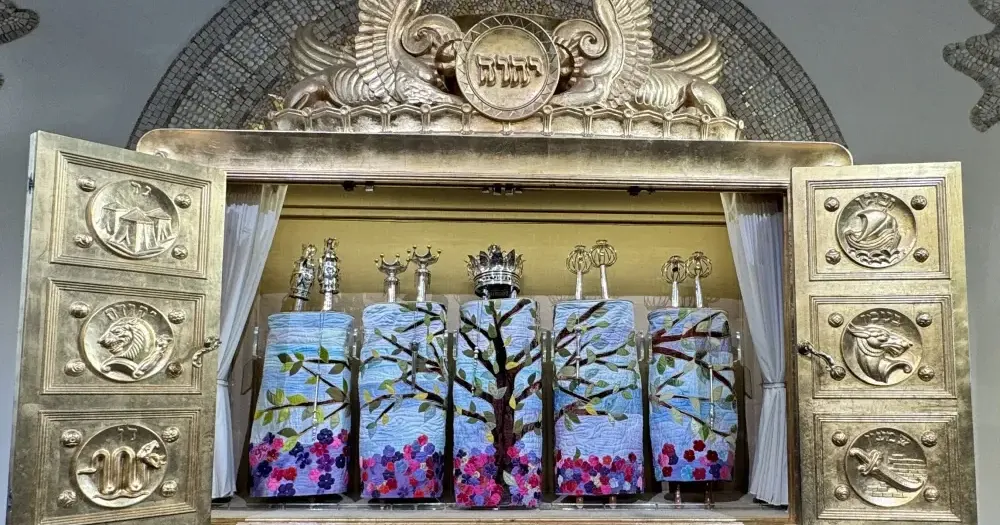
After the Temple Israel attack, displaced bar and bat mitzvahs continued at new locations, highlighting the strength of Detroit’s Jewish community.
There was never a question whether bar and bat mitzvahs were going to continue, says Rabbi Marla Hornsten of Temple Israel, despite the havoc that had teachers and children evacuate the building.
It was a roller coaster for Sam Frishman of Huntington Woods. His bar mitzvah the weekend of March 21-22 was supposed to be at Temple Israel, which his family calls home. But like other milestone events, educational and social functions, his was displaced after Ayman Mohamad Ghazali, 41, rammed his Ford F-150 pickup truck into the building on March 12.
Sam was so relieved that area synagogues and other venues opened their doors to families like his, who have been eagerly anticipating and preparing for these celebrations.
He was joined by Temple Israel clergy, as well as family and friends from near and far, says Sam, who turned 13 on Friday, March 20, the day before he was called to read Torah to that audience. “I just thought of it as my normal Temple Israel,” Frishman says of his bar mitzvah, which was among the second set to take place since the attack. “It means not thinking of what’s around it, just thinking what’s in it.”

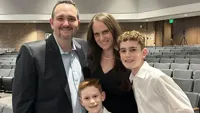
Henry Saperstein and family.
He was determined to look ahead, to give his speech and to talk about his mitzvah project. “I want people to know that this is a true gift, to be bar and bat mitzvahed,” he says. “It’s a gift, in general, to transition into Jewish adulthood, and I wanted people to see it as a regular bar or bat mitzvah and just to have fun.”
Temple Israel is very important to their family, says the teen’s father, Michael Frishman. His wife Julie’s bat mitzvah was there, the couple was married there, and his daughter’s bat mitzvah was held there as well. Still, he counts himself lucky to have been able to find another congregation to host his son’s service and says he feels appreciative of the supportive community around them.
“I wanted Sam to know that he is the No. 1 most important thing because of all of his hard work and studying that he’s done, and we weren’t going to let anything stop us from celebrating,” he says. “We did it in the most special way that we could and, yes, it wasn’t the way that we wanted it to be or where we wanted it to be, but it was still very special for him.”
And, he says, he knows that Sam “will be a great, outstanding member of the Jewish religion.”
‘The next day, Jewish Life in Detroit was Open’
“We knew we were going to find a way to make it happen, and we were really grateful that everything worked out so smoothly,” Rabbi Hornsten says. “The community has opened their hearts and their buildings to us. And the families have been super-flexible; they understand that this is not a normal time, so we are working within whatever constraints there are to make it happen. But I think the message is you go with the good, that we’re going to continue moving forward.”
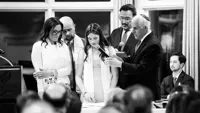
Sydney Cox reads from the Torah at her bat mitzvah.
That’s not to say people aren’t nervous or even afraid, she says, but they are continuing ahead with purpose.
“It hit home, literally. It’s not just something you see on the news. It happened to us,” says Hornsten, who has worked at the synagogue since the summer of 2000. “But there’s moving forward and there’s celebrating, and that’s what we do as Jews.”
It’s important to keep participating in Jewish life, says Michael Masters, national director and CEO for Secure Community Network, which liaises with law enforcement and other organizations to provide best practices for Jewish communal security.
“The goal of these individuals and groups is to frighten us into submission,” he says. “I believe that empowerment beats fear, and what we saw March 12 was an empowered, resilient, coordinated community. And in the midst of that attack, the next day, Jewish life in Detroit was open.”
Kimie Saperstein of Commerce Township says her son Henry, who turned 13 on March 21, had been holding out hope when the attack happened that the sanctuary wasn’t damaged and that he’d still be able to have his bar mitzvah at Temple Israel, where she and his father, Andrew Saperstein, grew up, and had their bat and bar mitzvahs. Henry attended the early-childhood center and still attends Monday-night school at Temple Israel. He had really been looking forward to having his bar mitzvah on that bimah, says his mother.
Clergy members reached out first thing March 13 to check on the family, she says, and to assure them the bar mitzvah was still going to take place. By March 14, despite everything else going on, they called back to confirm plans at a new location.
Henry was crushed at first, says Saperstein, but then heartened by the rabbis’ messages at the Shabbat service held at nearby Shenandoah Country Club and streamed online, that Temple Israel isn’t defined by a building.
“It’s the community; it’s the people, and he was surrounded by the same rabbis and the cantor,” Saperstein says. “He was surrounded by all of our family and friends. And the fact that the Torahs were saved — he still read from the same Torah from Temple Israel.”
They had their rehearsal at the new congregation, she says. “I think the community here is very special and that Jewish people as a whole are very resilient, and we have to rise above different situations,” she says.
“This community has really come together. We’re strong, and we’re not going to hide our Jewish identity. The only way to get through this is with love, with continuing to be Jewish and living by our Jewish values.”
‘For Generations, this Is Our Response’
Sydney Cox had practiced for her bat mitzvah in the sanctuary at Temple Israel just two days before the attack. In its aftermath, her service that week moved to her family’s country club.
“It’s hard thinking that somebody would do that to where I was supposed to have my bat mitzvah and where I was supposed to become a woman,” she says, adding that she is looking forward to having more responsibility in Jewish life as an official adult, according to tradition.
Although finding out what happened was scary because she’d grown up at Temple Israel, she didn’t want to let a bad thing take away from joy and celebration. The 12-year-old says she was proud of such an accomplishment amid “sadness and of being strong for our community.”
The most important thing is that everybody was safe, and that they could celebrate together, states her mother, Lindsay Cox. “It felt so bittersweet,” she says. They stood on a makeshift bimah with their friends and family from near and far close by.
“To see everyone we love and who loves us surround us was overwhelming, to say the least.” She notes the joy a day after heartbreak.
Rabbi Josh Bennett, who was there beside Sydney for her bat mitzvah, says the community turned to friends and neighbors to put plans in place for the essentials, like worship and simchahs.
“This is who the Jewish people are. For generations, this is our response,” he says, adding that he wants to express gratitude for the people who helped ensure Temple Israel’s safety.
“We are resilient; we are strong. We will not be deterred by this kind of violence. We will worship; we will gather, and we will have a future, despite what the terrorist wanted.”
Miles Dolgin’s bar mitzvah the weekend of March 21-22 was a chance for everyone there to heal together, says Talia Dolgin of Huntington Woods. The early-childhood center at the site of the attack is named for her parents, Rabbi Harold and Susan Loss. Her father has served the community as a Temple Israel rabbi since 1971.
Watching the news unfold was difficult, says Dolgin, but the community’s response showcases its strength. “We’re switching from hate to celebration, and we’re showing our Jewish pride in being together,” she says.
Temple Israel’s Torah scrolls were all brought to safety, and the congregation will certainly rebuild stronger, says Steve Ingber, CEO of the Jewish Federation of Detroit. “We will continue to live proud Jewish lives. None of that should change because of this.”
This is a time to join together and be together, he says, adding that partner agencies have come forward to help. Federation will continue its work with private security, local officials, county and state officials, and federal officials as needed.
As for Metro Detroit’s close-knit community, with so many families who have been here for generations, Ingber says: “We will continue to live our lives peacefully and continue to practice our religion and be proud of our religion.”
This story was first published at JNS.org.
The Detroit Jewish News has been supported by readers like you since 1942. Support independent, local, Jewish journalism with a donation today.