
Real journalists wrote and edited this (not AI)—independent, community-driven journalism survives because you back it. Donate to sustain Prism’s mission and the humans behind it.
Israel is continuing to target Palestinian journalists in Gaza despite the October ceasefire.
On March 9, an Israeli strike targeting tents sheltering displaced civilians in Al-Zawaida killed journalist Amal Al-Shamali, 46, a correspondent for Radio Qatar. Her death brought the total number of journalists killed in Gaza to at least 261.
Al-Shamali’s killing followed a Jan. 21 Israeli drone strike in the Netzarim area of central Gaza that killed three journalists—Mohammed Qashta, Abdul Raouf Shaat, and Anas Ghoneim—who were documenting humanitarian aid distribution in camps.
“This proves the continued violation of journalists’ rights and reflects an intent to silence the Palestinian voice,” Ahed Farwana, secretary of the Palestinian Journalists’ Syndicate in Gaza, told Prism.
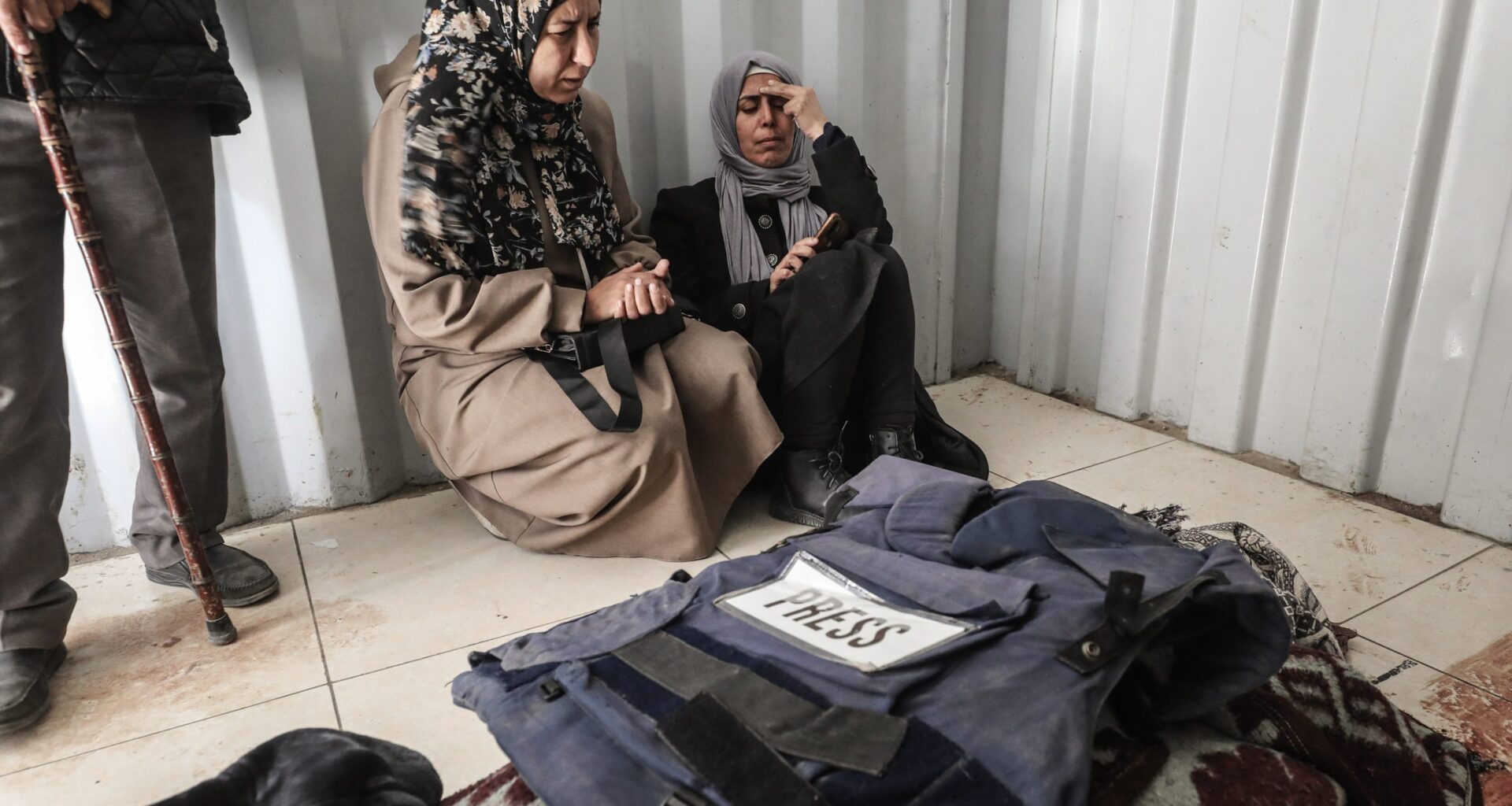
Since the genocide began in Gaza, journalism has transformed from a profession dedicated to reporting events into a daily struggle for survival. Journalists are subjected to relentless bombardment and direct, deliberate targeting. Protective gear no longer guarantees safety, as reporters are attacked even while wearing press vests and carrying out their duty to convey the truth. Even ceasefires have failed to halt the violence against them.
What journalists do is not merely a profession—it is a clear mission to expose the crimes committed against Palestinians.
Ahed Farwana, secretary of the Palestinian Journalists’ Syndicate in Gaza
“The Palestinian journalist in Gaza defies all harsh conditions to keep coverage going,” Farwana said. “What journalists do is not merely a profession—it is a clear mission to expose the crimes committed against Palestinians.”
In Gaza, journalists are paying with their lives to report the truth amid international silence and a clear failure to provide them with adequate protection.
I have faced numerous challenges as a journalist: repeated displacement, nearby bombardments, and constant fear. At one point, I lost internet access for more than two months. I also lost my laptop—my primary work tool—after leaving the vicinity of Al-Shifa Hospital in early 2024. Despite everything, I remained determined to continue my work and tell the truth.
In late January, while leaving the Palestinian Journalists’ Syndicate office after submitting reports, an explosion struck just meters away from me in western Gaza. Shrapnel scattered around me. In that moment, I realized how fragile our sense of safety is—that danger can strike anytime, anywhere, without warning.
I had believed the ceasefire might bring relief and allow us to work safely. But reality proved otherwise.
Farwana said that Palestinian journalists have endured displacement and bombardment like all civilians—but under even harsher conditions.
They are often forced to leave their families for weeks or months to remain in the field documenting events, all while lacking basic safety measures and equipment such as phones and cameras, many of which have been lost due to bombing or forced displacement.
Iman Al-Ajla, a 23-year-old freelance journalist from Gaza, said, “We, as journalists, played a major role during the war on Gaza. We conveyed the truth in both sound and image, documenting countless massacres and scenes. Our goal was to move the world to stop this war.”
A pattern of killing
Farwana said that Israel’s targeting of more than 260 journalists in Gaza during the war was “one of the gravest crimes against journalism in history.” Farwana noted that no previous global or regional conflict has seen such a high number of journalists killed.
Israel’s targeting of journalists is not new; it has killed dozens of journalists in occupied Palestine over the decades, including the high-profile shooting of Palestinian American journalist Shireen Abu Akleh in Jenin in 2022. Israel has also killed journalists in surrounding countries, including more than a dozen killed since 1992 in Lebanon and 31 journalists and media workers killed in a single September strike on newspaper offices in Sanaa, Yemen.
But the targeted killings of hundreds of media workers in Gaza have reached a new peak. The Committee to Protect Journalists (CPJ) said, “Israel is engaging in the deadliest and most deliberate effort to kill and silence journalists that CPJ has ever documented. Palestinian journalists are being threatened, directly targeted, and murdered by Israeli forces, and are arbitrarily detained and tortured in retaliation for their work.”
Under international humanitarian law, journalists are classified as civilians and are entitled to protection. Article 79 of Additional Protocol I to the Geneva Conventions explicitly affirms their right to full protection as long as they do not participate in hostilities.
However, the reality in Gaza reveals repeated violations of these laws. Reporters Without Borders has filed five complaints against Israel with the International Criminal Court (ICC) for its killing of journalists.
“In the vast majority of cases, journalists are targeted because of their journalistic work or while carrying it out,” the group said in a press release. “We are shocked that the perpetrators of these crimes are still able to enjoy impunity as a result of judicial and political inaction. We call on the ICC in particular to hold firm despite threats, pressure and sanctions, and to do its duty, nothing but its duty, and its entire duty. Crimes against journalists must be punished.”
Palestinian journalists are also struggling with a lack of equipment as Israel’s targeting of journalists and offices has destroyed their gear. Farwana said that many tools, such as cameras, also require maintenance, but there is no possibility to repair them.
“From the very first day, Palestinian journalists in Gaza have suffered from a shortage of journalistic tools and equipment,” Farwana said.
The Journalists’ Syndicate tried to provide support to help journalists continue their work, including distributing power banks to help charge phones.
Israeli blockades are also limiting reporters’ access to professional safety equipment.
Journalist Doaa Al-Dahdouh said, “I face difficulties due to losing my press vest and helmet after my home was destroyed.” After losing her safety equipment, Al-Dahdouh has had to borrow a press vest from her colleagues, and often she cannot obtain one because it’s in use at the time.
Memory, loss, and courage
Journalists in Gaza live with constant grief after losing colleagues and friends.
“I cannot process what happened to my colleagues and friends,” Al-Ajla said. “We shared everything: living in the same tents, sharing food and water, going together to cover strikes, and living with the same fear that we could be targeted at any moment.”
Throughout the war, journalists often left their families behind for extended periods, living in tents designated for media workers typically located near hospitals or shelters. Despite their hardship, these tents offered no real safety. Journalists remained exposed to direct attacks, such as Israeli strikes that targeted media tents at Al-Shifa Medical Complex in August, killing several journalists, including Al Jazeera’s Anas Al-Sharif.
“I was directly targeted several times,” Al-Ajla said. “I always survived—until one incident when a nearby building was bombed, and shattered glass struck me, causing injuries.”
Gaza’s reporters carry an enduring sense of loss. Even as voices fall silent, memories remain vivid: colleagues remembered for their laughter, courage, and determination to report despite constant danger.
Al-Ajla recalled her close friend, photojournalist Mariam Abu Daqqa, who was killed on Aug. 25, in a direct strike on Nasser Medical Complex in Khan Younis while wearing her press vest. Before her death, Mariam had shared a video removing her press armor in protest against the lack of protection for journalists.
“Mariam was my soul, my closest friend. I never imagined losing her, even though she often said she believed she would be targeted and killed,” Al-Ajla said.
Omar Al-Dahdouh, a correspondent for Palestine TV, told Prism of losing his colleague, photographer Hossam Al-Masri.
“We endured immense suffering while fulfilling our duty to convey the truth to the world,” Al-Dahdouh said. “We lost many colleagues, as journalists were specifically targeted.”
Al-Masri, a Reuters cameraman, was killed in the same attack that claimed Abu Daqqa. He was among those documenting daily life, human suffering, and ongoing dangers in Gaza.
Farwana said that the Palestinian Journalists’ Syndicate continues to document violations and prepare detailed legal files. The syndicate has obtained legal authorizations from the families of slain and injured journalists to pursue cases against Israel at the ICC.
These efforts aim to hold those responsible accountable, prevent impunity, and push for genuine international protection for journalists working under constant threat—ensuring that the truth is not silenced.
Editorial Team:
Sahar Fatima, Lead Editor
Lara Witt, Top Editor
Stephanie Harris, Copy Editor
Related