
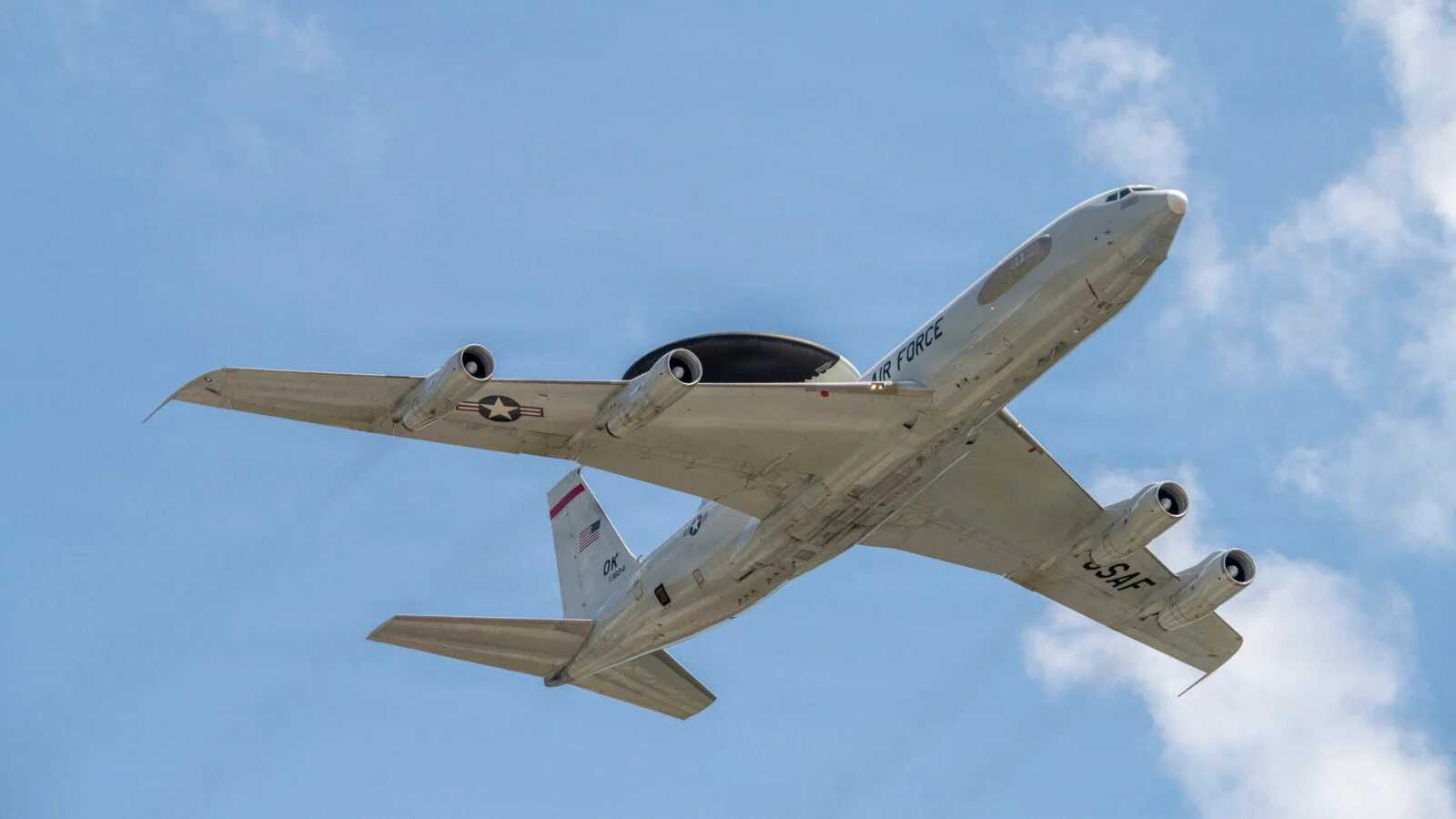
Whether responding to Russian or Iranian drone incursions, patrolling the Red Sea, or bolstering situational awareness off Venezuelan coastlines, airborne battle management (ABM) aircraft like the E-2s, E-3s, and E-7s are in high demand.
Operation Epic Fury has further highlighted ABM aircraft’s indispensable role: coordination in a congested and dynamic airspace, and an unmatched ability to identify and orchestrate responses to low-flying drones and cruise missiles. But the operation has also thrown the spotlight on the dilemmas of a limited fleet — even before an E-3 was reportedly damaged by Iranian weapons.
While drone and cruise missile threats are abundant, the United States lacks enough available and updated ABM aircraft to support its defense priorities. Instead of resourcing solutions to this challenge, the Department of Defense has aggravated the issue by attempting to cancel future ABM systems in favor of unproven or unequal alternatives.
Without a change of approach, the United States risks under-resourcing one of its most important enablers at a time when the effectiveness of air operations is at a strategic premium.
The ABM capacity gap is most apparent in the Air Force. Driven by chronic readiness strains — aging airframes, profuse maintenance needs, and limited component replacement options — USAF now only possesses sixteen E-3 Sentries. As recently as 2024, just over half were available for missions. The United States recently deployed six E-3s to support Operation Epic Fury, a commitment that likely leaves only two or three remaining Sentries available for other existing needs, and suggests the USAF ABM fleet has no slack remaining without sacrificing priority missions.
Prolonged, high-intensity air operations—and the current air campaign does not appear to be closing anytime soon—impose wear and tear on any platform and crew. Airframes approaching fifty years old are no exception. Rather than slowing down as the campaign progresses, it is also possible that E-3s are now assuming an even greater role following the destruction US ground radars—an outcome that would only increase the toll on readiness. If the US air campaign continues unabated for several more weeks, the number of aircraft headed for what one former Air Combat Command head has termed “hospice care” is likely to increase with no obvious replacement.
Beyond readiness, the ABM fleet’s problem also lies in fielding enough sensing capability to address one of the Joint Force’s most important threats: low-flying drones and cruise missiles. For this mission, ABM aircraft hold a unique advantage: Airborne, top-down sensors can identify and track low-altitude threats much sooner than horizon-constrained surface sensors. However, “clutter” around low-flying objects requires distinguishing drones and missiles from background objects such as trucks, or terrain features such as waves. Older radars, like those on E-3s, are less suited to this task.
The Navy fields approximately 70 E-2D Advanced Hawkeyes whose more advanced radars distinguish threats from clutter and proved their worth in countering Houthi drone attacks in 2024. However, the E-2D fleet is primarily tasked with defending the carrier strike group, and is not intended to take on ABM responsibilities for the entire Joint Force.
The department needs additional ABM aircraft to avoid potentially disastrous drone and missile attacks, such as those that have struck ground bases in the Middle East. But the Pentagon’s current solution places too much stock in unequal and unproven alternatives.
Space-based airborne moving target indicator (AMTI) satellites are far from being able to provide both reliable and time-sensitive data to surface forces. Even if the fundamental technological challenges for AMTI are resolved, forward-operating battle mangers will still be essential to cue responses and disseminate new orders, particularly in the event space or other nodes become compromised.
As I argued in a recent Center for a New American Security report, ground- and fighter-based battle management alternatives, though capable, also do not substitute for ABM aircrafts’ contributions to the drone and cruise missile threat. While over-the-horizon radars can dramatically increase detection range, their fixed positions make them predictable planning factors and highly vulnerable to attack. Fighter-based sensors and networking suites, while impressive, simply do not achieve the same scale of tracking and control as dedicated ABM aircraft, and are even further outstripped by the combined cognitive capacity of anywhere from four to 20 dedicated ABM operators.
Taken together, the Department has yet to articulate and resource a viable near-term to solution to the expanding ABM gap. The fiscal 2026 defense budget’s “bridge” strategy, which attempted to cancel the E-7 program and instead procure a small number of additional E-2Ds, did not come close to filling the emergent ABM void.
Looking ahead, DoD and Congress must work together to revitalize the ABM fleet, protect and elevate its role in priority theaters, and ensure a resilient and balanced sensing and C2 architecture over the long-term.
The Department of Defense needs to reinterrogate total force requirements for the ABM fleet — and do so with a sober appreciation of what its alternatives can and cannot do. In the upcoming budget, Congress must authorize and appropriate funds for new ABM aircraft and updated airborne radar systems to replace the ABM fleet’s older and outdated components. Throughout all this, the department needs to ensure the ABM pilot and crew pipeline remains intact, even as older aircraft are retired.
The ABM force structure crisis comes at an acute moment for US air operations. In DoD’s priority scenarios and beyond, US air operations depend on reliable early warning and responsive air battle management. While complements to ABM abound, there are no replacements.
Today, the procurement gap is even more pronounced in light of force commitments to the Middle East. The United States needs to chart a stronger path forward for the quarterbacks of its air operations, or risk being sacked for a catastrophic loss.
Philip Sheers is an Associate Fellow with the Defense Program at the Center for a New American Security (CNAS). His research covers escalation management and nuclear deterrence, airpower and great power conflict, and defense industrial base (DIB) and defense budget issues.