
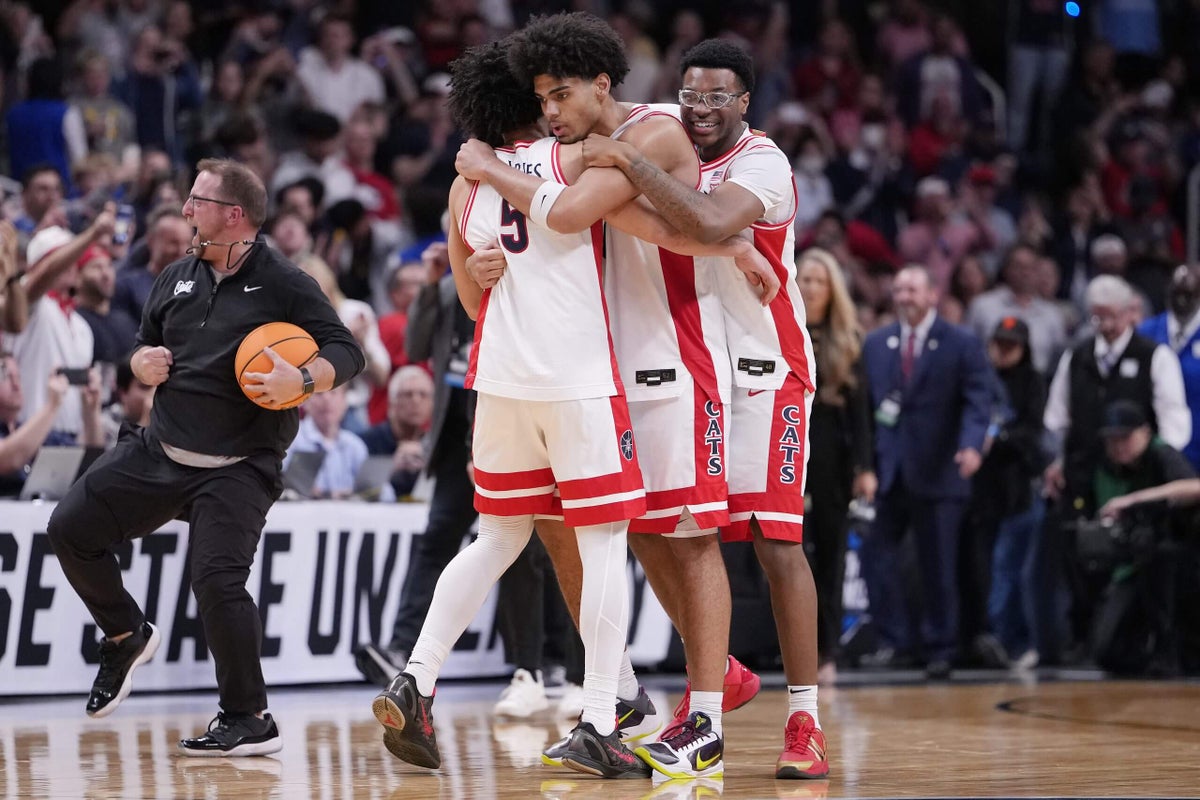
SAN JOSE, Calif. — During the most important halftime of his coaching career, Tommy Lloyd stopped talking. He wasn’t nervous. He wasn’t out of answers. He just knew it was time to say less.
For a quarter century, this round of the NCAA Tournament had tormented Arizona. Different coaches. Different stars. Same ending. The Elite Eight became a championship program’s ceiling. It was repetitive agony — 2003, 2005, 2011, 2014, 2015 — five good seasons that came undone before they could vault to something more. The most heartbreaking defeats leached onto the school’s identity, creating the perception that the Wildcats had become chokers.
Inside the SAP Center on Saturday night, they faced scrutiny again. They were down by seven to Purdue at halftime and summoning the demons of Elite Eights past. A familiar pressure resurfaced. You could feel it in the building and see it in their skittish play.
It was time for the coach to put his foot down. And so he did. But his goal wasn’t to exert authority. Instead, he chose to walk away.
“Guys, the coaching staff and I are going to leave right now,” Lloyd recalled telling the team. “You guys got a few minutes to talk among yourselves and kind of figure this deal out.”
He added: “Let’s go kick their ass in the second half.”
And then the coaches left.
No diagrams. No screaming. No over-coaching. Just space.
By the end of the night, Arizona was laughing at the ghosts. The top-seeded Wildcats regrouped and owned the second half, taking down No. 2 Purdue, 79-64, in the West Region final. They’re not a proud program with the yips anymore. They’re headed to the Final Four for the first time since 2001.
When the players huddled without the coaches, they focused on their mentality. “Keep going,” they told each other. Forget about the stakes. Forget about the score. Just play as if they had the lead.
For Lloyd, his greatest tactic proved to be no tactic at all. After giving a few brief points of emphasis, he realized his team didn’t need more information. It needed ownership.
This Arizona team doesn’t remember past disappointments. The players who carried that weight are long gone. In their place is the most balanced team in America, a group that performs best when it isn’t forced to inherit anxiety. Such freedom is a fragile thing. Lloyd protected it by giving his trust.
So, Lloyd trusted them.
Whatever the players said in private, it worked. Or, actually, maybe it’s that whatever wasn’t said worked.
The Wildcats outscored the Boilermakers 48-26 during the final 20 minutes. Desperation didn’t cause them to explode. This was simply an exceptional team asserting itself. The ball moved. The pace returned. The hesitation vanished.
“I was literally a spectator just like you guys were in that second half,” Lloyd said. “That’s what it felt like.”
That’s not false modesty. It’s recognition.
For five years, Lloyd has built systems, habits and expectations. He has a feel for his program to complement the structure he created. He has the confidence to take his hands off the wheel now.
“The most powerful thing in a team sport is a player-led program,” Lloyd said. “The coach, you have to help them navigate it, but when you can get the players to kind of own these moments, you are just so much better.”
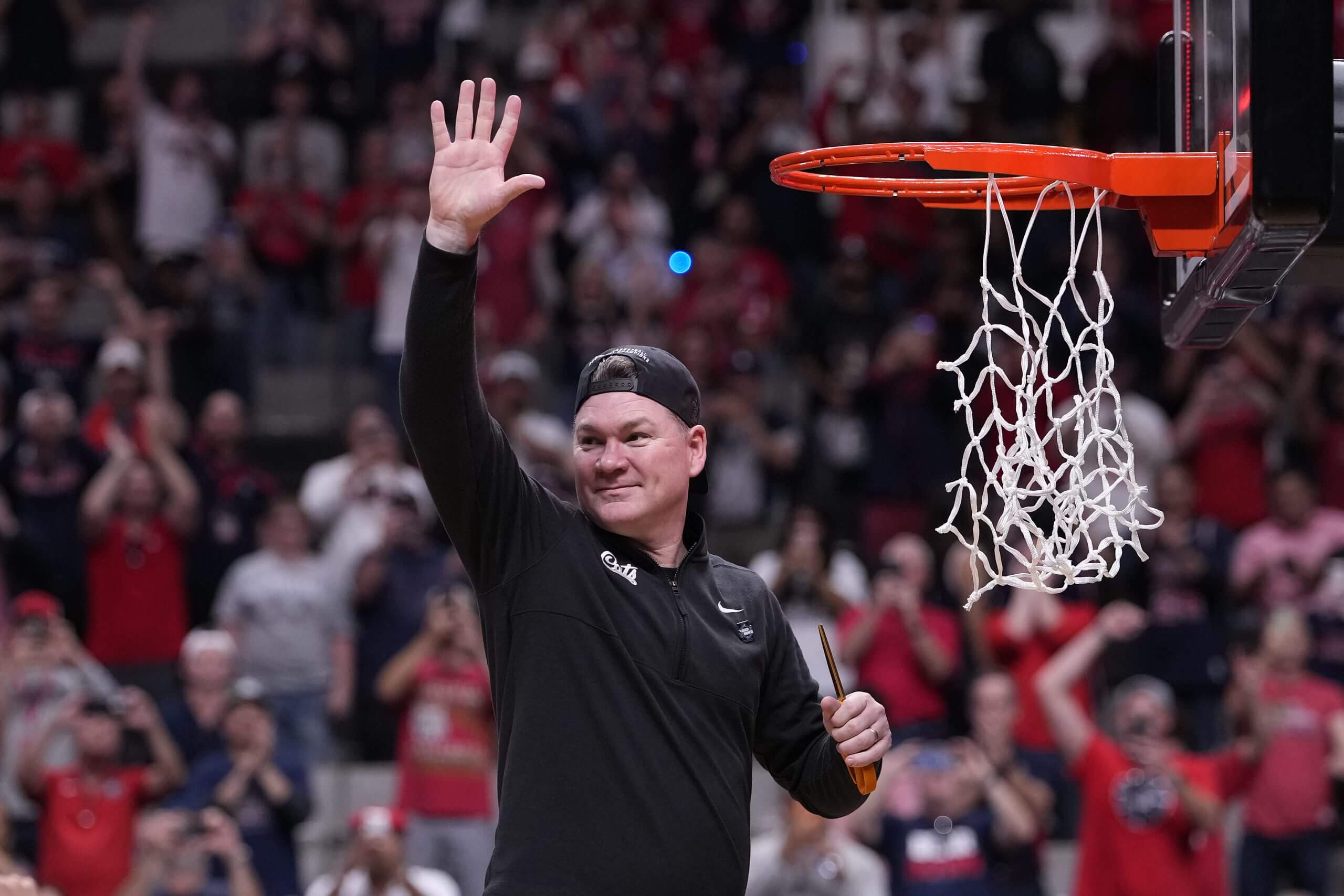
Arizona coach Tommy Lloyd cuts down the net after the Wildcats’ comeback victory against Purdue in the Elite Eight. (Thearon W. Henderson / Getty Images)
Lloyd estimated that he has shut his mouth and stepped back four or five times this season.
“Every time, it’s worked,” the coach said. “These guys have a way about them. There’s a seriousness about them. They know how to kind of ratchet things down and tighten it up and get after people.”
Belief slayed the Elite Eight demons. It wasn’t some kind of loud and performative exorcism. Arizona made quiet, subtle breakthroughs. It showed up in the players’ decision-making: passes thrown a split-second earlier, shots taken without a second thought, defensive rotations on point. Koa Peat lived in the paint. Ivan Kharchenkov sprinted from defense to offense. Brayden Burries shook off a timid start and provided just enough perimeter shooting.
To beat the veteran Boilermakers, composure had to be part of the game plan. As the Arizona lead grew, the program’s dusty old failures lost their impact. The five devastating losses, the blown leads, the years that stalled at “almost,” became irrelevant in the second half. The drought didn’t end with a dramatic, conscious break from the past. It succumbed to indifference.
The coaches have taught their players the good, the bad and the agonizing parts of Arizona history. The players just don’t treat those memories like they owe a debt.
“They’re going to tell us, even if we don’t want to hear it,” senior guard Jaden Bradley said.
Afterward, Lloyd stood with a microphone and looked skyward, invoking Lute Olson, the architect of Arizona’s greatness.
“There’s a good-looking guy with white hair looking down on us who’s happy,” Lloyd told the crowd.
On a night like this, legacy wasn’t a burden. It was a backdrop.
This team will be remembered differently. It connected the present to Olson’s glory, which included four Final Four berths and the 1997 national title. But it’s not just about getting back to the Final Four. It’s how the Wildcats arrived here. They have already won a school-record 36 games. They’re on a 13-game winning streak. They hadn’t experienced much difficulty during this tournament run, but when they did, their response to pressure looked nothing like the recent past.
In sports, it’s tempting to frame breakthroughs around speeches. Coach, what did you tell your team at halftime? We’re always searching for the act that changes everything. But Arizona’s defining moment might be the absence of one.
At halftime, Lloyd didn’t try to win the game with words. He let go, and in doing so, he gave his team the freedom to finish it.