
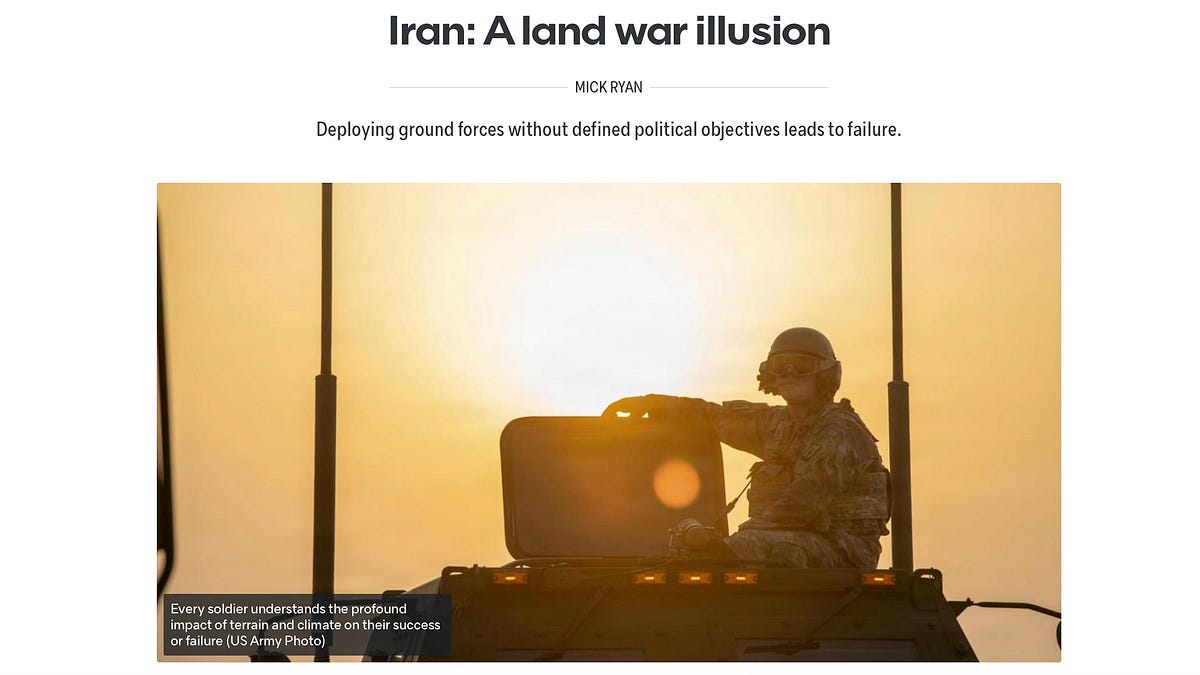
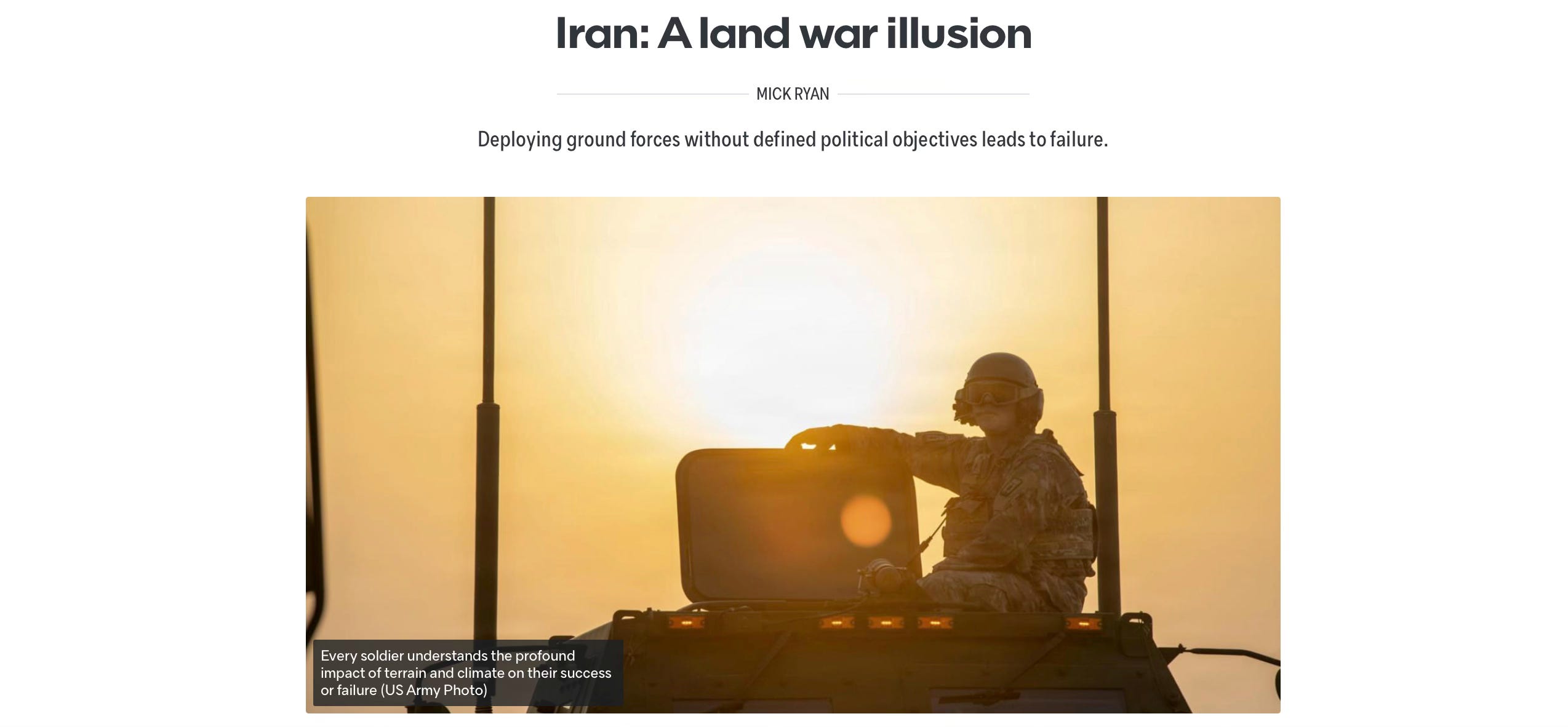
More than any other environment, land operations are characterised by uncertainty, fear, friction and surprise. In his brilliant book, Military Strategy, Rear Admiral J.C. Wylie wrote that “the ultimate determinant in war is the man on the scene with a gun”.
America is weighing the deployment of land forces onto Iranian territory – a move that would dramatically escalate the war and risk drawing it into a prolonged conflict. While this conflict is not Iraq, Afghanistan, Vietnam or any number of previous wars, history offers a guide on employing ground forces. They can be extraordinarily decisive when used at scale, for the right mission and with a clear political objective. But, without these things, land operations can result in tactical catastrophe, the death of soldiers and marines, and overall political failure in war.
All strategies start with a diagnosis of the problem to be solved. Any consideration of land force operations in Iran – and in any war – must begin with the following question: “What problem will land forces solve?”
The political objectives of employing land forces are several. First, the American president will want Iran to see US troops on the ground as a profound statement about US will. He will want them to know that he is not giving up and walking away from the war. Second, Trump will use land forces as a statement of commitment to regional allies: America is not abandoning you. And finally, the commitment of land forces will aim to solve an ongoing political quandary for Trump: how to bring the Iranians to the table, quickly, for diplomatic negotiations that can end the war.
What might be America’s military objectives? Securing Iran’s enriched nuclear material will be a high priority – a mission that both American and Israeli ground forces have rehearsed for years, although rehearsals do not guarantee success or casualty-free operations.
Another priority will be to re-open the Strait of Hormuz. Not only is the shipping restriction having a profound impact on the global economy, but it is also being used by Iran as a symbol of American weakness in its cognitive warfare. The US mission might also be to seize ground objectives – including refineries, bases, islands – that provide America with enhanced leverage in diplomatic negotiations. Most of these operations would best be described as raids and could last from hours to days. Maybe.
In war, the enemy gets a vote. What might Iran’s political goals be for their own employment of land forces?
The Iranians, who have shown a deft hand at political manoeuvring and cognitive warfare since the war began, will probably prioritise above all else the killing and capturing of American soldiers. They probably assess that this will substantially erode the American population’s support for the war. But they will also use it to signal to the Iranian people – and regional nations – that the will of the Iranian regime is unbreakable, and that they are comfortable killing anyone who challenges them.
Clearly, the Iranians will want to take back any Iranian territory seized by the Americans. However, they will understand that killing Americans is far more important, and that in due course the Americans will leave anyway. Seizing back their own territory will thus be a lesser military goal for the Iranians.
We should expect that the Iranians will be assisted by Russia in any ground fight against American forces. There are already multiple reports of Russian intelligence being provided to Iran. If Iran seeks Russian help in killing American soldiers and marines, the Russians are likely to be willing partners. They hate America for helping Ukraine kill hundreds of thousands of Russians.
Russia is keen for payback and understands that there is a minimal price to be paid. When asked whether Russian assistance would affect his view of the bilateral relationship, US President Donald Trump drew a comparison to US intelligence support for Ukraine, saying “they’d say we do it against them”.
You can read the full article, for free, at the Lowy Interpreter by following this link.