

The Knesset passed a highly controversial law mandating the death penalty for West Bank Palestinians convicted of carrying out deadly terror attacks on Monday.
Lawmakers voted 62-47 to mandate death by hanging as the default punishment for West Bank residents convicted of deadly terrorist acts by military courts. While judges can opt for life imprisonment under vaguely defined “special circumstances,” the death penalty would otherwise be mandatory and be carried out within 90 days of sentencing.
The vote marked a major victory for far-right National Security Minister Itamar Ben Gvir, whose Otzma Yehudit party has long championed the legislation and who immediately handed out champagne as members of the coalition celebrated its passage following nearly twelve hours of debate.
“This is a day of justice for the victims and a day of deterrence for our enemies. No more revolving door for terrorists, but a clear decision. Whoever chooses terrorism chooses death,” said a jubilant Ben Gvir, sporting the golden noose-shaped lapel pin he and other advocates of the measure have donned to symbolize their campaign for the death penalty.
The sentence would require a simple majority of judges rather than a unanimous decision, while eliminating any right of appeal.
Get The Times of Israel’s Daily Edition
by email and never miss our top stories
By signing up, you agree to the terms
Despite being promoted by its supporters as a response to the October 7 attacks, the law would not apply retroactively, including to the perpetrators of that 2023 Hamas-led onslaught, whose prosecution will be covered in a separate bill being advanced through the Knesset.
The law effectively enshrines capital punishment for Palestinians alone, as it explicitly excludes Israeli citizens or residents, and Palestinians alone are tried in military courts. Israelis are tried in civilian courts.

Prime Minister Benjamin Netanyahu arriving at the Knesset plenum, March 30, 2026. (Chaim Goldberg/Flash90)
Though a separate provision allows courts to impose the death penalty on anyone, including Israeli citizens, it applies only to those who “intentionally cause the death of a person with the aim of denying the existence of the State of Israel” — a definition designed to exclude Jewish terrorists.
While the death penalty formally exists in Israeli law, it has been carried out only once — the 1962 execution of Nazi war criminal Adolf Eichmann. Until now, Israeli courts could impose capital punishment only under extremely narrow circumstances and only with a unanimous decision from a panel of judges, a threshold that has never been met in terrorism cases.
Supporters of the law argue that the measure will strengthen deterrence against terrorism and reduce the incentive for terrorist organizations to abduct Israelis.
“We are not bloodthirsty and do not seek to kill; we are a people that sanctifies life, and precisely for that reason, we cannot allow ourselves to abandon lives,” said Otzma Yehudit MK Tzvika Fogel, who chairs the Knesset National Security Committee that advanced the legislation, before the plenum.
“This is a day on which the State of Israel chose life,” said Otzma Yehudit MK Limor Son Har-Melech, who spearheaded the law, calling it an example of “true Jewish morality.”

Limor Son Har-Melech (right) attends a meeting of the Knesset Lobby for the Renewal of Jewish Settlement in the Gaza Strip, held at the Knesset in Jerusalem, July 22, 2025. (Chaim Goldberg/Flash90)
The legislation has been a personal crusade for Son Har-Melech, whose husband was killed in a 2003 terror attack. She tearfully thanked Prime Minister Benjamin Netanyahu – who previously expressed reservations – in the plenum for backing the measure.
Right-wing opposition party Yisrael Beytenu also supported the law after party chair Avigdor Liberman conditioned his faction’s backing on Netanyahu and ultra-Orthodox Shas party leader Aryeh Deri voting for it in person, which they did in the final moments of the debate.
Ultra-Orthodox United Torah Judaism’s Degel HaTorah faction also voted in favor despite earlier reports that it would oppose it after its spiritual leader Rabbi Dov Lando warned the legislation could endanger Diaspora Jewry. UTJ’s Agudat Yisrael faction voted against it.
‘An immoral law’
Following the bill’s passage, several opposition parties, including Yair Lapid’s Yesh Atid, Arab-majority Hadash–Ta’al, and the left-wing Democrats party, along with several human rights organizations, announced they would petition the High Court of Justice to nullify the law.
“This is an immoral law that contradicts the foundational values of the State of Israel as a Jewish and democratic state, and the provisions of international law that Israel has undertaken to uphold,” said Democrats MK Gilad Kariv, who is on the Knesset National Security Committee and has been among the law’s fiercest opponents.
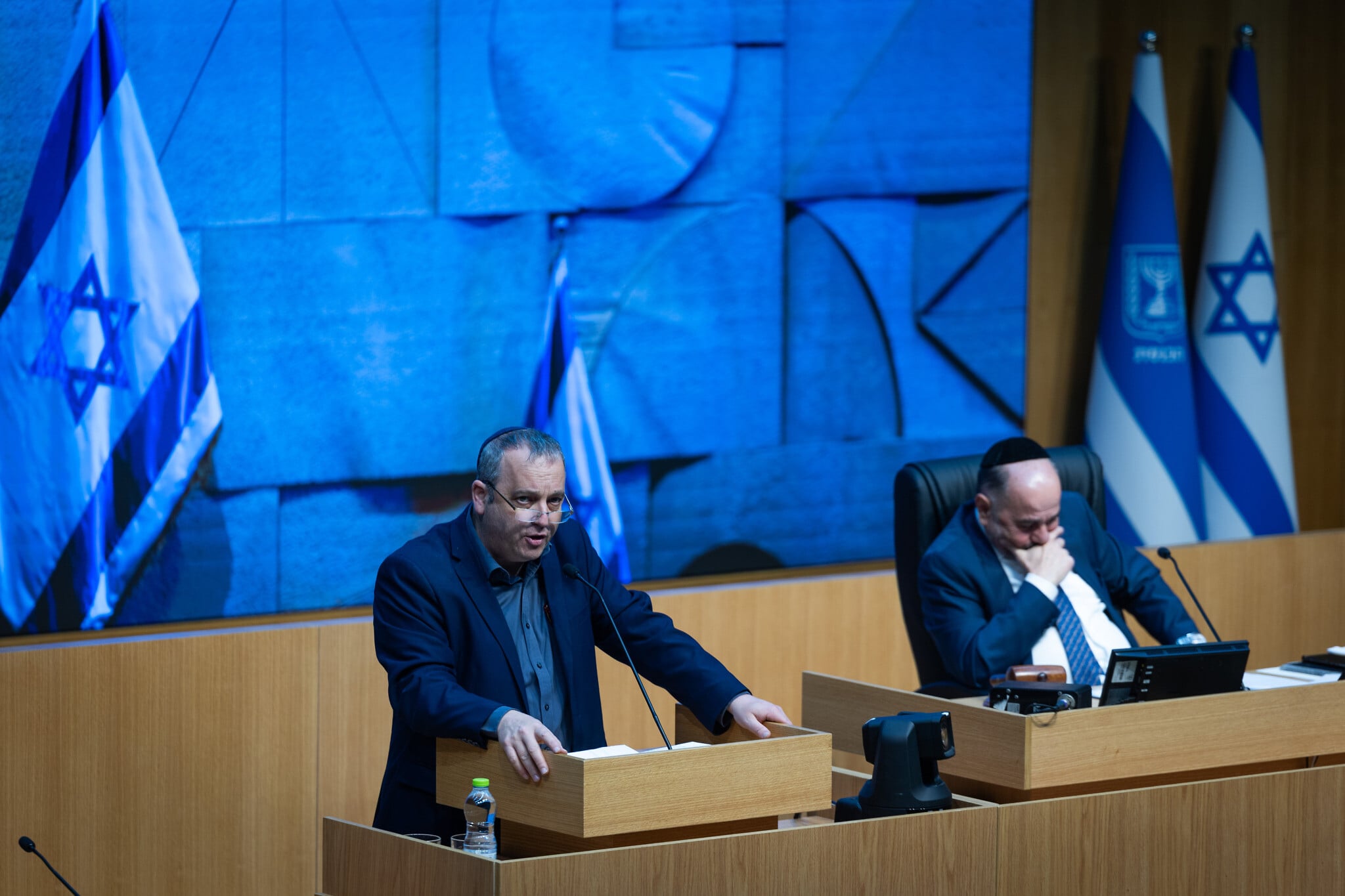
MK Gilad Kariv speaking before the Knesset, March 18, 2026. (Yonatan Sindel/Flash90)
Rabbis for Human Rights, which is petitioning the court alongside Kariv, said, “A death penalty policy runs contrary to the spirit of Jewish law and to the principle of the sanctity of life at its core. It ignores warnings from senior security officials who cautioned that the law would not deter but rather escalate violence, and it harms the Jewish and democratic character of the state.”
Kariv has also argued the law could complicate future hostage negotiations by restricting the government’s ability to consider prisoner releases.
The Arab-majority Hadash–Ta’al said in a statement, “This law is not merely a punitive measure—it is an official declaration of the institutionalization of apartheid and racism, and the transformation of the legal system into yet another tool in the violent political repression of the Palestinian people.”
The Association for Civil Rights in Israel also announced that it would petition the court, arguing that the Knesset does not have the authority to pass legislation that applies to the Palestinian population of the West Bank since Israel does not formally hold sovereignty there, and because under the relevant international laws, which Israel largely recognizes, legislative authority lies with the military commander.
“While the Knesset has previously legislated to apply Israeli law to Israeli settlers, this law is categorically different: it applies to the protected Palestinian population,” ACRI said in a statement.
“The military’s own legal advisors warned the committee that this amounts to de facto annexation,” the organization added.
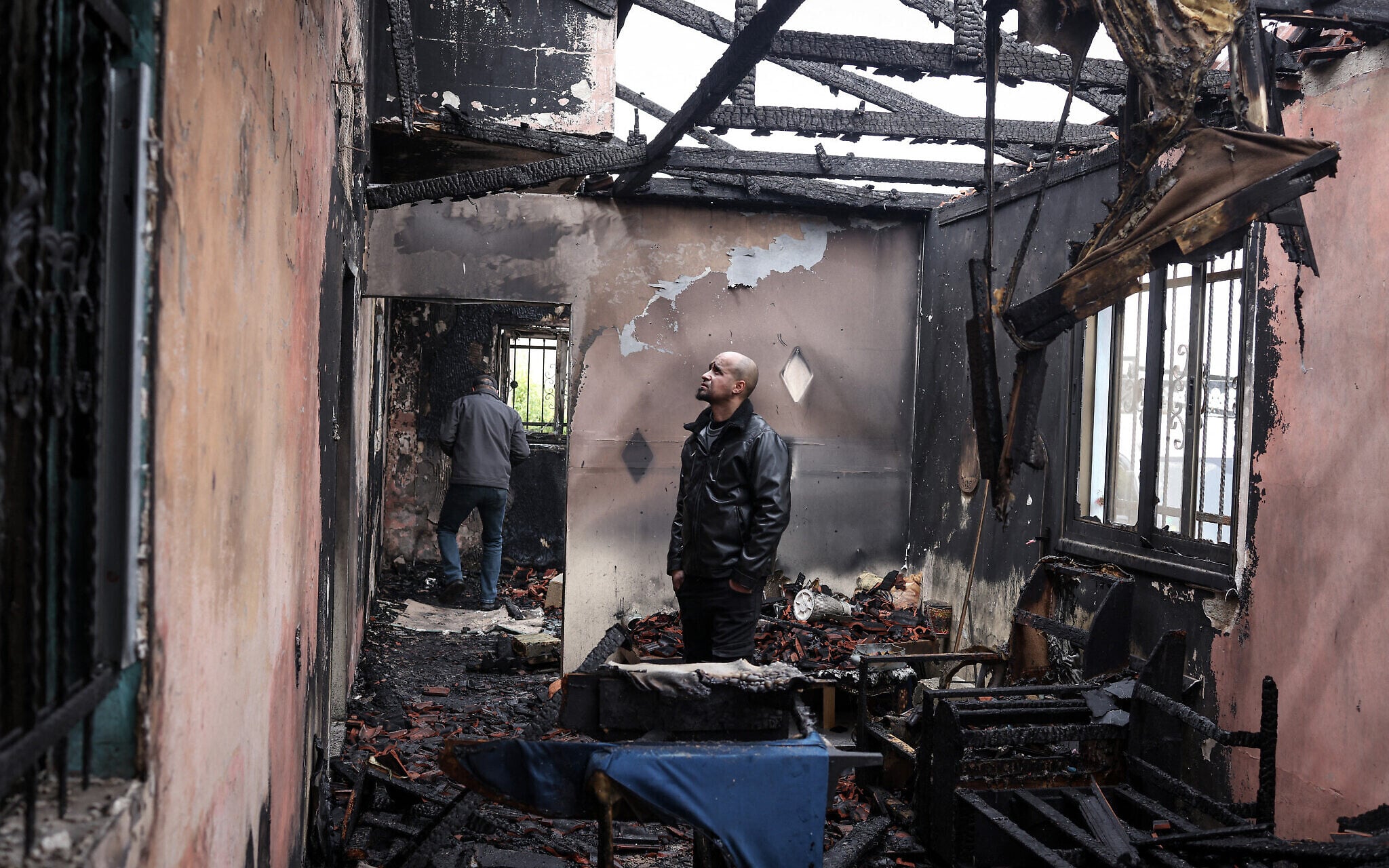
A Palestinian man inspects the remains of his burnt-out family home following a reported attack by extremist Israeli settlers in the village of Fandaqumiya, southwest of Jenin, in the West Bank on March 22, 2026. (Zain JAAFAR / AFP)
An international outlier
The law has also generated international condemnation. The Palestinian Authority, which nominally governs day-to-day affairs in parts of the West Bank, readily condemned the law, calling it a “dangerous escalation.”
In a post on X, the PA’s Foreign Ministry said that “Israel has no sovereignty over Palestinian land,” adding, “This law once again reveals the nature of the Israeli colonial system, which seeks to legitimize extrajudicial killing under legislative cover.”

A West Bank settler putting on tefillin and praying while grazing his sheep among Bedouin compounds close to the Palestinian town of Duma, March 6, 2026. (Courtesy)
Earlier on Monday, ahead of the vote, the foreign ministers of Germany, France, Italy and Britain urged Israeli lawmakers to abandon the measure.
“We are particularly worried about the de facto discriminatory character of the bill. The adoption of this bill would risk undermining Israel’s commitments to democratic principles,” the ministers said in a statement shared by the German Foreign Office.
Amid concerns that the law would harm and isolate Israel diplomatically, the legislation underwent significant revisions in the last month following pressure from Netanyahu’s office, with the support of the National Security Council, the Shin Bet, and the Foreign Ministry, which warned that earlier versions were harsher than US capital punishment standards and risked legal challenges abroad.
The revisions included removing a clause mandating the death penalty without judicial discretion, allowing judges a “special circumstances” option to choose between capital punishment and life imprisonment, removing the requirement that trials take place in military courts and allowing them to be held in civil courts, and dropping language defining terror victims as “Israeli citizens,” which would have applied the death penalty differently based on the victims’ citizenship status and excluded Palestinian victims of Jewish terrorism.

Members of Hamas’s elite Nukhba force who participated in the onslaught of October 7, 2023, crouch with their hands behind their backs in a prison cell in central Israel on March 4, 2025. (Chaim Goldberg/Flash90)
However, even after the revisions, representatives from the Attorney General’s office, the Shin Bet, the Foreign Ministry, and the Justice Ministry appeared before the Knesset National Security Committee to express their continued opposition to the bill.
The Knesset’s legal advisers to the National Security Committee repeatedly warned that the legislation may not be constitutional and could run afoul of international law, noting that it would deny those convicted in the West Bank the ability to seek clemency – a safeguard required under the Geneva Conventions and other international agreements Israel has signed – and could expose Israeli soldiers and political leaders to potential criminal liability abroad.
Fifty-four countries around the world permit the death penalty, including a handful of democracies such as the United States and Japan, according to Amnesty International. The group says that the global trend on the death penalty is toward abolition, with 113 countries having outlawed it for all crimes.
Reuters and Charlie Summers contributed to this report.