
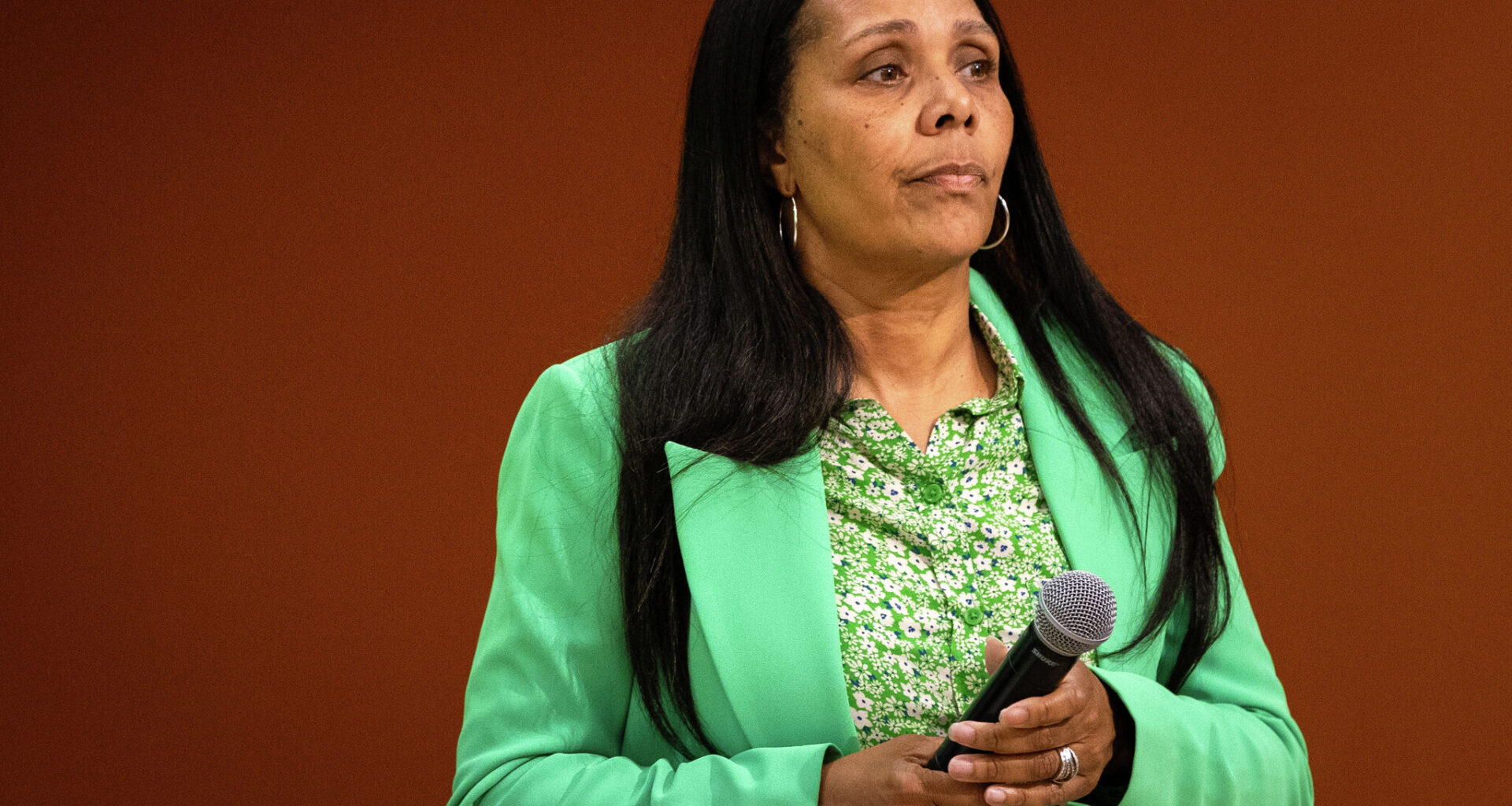
Sheryl Davis, once San Francisco’s most powerful civil rights watchdog, continued her spectacular fall on Monday when she was booked on suspicion of a raft of felony financial misconduct and ethics-related charges, the Chronicle has learned.
Manuel Orbegozo/For the S.F. Chronicle
James Spingola surrenders to authorities Monday morning. Spingola was being held on unspecified charges.
Benjamin Fanjoy/For the S.F. Chronicle
Sheryl Davis, who oversaw the San Francisco Human Rights Commission under former Mayor London Breed, was booked on the same morning as James Spingola, the former CEO of Collective Impact, a nonprofit Davis funded. Spingola is shown in a 2018 file photo.
Santiago Mejia/S.F. Chronicle
San Francisco District Attorney Brooke Jenkins speaks at a news conference about charges filed against Sheryl Davis and James Spingola, with, from left, Assistant District Attorney Matt McCarthy, Chief Investigator Andrea Moreland, Assistant District Attorney Erin Loback and district attorney investigator Hung LeDang.
Mike Barba/S.F. Chronicle
Once San Francisco’s most powerful civil rights watchdog, Sheryl Davis continued her spectacular fall on Monday when she surrendered to authorities to face accusations that she misappropriated funds and engaged in “pervasive” self-dealing while leading a landmark initiative meant to benefit the city’s Black community.
District Attorney Brooke Jenkins filed a raft of felony financial misconduct charges against Davis, who oversaw the San Francisco Human Rights Commission under former Mayor London Breed, and James Spingola, the former CEO of Collective Impact, a nonprofit Davis funded.
A sweeping, 57-page affidavit supporting a warrant for their arrests outlines numerous alleged conflicts of interest, misspending of city funds and self-dealing by Davis that benefited her, her family and her allies.
Article continues below this ad
“She created a scheme that she believed no one would challenge, that no one would shed light on,” Jenkins told the Chronicle. “It really is an unfortunate situation in which now the Black community has lost out on this opportunity because of this abuse of power.”
Jenkins told reporters that Davis misappropriated about $350,000 in public funds from her department and the Dream Keeper Initiative that Breed created in 2021 to invest tens of millions into the Black community.
San Francisco Chronicle Logo
Make us a Preferred Source to get more of our news when you search.
Add Preferred Source
Davis and Spingola have previously denied wrongdoing, and Davis and her allies have argued they were subject to unfair and racially motivated scrutiny. Davis’ attorney, Tony Brass, pushed back on the charges Monday and said Davis had not sought to enrich herself with public resources.
District Attorney Brooke Jenkins holds a news conference to discuss the case against Sheryl Davis at the San Francisco District Attorney’s Office.
Laura Morton/Special to The Chronicle
The charges represent a stunning blow to Davis, a friend and ally of Breed who was held up as a local hero for her work with the city’s Black community. Two years ago, the Chronicle named her one of the 20 most influential people in San Francisco.
Article continues below this ad
Davis’ position overseeing Breed’s Dream Keeper Initiative gave her sway over city spending beyond her own department. Beyond City Hall, she led a community group, MegaBlack SF, whose members used a call and response chant that contained the line, “we give all honor to our queen Sheryl Davis.”
But her alleged disregard for city rules and blurring of the lines between her public and private lives prompted investigations by journalists and four city agencies. The new charges reflect and expand upon previous reporting by the Chronicle.
Davis and Spingola were booked Monday morning and each held on $50,000 bail, jail records show.
Davis faces 13 counts of having a financial conflict of interest in a government contract, one count of misappropriating public money, three counts of perjury, one allegation of accepting a gift from a restricted source, and one count of having a financial conflict of interest in a government decision. If convicted, she could face prison time, fines and a permanent ban from public office.
Spingola is charged with four felony counts of aiding and abetting a financial conflict of a government contract.
Article continues below this ad
The criminal case is likely to draw national attention given President Donald Trump’s opposition to anti-discrimination programs. The head of the Department of Justice’s Civil Rights Division, Harmeet Dhillon, reacted on social media this month to a conservative activist’s attack on the Dream Keeper Initiative, which continues at a smaller scale under Mayor Daniel Lurie. Dhillon responded to the piece, which described the program as a “race-based slush fund,” with one word: “what.”
The DOJ declined to say whether it was investigating the program, but the charges could prompt new questions about its future.
Jenkins called the impact of Davis’ conduct devastating.
“Anyone else who even thinks of granting money to Black nonprofits will think twice and will second-guess themselves,” Jenkins said. “This broke the trust for the entire community.”
The Dream Keeper Initiative was San Francisco’s response to the Minneapolis police killing of George Floyd. The effort started with a pledge to redirect $60 million a year from law enforcement, funding programs aimed at helping the city’s dwindling Black population. Collective Impact, which runs a community center in the Western Addition, was among the largest beneficiaries of Dream Keeper dollars.
Davis, 57, previously led Collective Impact and was close with her successor, Spingola, who is 65. The pair lived together, traveled together and shared bank accounts and a car, prosecutors said. She signed city contracts awarding Collective Impact $1.5 million in Dream Keeper funds in 2021 and 2022. During that time, she never disclosed to the city her financial interests in Collective Impact or her close relationship with Spingola, according to the affidavit.
Article continues below this ad
Collective Impact was an organization that Davis “used to lead, but never really let go of,” prosecutors said. Years after leaving the nonprofit for public service, Davis retained control over its spending and used its publicly and privately funded bank account as a “slush fund” for her department, according to the district attorney.
“In short, Davis, as a City department head responsible for fairly distributing huge sums of public money, improperly gave millions of dollars to an organization she effectively controlled and directly profited from,” prosecutors wrote.
Brass told the Chronicle on Monday that Davis had been “very candid” with city investigators.
“She had proactively disclosed that she had conflicts of interest with Collective Impact,” he said. “The city hired her from Collective Impact, and then had her do business with Collective Impact, and then acts surprised there might be conflicts of interest there.”
“It’s as strange to me now as it has been throughout this whole process,” he added.
Article continues below this ad
Spingola’s attorney, Randy Knox, said that he had not yet had a chance to review the evidence against his client but that he had confidence in the judicial process.
“He’s presumed innocent,” he said. “I understand the district attorney is doing a press conference later today. I’m not going to try this case in this press. This should be more about public corruption, not public relations.”
Davis wrote a letter disclosing her prior employment with Collective Impact, but did not document her close personal relationship with Spingola or ongoing financial entanglements.
The probe found that Davis engaged in numerous acts of self-dealing. For example, prosecutors said Spingola made rent payments to Davis while she signed off on the city contracts that paid his salary. She used city funds to pay a public relations firm for work on her “personal website and her personal ‘brand management,’” according to the affidavit. She allegedly arranged the sale of 1,500 copies of her self-published children’s book, “Free to Sing,” to the San Francisco Public Library, costing taxpayers $10,000 and netting Davis about $5,000 in profit.
Prosecutors unearthed bank records that revealed another alleged conflict of interest with a different Dream Keeper recipient, the Homeless Children’s Network. Davis signed contracts granting the nonprofit $3.5 million around the time it paid her son nearly $140,000, depositing the money in a bank account Davis jointly held with him. Prosecutors called the payments to her son questionable and said he often got to set his own pay rate.
Before becoming one of the city’s most powerful officials, Davis worked as a teacher and on literacy initiatives and other programming for youth in the Western Addition. She became the executive director of Collective Impact in 2011. Former Mayor Ed Lee appointed her director of the Human Rights Commission in 2016.
Spingola began his tenure at Collective Impact in 2004, a week after he finished serving a sentence for bank robbery, and eventually became the organization’s executive director. He moved in with Davis and her son in 2015 after he was diagnosed with cancer, according to depositions the duo gave in 2018 as part of a lawsuit. Davis said she rented Spingola a room for $3,000 a month because she wanted to help him.
Davis and Spingola have each denied being romantically involved, though their close relationship was an open secret at City Hall. Investigators said the two lived together for more than a decade, shared multiple bank accounts, co-owned a vehicle, and traveled together to Hawaii, Houston and Washington, D.C. At least once, Davis claimed Spingola was “her spouse” on a credit card application.
“The actual nature of their relationship — romantic or friendship — does not matter,” prosecutors wrote in charging documents. “At least half the rent on the home in which Davis lived at the time she was making contracts and steering Dream Keeper money to Collective Impact was paid by Spingola, whose paycheck came from Collective Impact.”
The city began investigating the pair in July 2024 when an anonymous whistleblower complained to the San Francisco Controller’s Office, alleging “financial improprieties by Davis in her role at the Human Rights Commission,” according to the charging documents.
In the months that followed, stories in the Chronicle scrutinized Davis’ leadership. The newspaper revealed Davis’ decision to fund Urban Ed Academy, an education nonprofit that used grant money to place aspiring teachers in Oakland schools despite city officials saying that Dream Keeper money should fund San Francisco initiatives. Davis responded to the story a week later asking for a full audit of Dream Keeper spending, only to resign Sept. 13 after the Chronicle raised questions about her use of Dream Keeper funds and the San Francisco Standard published a story revealing that Davis and Spingola lived together.
Amid the fallout from the scandal, Davis’ second-in-command, Saidah Leatutufu-Burch, resigned, In December 2024, two city departments canceled contracts with Collective Impact.
Chronicle reporters also charted Davis’ use of city dollars to promote her personal podcast and writing career, documented a “hornets’ nest” of conflicts of interest involving her relatives and revealed that she had accepted a $5,500 painting from Urban Ed Academy, which the controller’s office said in a 2025 report created the “appearance of a bribe.”
Two weeks after the controller’s report, City Attorney David Chiu moved to suspend Collective Impact’s ability to contract with the city, citing revelations that the nonprofit helped pay for marketing expenses for Davis’ book and her son’s tuition at UCLA. In August, the nonprofit pushed back, saying the city’s actions would force its potential closure. (It continues to operate today.)
The city attorney and controller fired another salvo at Davis in September, releasing a joint audit report of Dream Keeper spending that found that Davis fostered an “unethical tone at the top” and that the program misused more than $4 million in ways the controller called “frivolous, unethical and unjustifiable.”
The city’s legal battle with Davis and Spingola suffered a setback in October, when a hearing officer shot down officials’ efforts to bar the nonprofit from obtaining city contracts, saying the city had not proved that Collective Impact intended to break the rules. Collective Impact’s board said the findings vindicated the organization and also announced that Spingola was stepping down.
The city has since said it plans to appeal the ruling, calling it a “bizarre decision with no reasoning or analysis.”
The City Attorney’s Office said Monday that it’s going to suspend Davis, Spingola and Collective Impact from bidding on or receiving new contracts from the city based on the new charges and that the appeal of the debarment decision continues.
“The District Attorney’s Office did a fantastic job investigating this case, pushing the issue forward, and bringing accountability,” City Attorney spokesperson Jen Kwart said in a statement.
The San Francisco Ethics Commission in November brought its own charges against Davis, formally accusing her of more than 30 conflict of interest violations, including unlawfully accepting first-class flight upgrades and other gifts from city-funded nonprofits around the same time that she funded those organizations with taxpayer dollars. Each of the 30 counts carries a fine of up to $5,000.
Davis has denied all wrongdoing in the ethics case while citing her Fifth Amendment right to not incriminate herself. In January, her lawyers attempted to pause the ethics inquiry, saying the commission should hold off until prosecutors decide whether to charge her.
On Monday, after an 18-month investigation, Jenkins answered that unresolved question.
Jenkins said she was well aware of the fraught racial dynamics of the case, and the criticism San Francisco might face for “even setting aside those funds for the Black community.”
But Jenkins defended the prosecution, saying her office focused on conduct not race and its job is to ensure equal treatment and build trust “so that justice is served for all.”
“We had a job to do,” Jenkins said. “We did the investigation. It has led us here to where we are at.”