
This is The Poynter Report, your daily guide to the news about news. Subscribe to get it in your inbox every weekday.
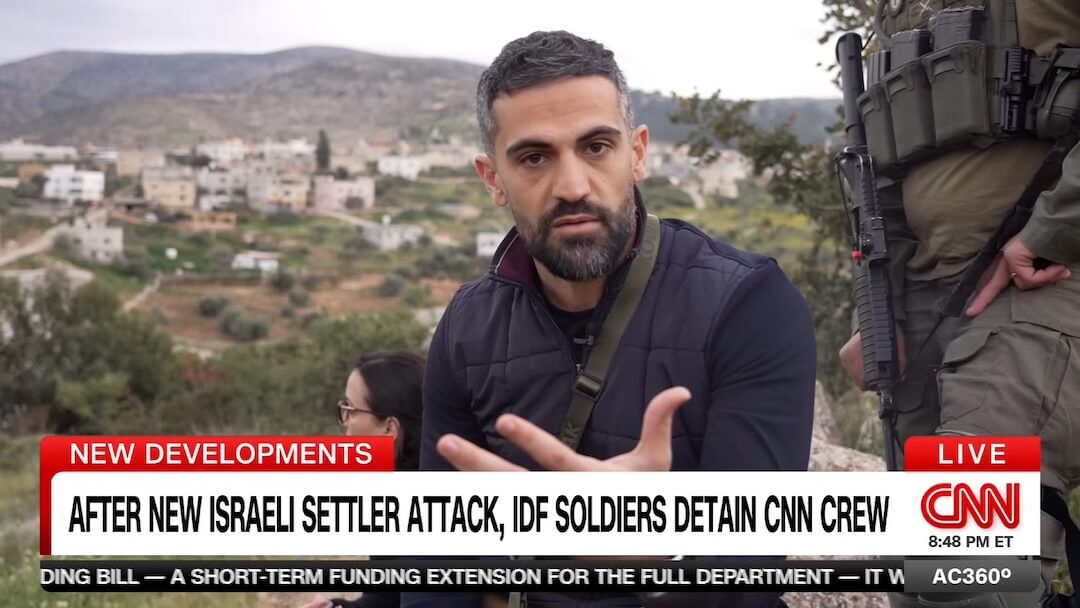
Late last week, CNN’s Jeremy Diamond reported that he and his crew were detained and assaulted by members of the Israeli military while reporting from the West Bank. (The link above includes video of the incident.)
Over the weekend, Diamond wrote that CNN was covering a story about Israeli settlers brutally attacking several Palestinians and establishing a new illegal outpost in the village of Tayasir. While there, Diamond reported, Israeli soldiers pointed guns at the CNN team and ordered them to sit.
Diamond wrote, “Seventy-three seconds later, one of the soldiers came up behind CNN photojournalist Cyril Theophilos and put him in a chokehold, bringing him to the ground and damaging his camera. Within minutes, we and several Palestinians in the area were detained by the soldiers.”
Another soldier knocked Diamond’s cellphone out of his hand as other soldiers pointed their guns.
The crew was detained for two hours by a reserve battalion of the Israeli military.
Diamond wrote, “The two hours we spent detained by them laid bare the settler ideology motivating many of the soldiers who operate in the occupied West Bank — and the ways in which soldiers frequently act in service of the settler movement. Their comments build on a large body of evidence documented by journalists, activists and Palestinians that show Israeli soldiers supporting or standing idly by as Israeli settlers attack Palestinians or encroach on their land.”
Here’s a photo of a soldier watching the CNN crew as they were being detained in their vehicle:
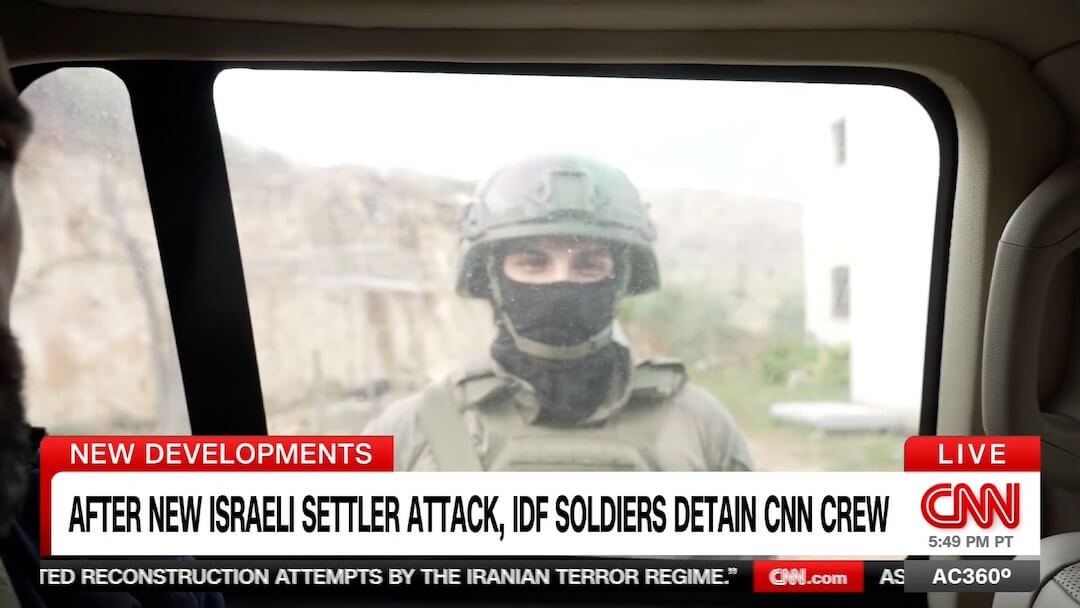
(Courtesy: CNN)
After the journalists were released, the Israeli military told CNN, “The actions and behavior of the soldiers in the incident are incompatible with what is expected of IDF (Israel Defense Forces) soldiers operating in the Judea and Samaria area.”
On Sunday, Nadav Shoshani, a spokesperson for the Israeli military, said in a news briefing, “It was a bad incident that shouldn’t have happened. It doesn’t represent how our soldiers should speak or act.”
Then on Monday, Diamond and Tal Shalev reported that the Israeli military’s top general suspended all operational activities of the reserve battalion and that one soldier had been dismissed from military service.
Diamond and Shalev wrote, “The reserve battalion, which is comprised of hundreds of reservists who served in the ultra-Orthodox Netzah Yehuda battalion, will be immediately withdrawn from the West Bank and reassigned to training until further notice, an Israeli military official said. The sweeping disciplinary action by Lt. Gen. Eyal Zamir, the Israeli military chief of staff, appears to be unprecedented in speed and scope, coming about 48 hours after CNN’s report about the incident first aired. It also appeared to reflect growing concerns inside the Israeli security establishment about spiraling Israeli settler violence in the West Bank.”
The assault on Theophilos, the CNN photojournalist, will be investigated by Israel’s military police.
In a statement, the IDF said the incident was a “serious ethical and professional failure.”
Over the past couple of weeks, we’ve seen the phrase “boots on the ground” as it relates to the United States’ war with Iran. Essentially, it means the possibility of the U.S. sending military personnel into Iran.
It’s not a new phrase. Back in 2008, William Safire — the legendary syndicated political columnist for The New York Times and author of the “On Language” column in the Times — did a piece on the origins of “boots on the ground.” With the help of a historian, Safire pointed to a 1980 article in the Christian Science Monitor about the Iranian hostage crisis. It quoted U.S. four-star Gen. Volney Warner as saying, “getting U.S. combat boots on the ground.”
A 2014 BBC article notes that British military officer Sir Robert Grainger Ker Thompson came close to using the phrase in his 1966 book about his experiences in Malaya and Vietnam. One of the chapters in the book was titled, “Feet on the Ground.”
Despite its unclear origins, the phrase is widely used. But, perhaps it shouldn’t be.
CNN media writer Brian Stelter made an excellent point in his “Reliable Sources” newsletter on Monday. Stelter wrote:
Can members of the media think twice before using the term “boots on the ground” in every other sentence about the war? Those boots belong to people. We’re talking about American service members in harm’s way.
I know reporters and editors aren’t thinking too deeply about it when they use the phrase, but it really does abstract people into objects and soften the very serious stakes of warfare. It’s euphemistic when we need to be direct.
Well said.
The New York Times has cut ties with a freelance journalist after it discovered he used artificial intelligence to help him write a book review. TheWrap’s Corbin Bolies broke the story that said Alex Preston’s Jan. 6 review of Jean-Baptiste Andrea’s book “Watching Over Her” had similarities to an August 2025 review in The Guardian of the same book.
Preston’s review in the Times now includes this editor’s note:
A reader recently alerted The Times that this review included language and details similar to those in a review of the same book published in The Guardian. We spoke to the author of this piece, a freelancer reviewer, who told us he used an A.I. tool that incorporated material from the Guardian review into his draft, which he failed to identify and remove. His reliance on A.I. and his use of unattributed work by another writer are a clear violation of The Times’s standards. The reviewer said he had not used A.I. in his previous reviews for The Times, and we have found no issues in those pieces.
The Times also linked to The Guardian review in its note.
A Times spokesperson told Bolies that Preston, who has written six reviews between 2021 and 2026, would no longer write for the paper.
In an email to Bolies, Preston wrote that he had used an AI tool “improperly on a draft I had written” and that he failed to catch “overlapping language” from the Guardian story. He also wrote to Bolies, “I took responsibility immediately and apologized to The New York Times. Beyond that, I have nothing more to add.”
You get the sense that we might see more of these kinds of stories in the future. In this case, it’s good that the Times addressed the issue head-on and was transparent about it. On the other hand, the original problem was apparently discovered by a reader, not someone at the Times. It just goes to show that even at a respected and enormous news outlet such as The New York Times, these kinds of transgressions can sneak through if the proper guardrails — assuming they even exist — fail to stop them.
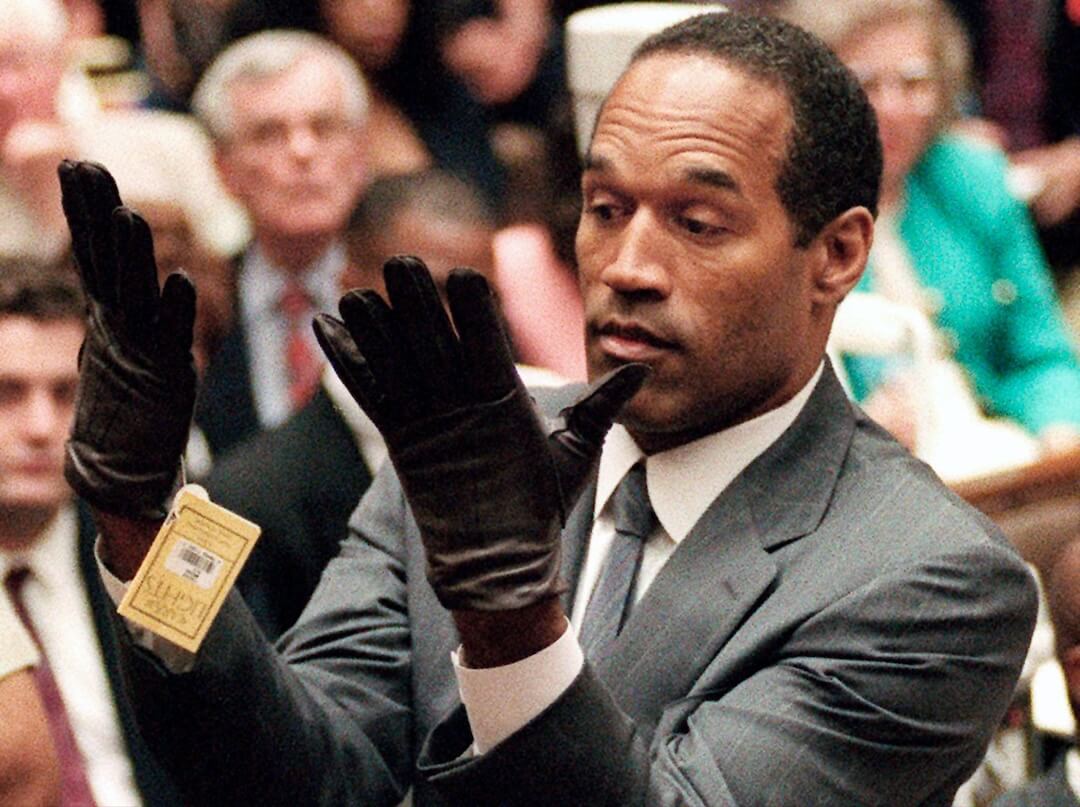
O.J. Simpson holds up his hands before the jury after putting on a new pair of gloves similar to the infamous bloody gloves, during his double-murder trial in Los Angeles in 1995. (Vince Bucci/Pool Photo via AP)
Be sure to check the latest story in our “Poynter 50” — a series reflecting on 50 moments and people that shaped journalism over the past half-century — and continue to influence its future. My colleague, Amaris Castillo — who, by the way, has become our go-to reporter in this series — looks back at something most of you remember quite well in “The O.J. Simpson trial ushered in the era of infotainment.”
Castillo talks with Geraldo Rivera, the longtime TV journalist and personality who covered the trial prominently on his “Rivera Live” program on CNBC. Rivera told Castillo, “This story had everything. O.J. Simpson was enormously well-known — almost universally adored, certainly loved, even beloved. And the crime was so brutal, and the victim so sympathetic, it had every element that you could expect for a huge audience.”
Castillo’s story isn’t about reliving what happened, but looking into how it changed the media landscape.
No reporter has done more reporting and had more of an impact on the Jeffrey Epstein story than the Miami Herald’s Julie K. Brown.
The Hollywood Reporter’s Rick Porter sums it up well when he writes, “Brown’s 2018 reporting in the Miami Herald led to a raft of new charges of sex trafficking against Epstein — who had previously been convicted on charges of procuring a minor for prostitution and soliciting a prostitute — and (partner Ghislaine) Maxwell and led the to the still-ongoing calls for the Department of Justice to release its complete files on Epstein and his associates and acquaintances, who included presidents (Donald Trump and Bill Clinton), royals (Britain’s former Prince Andrew) and prominent business leaders and media figures.”
Now actress Laura Dern and director/producer/writer Adam McKay are teaming up for a limited series about the Epstein story, with Dern scheduled to play Brown.
Dern and McKay are working with Sony Pictures, which describes the series as “an explosive account of an investigative reporter exposing the secret plea deal between Epstein and federal prosecutors. Drawing from Brown’s experience as a groundbreaking reporter for the Miami Herald, the book and the limited series follow her relentless years-long investigation that identified 80 victims, persuaded key survivors to go on the record, and led to Epstein and Ghislaine Maxwell’s arrests.”
Brown, Dern and McKay will all serve as executive producers. Sharon Hoffman, who has been a writer on “Mrs. America” and “House of Cards,” will write the project and serve as co-showrunner with Eileen Myers, who is known for her work as a producer on “Masters of Sex” and “The Night Agent.”
Become a Poynter Member by April 1 to save on our AI for journalists course. Join now. Get the tools, mentorship and peer community to turn your non-fiction book idea into a publishable proposal. Apply for our workshop today. New editors: Get guidance from industry veterans and build the skills you need to become indispensable to your newsroom. Apply now.
Have feedback or a tip? Email Poynter senior media writer Tom Jones at tjones@poynter.org.
The Poynter Report is your daily dive into the world of media, packed with the latest news and insights. Get it delivered to your inbox Monday through Friday by signing up here. And don’t forget to tune into our biweekly podcast for even more.