
Welcome back to World Brief, where we’re looking at major U.S. and Iranian military operations, concerns that Hungary is too close to Russia, and Israel’s new capital punishment law for Palestinians in the West Bank.
Under Fire
U.S. Defense Secretary Pete Hegseth warned on Tuesday that the next few days of the Iran war will be decisive, just 24 hours after President Donald Trump vowed to obliterate Iran’s energy sector if Tehran does not reopen the Strait of Hormuz and agree to a peace deal by April 6.
But Iran does not appear deterred. Instead, the country’s Islamic Revolutionary Guard Corps (IRGC) warned on Tuesday that Iranian forces will begin targeting U.S. companies in the Middle East on Wednesday. Seventeen major corporations were listed as targets: Cisco, HP, Intel, Oracle, Microsoft, Apple, Google, Meta, IBM, Dell, Palantir, Nvidia, J.P. Morgan Chase, Tesla, GE, Spire Solution, and Boeing. The Emirati company G42 was also listed.
Tehran said that the looming strikes are in retaliation for U.S. assassinations in Iran and for some of these companies’ involvement in U.S. defense contracts. The IRGC warned the companies’ employees and civilians within 1 kilometer of their facilities to evacuate and said that it would begin the strikes on Wednesday at 8 p.m. local time.
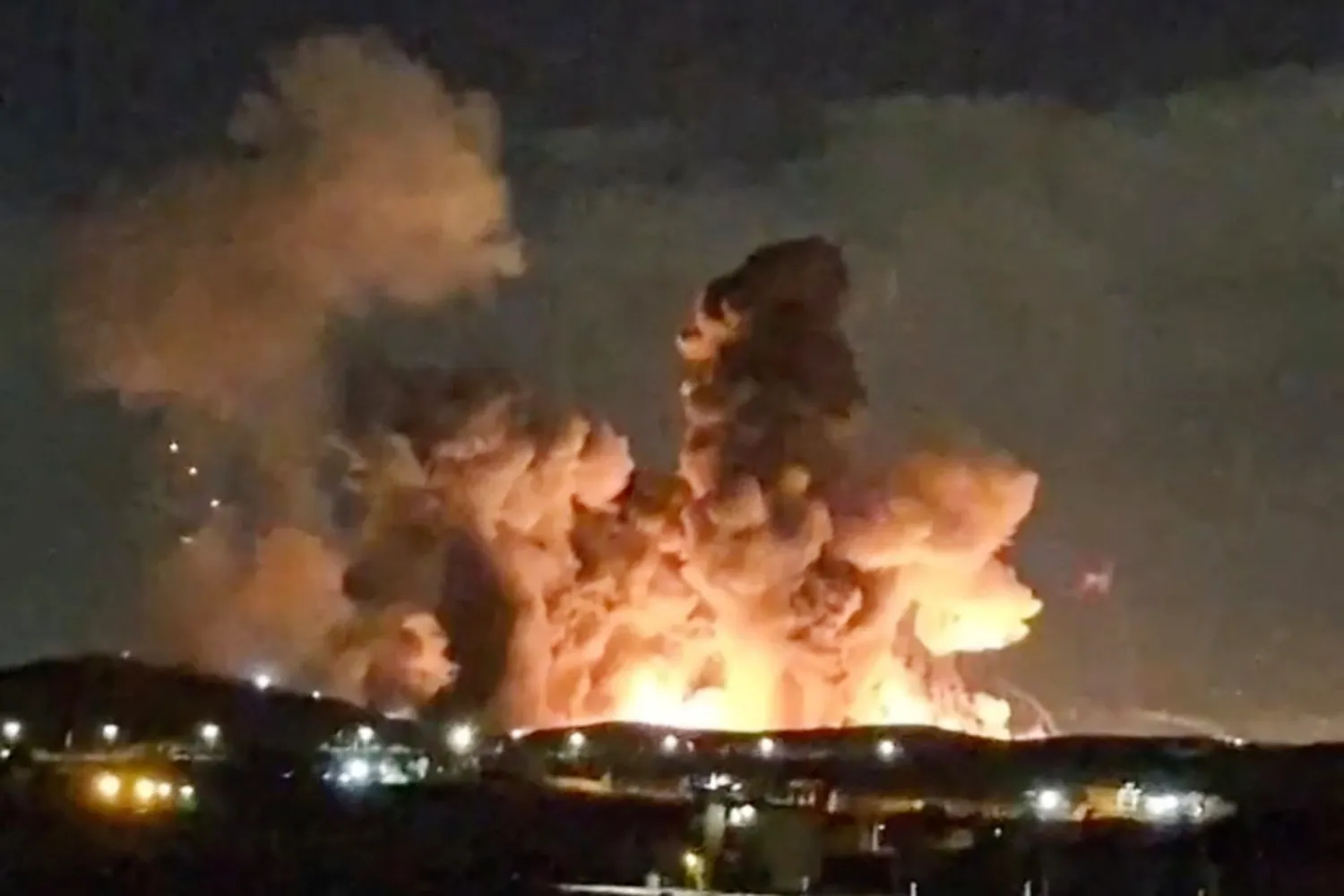
The threat comes amid a slew of major military operations on both sides. A U.S. official told the Wall Street Journal on Tuesday that U.S. forces bombed an ammunition depot in Esfahan, the city where one of Iran’s main nuclear facilities is located. The attack used 2,000-pound bunker-buster bombs, which are much smaller versions of the same type of weaponry that the United States used to strike the Esfahan nuclear site (along with two others) last June.
Also on Tuesday, U.S. Joint Chiefs of Staff chairman Gen. Dan Caine confirmed that U.S. troops have begun flying B-52 bombers over Iranian territory for the first time since the war began. Using this strategic bomber—built by Boeing, one of the IRGC’s listed targets—suggests that Iran’s air defenses may be significantly degraded. According to Caine, the U.S. military has struck more than 11,000 targets inside Iran and is now focused on destroying supply chains that are vital to Tehran’s missile-, drone-, and ship-building facilities.
Meanwhile, Iranian forces set ablaze a fully loaded Kuwaiti oil tanker at a Dubai port on Tuesday. The attack was just the latest Iranian assault on merchant vessels and energy assets in and near the Persian Gulf. Since mid-March, Iran has effectively shut down traffic through the vital Strait of Hormuz, which connects the Persian Gulf to the Gulf of Oman; more recently, Tehran has transformed the strategic waterway into a “toll booth,” rerouting ships to an alternate path close to the Iranian coastline and even charging some ships as much as $2 million per transit.
All of this has caused an unprecedented disruption to global energy flows. U.S. gas prices exceeded an average of $4 a gallon on Tuesday for the first time since 2022, when Russia launched its full-scale invasion of Ukraine. And Brent crude prices continue to hover above $100 per barrel—up from roughly $70 before the conflict began on Feb. 28.
European Union energy ministers convened an emergency meeting on Tuesday to warn of prolonged turmoil in the energy sector, specifically for jet fuel and diesel supplies. “It will not be short because even if there was a peace tomorrow, there will still be consequences because energy infrastructure in the region has been ruined by war,” EU Energy Commissioner Dan Jorgensen said.
The bloc is considering reviving several crisis measures that were last used in 2022 to address the problem. They include potentially curbing grid tariffs and taxing electricity. But Trump has a different message for Washington’s European allies: “I have a suggestion for you: Number 1, buy from the U.S., we have plenty, and Number 2, build up some delayed courage, go to the Strait, and just TAKE IT. You’ll have to start learning how to fight for yourself, the U.S.A. won’t be there to help you anymore, just like you weren’t there for us.”
Today’s Most Read
What We’re Following
Leaked phone call. Hungarian Foreign Minister Peter Szijjarto told his Russian counterpart, Sergey Lavrov, in August 2024 that Hungary (alongside Slovakia) would submit a proposal to remove the sister of a Russian oligarch from the European Union’s sanctions list, according to leaked audio of the call that was published on Tuesday. Gulbakhor Ismailova is the sister of Russian billionaire Alisher Usmanov, a close ally of Russian President Vladimir Putin; she was removed from the EU sanctions list seven months after the call.
VSquare, a Central European investigative news outlet, published the transcript and audio of the call, as well as calls between Szijjarto and other Russian officials, all of which it said were obtained and confirmed by a consortium of investigative news outlets consisting of VSquare, FrontStory, Delfi Estonia, The Insider, and the Investigative Center of Jan Kuciak.
Szijjarto’s conversation underscores European concerns that Hungary is too close to Russia. During the call, Szijjarto and Lavrov criticized then-EU foreign-policy chief Josep Borrell and expressed disdain for the bloc’s pro-Ukraine tilt. “I am always at your disposal,” Szijjarto told Lavrov before hanging up.
On Tuesday, Szijjarto confirmed that he had spoken with Lavrov and accused “foreign secret services” of wiretapping his calls, describing it as a “huge scandal.” Szijjarto also noted that the call became public just weeks before Hungary holds critical parliamentary elections. Last week, Hungarian Prime Minister Viktor Orban ordered an investigation into the alleged wiretapping of Szijjarto’s devices.
Several European officials on Tuesday spoke out about the call. “Hungary is and will be in the European Union. Victor Orbán and his foreign minister left Europe long ago,” Polish Prime Minister Donald Tusk wrote on X. Czech Republic President Petr Pavel said his country should reassess its contacts with Budapest.
However, Slovak Prime Minister Robert Fico pushed back against the bloc’s concerns, arguing that other EU members also voted to remove the sanctions on Ismailova. “You cannot accuse anyone of being a Russian agent,” Fico said. “Then you must accuse all 27 member states of being Russian agents if they have reached a decision.” The Kremlin has yet to issue a statement.
Capital punishment. The Israeli Knesset passed a law on Monday making death by hanging the default punishment for Palestinians in the occupied West Bank who are convicted of deadly attacks on Israelis. Execution by hanging must occur within 90 days of sentencing and offers no right to clemency. Life imprisonment is an alternative only in unspecified “special circumstances.”
Israeli Prime Minister Benjamin Netanyahu’s ring-wing allies celebrated the legislation’s passage. “This is a day of justice for the murdered, a day of deterrence for enemies,” National Security Minister Itamar Ben-Gvir told lawmakers on Monday. In recent years, far-right cabinet members have pressured Netanyahu to expand Israeli settlements in the West Bank despite them being illegal under international law.
However, rights groups condemned the law for its double standard between Israelis and Palestinians. Jewish Israeli settlers who commit similar crimes may not receive the same penalty, as the law only applies to Israelis whose attacks are aimed at “ending Israel’s existence.”
The Association for Civil Rights in Israel filed an appeal with Israel’s Supreme Court on Monday, arguing that the legislation is “unconstitutional, discriminatory by design and—for West Bank Palestinians—enacted without legal authority.”
Escalating gang violence. Armed members of Haiti’s Gran Grif gang killed at least 70 people and injured around 30 others during an attack on the Artibonite region that began on Sunday and stretched into Monday. According to the Defenseurs Plus rights group, gang members burned down dozens of residences and forced approximately 6,000 people to flee their homes in the Jean-Denis area.
The United Nations called for a thorough investigation on Monday. “This attack underscores the gravity of the security situation faced by the Haitian population,” said Stéphane Dujarric, a spokesperson for U.N. chief António Guterres. The incident follows U.N. reports that similar gang raids in nearby Verrettes recently displaced more than 2,000 people.
Last week, the United States offered a reward of up to $3 million for information that could help disrupt the financial mechanisms of Gran Grif and Viv Ansanm, another Haitian gang; the United States labeled both groups as foreign terrorist organizations last May. According to an audio message attributed to Gran Grif leader Luckson Elan, this week’s assault was in retaliation for a rival gang’s attacks on Gran Grif’s base in Savien, another town in the Artibonite region. Artibonite is Haiti’s largest department, a key agricultural sector, and the site of some of the country’s worst gang violence since the assassination of President Jovenel Moïse in July 2021.
Odds and Ends
France is not the only European country reeling from a lucrative art heist. Italian authorities revealed on Monday that thieves stole three paintings (in just three minutes!) from the Magnani-Rocca Foundation near the northern city of Parma on March 22. The masterpieces—Pierre-Auguste Renoir’s “Les Poissons,” Paul Cézanne’s “Still Life With Cherries,” and Henri Matisse’s “Odalisque on the Terrace”—were collectively worth around $10 million. A fourth work was abandoned at the scene after the museum’s security system interrupted the suspects. An investigation remains ongoing.