
I’m fairly obsessed with the serial damage the Iranians have done on Prince Sultan Air Base (and other US facilities) in Saudi Arabia. While there has been some superb work analyzing the second and third successful strike at Prince Sultan, this NYT article I keep returning to is the only one I’ve seen documenting the damage from the first strike, which hit a building close to a radar facility (ABC reported the strike itself).
On Saturday night, the Islamic Revolutionary Guards Corps announced that the Prince Sultan Air Base in Saudi Arabia had been targeted with missiles and drones. The following morning, satellite imagery captured a mile-long smoke plume rising from a building connected to the site.
Another satellite image captured on Tuesday showed the structure was largely destroyed.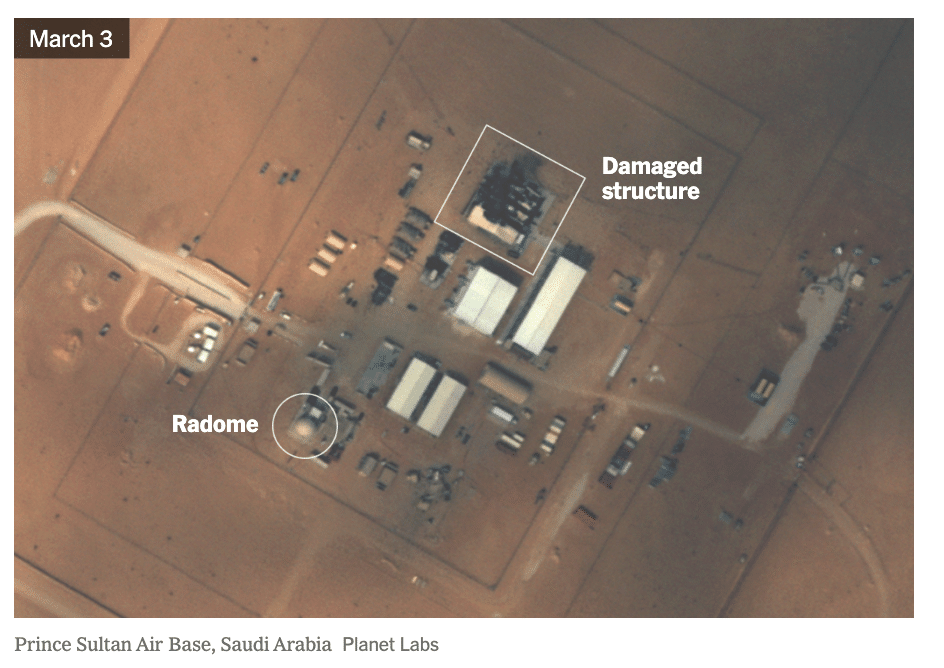
The building that was hit is close to a radome and sits within a fenced-off area roughly six miles east of the main base, indicating Iranians may have been specifically targeting a communications section of the site.
So the first thing Iran did when the US launched its attack was to target this facility in Saudi Arabia. Based on what I’ve seen publicly, this may not have been the most serious damage done in those initial attacks. But this piece assesses that one reason Israel is failing to intercept everything Iran launches at it may stem from a degradation of detection systems elsewhere in the region, including what ABC reports to be the AN/TPY-2 at Prince Sultan.
Reports based on available satellite imagery suggest that at least 10 U.S. radar sites in the Middle East have been hit by Iranian drones since the start of the war. These include multiple AN/TPY-2 radars used in the THAAD air defense systems, and an AN/FPS-132 Phased Array Radar in Qatar. Though the loss of a single radar would not disable the whole air defense network, the loss of 10 or more radars or sensing systems would significantly degrade the U.S. ability to identify and respond to incoming threats.
Not even the death of Benjamin Pennington a week later, understood to be a result of injuries suffered in that initial March 1 attack, has led to closer coverage of that strike. Who else was injured in the strike that ended up killing him? What was the facility that appears to have been destroyed?
On March 3, Iran succeeded in striking the part of the US Embassy in Riyadh housing the CIA station.
A suspected Iranian drone attack hit the CIA’s station at the U.S. Embassy in Saudi Arabia on Monday, in what would amount to a symbolic victory for the Islamic republic as it lashes out at U.S. targets and personnel across the Middle East, according to two people familiar with the matter.
The U.S. and Saudi governments confirmed that two drones hit the U.S. Embassy complex in Riyadh but did not disclose that America’s spy hub was hit in the attack.
No CIA personnel were wounded. The agency declined to comment.
The drone attack came three days into a conflict launched early Saturday by the United States and Israel on Iran. The waves of strikes that killed Iran’s supreme leader and scores of its senior military and political command have prompted fierce retaliation by the Islamic republic against U.S. and Israeli targets in the region, as well as those of Gulf partners.
An internal State Department alert obtained by The Washington Post said the drone attack “collapsed” part of the embassy’s roof and “contaminated” the inside with smoke. The notice said the embassy sustained “structural damage” and personnel “continue to shelter in place.”
Five days later, DOD announced the death, overnight on March 7, of a soldier they would later identify as Pennington.
Another American service member has died in the war with Iran, the Pentagon said on Sunday, bringing the number of American troops killed in the conflict to seven.
The service member, who was not publicly identified while the military notifies relatives, was seriously injured on March 1 when Iran struck a Saudi military base where American troops were stationed, U.S. Central Command said in a statement. The service member died on Saturday night from those injuries while military health officials were preparing a transfer for more advanced medical care at a U.S. military hospital in Germany, officials said.
Among the things we’ve never seen explained is why DOD hadn’t evacuated Pennington earlier.
The next day, March 9, several sources (of uncertain reliability) claimed that the US had evacuated a number of Boeing refueling tankers from the base to Europe after aggressive strikes on March 8.
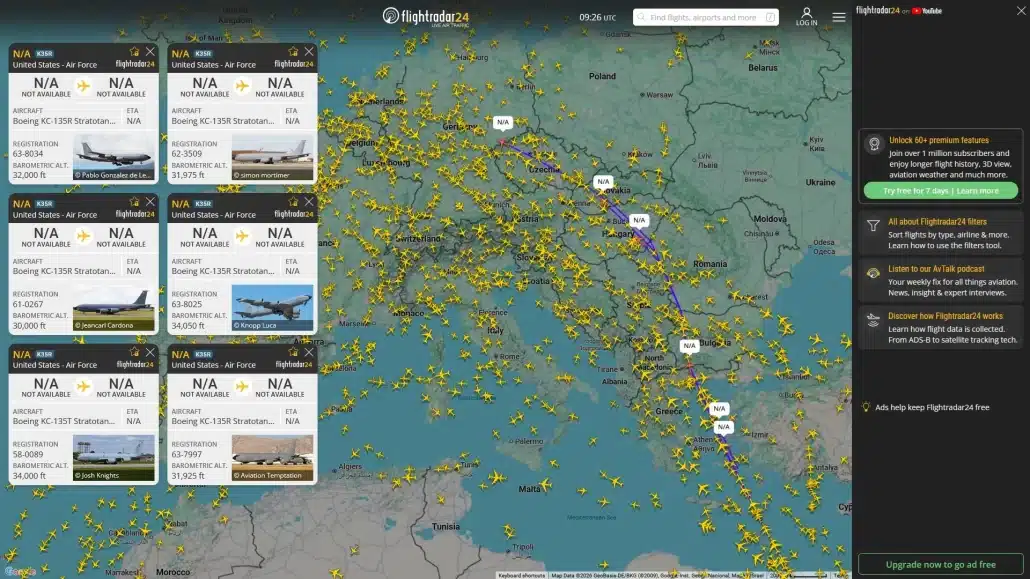
The decision to disperse KC-135 aerial refueling tankers from Prince Sultan Air Base follows a sustained Iranian missile and drone campaign targeting U.S.-linked military infrastructure across the Gulf, exposing the operational vulnerability of centralized logistics nodes that are essential to American airpower projection.
On 6 March 2026, Saudi air-defence systems intercepted three ballistic missiles and one drone directed toward PSAB, illustrating the persistent targeting of the base as part of a broader Iranian operational strategy aimed at disrupting U.S. military logistics and command support networks in the region.
Although Saudi and American air-defence systems successfully intercepted incoming threats during that attack, some missiles landed in close proximity to U.S. personnel operating at the installation, causing minor injuries and underscoring the operational danger posed by saturation missile attacks.
That report was all the more confusing given that five days after that, and one day after a tanker crashed in Iraq purportedly as a result of a collision with another one, killing its crew, Iran successfully hit at least five tankers, still at Prince Sultan.
An Iranian missile strike damaged five U.S. Air Force KC-135 Stratotanker refueling aircraft on the ground at Prince Sultan Air Base in Saudi Arabia, two U.S. officials told The Wall Street Journal.
The aircraft were parked on the flight line at the time of the strike and sustained damage but were not destroyed, according to the officials. The tankers are being repaired and are expected to return to service. No U.S. personnel were killed in the attack, The Wall Street Journal reported.
President Donald Trump disputed those characterizations in a Saturday Truth Social post, saying, “The Base was hit a few days ago, but the planes were not “struck” or “destroyed.” Four of the five had virtually no damage, and are already back in service. One had slightly more damage, but will be in the air shortly. None were destroyed, or close to that.”
Trump singled out The Wall Street Journal by name, saying its reporting was “the exact opposite of the actual facts.”
This is the strike that, according to NBC, Trump found out about by reading WSJ.
One example came this month when five U.S. Air Force refueling planes were hit in an Iranian strike at Prince Sultan Air Base in Saudi Arabia, according to one of the current U.S. officials. Trump wasn’t briefed about the strikes, and he learned what had happened from media reports, the official said. When Trump inquired, he was told the planes weren’t badly damaged, the official said.
The official said Trump reacted angrily behind the scenes to the news coverage. Publicly he posted on Truth Social calling coverage of the strike misleading and accusing media organizations of wanting the U.S. “to lose the War.”
Last Friday — as Anna Paulina Luna was hosting Russian Duma members and Trump and Jared was yucking it up at a Saudi investment conference in Florida — Iran struck again, destroying an AWACS radar plane.
The extent of the damage in Friday’s strike is still uncertain. One source says just one AWACS was hit (and destroyed). But NPR reported yesterday two were, in addition to 15 or so service members; other reports say more tankers were damaged.
But it will further degrade the US ability to protect its own resources.
The destruction of a US Air Force E-3 Sentry aircraft in an Iranian strike on a Saudi Arabia air base could damage US abilities to spot incoming Iranian threats at distance, analysts say.
Dramatic images of the wrecked aircraft, geolocated by CNN, show its tail broken off and its distinct rotating radar dome –– a critical part of the airborne warning and control system, or AWACS –– on the ground at the Prince Sultan Air Base.
The loss of the AWACS is “a serious blow to (US) surveillance capabilities,” said CNN military analyst Cedric Leighton, a former US Air Force colonel who has flown on the aircraft.
“It can potentially impact (US) ability to control combat aircraft and vector them to their targets or protect them from engagements of hostile aircraft and missile systems,” he said.
All this just documents what has happened at Prince Sultan Air Base (and the CIA station).
That’s separate from less successful Iranian efforts to damage Saudi oil capacity, which thus far have hit but done limited damage to refineries and drilling facilities.
[snip]
[snip]
Following the Saudis’ successful diversion of some production through a pipeline to Yanbu (on its west coast), the Houthis joined the fighting. Thus far, they appear to be targeting exclusively Israeli targets, but they can roil shipping through the Red Sea, thwarting the effort to shift shipping away from Hormuz, and might choose to focus on the closer Saudi oil facilities instead.
Still, particularly as compared to Qatar or UAE, the Saudi damage appears to come primarily at Prince Sultan.
Enter Zelenskyy
Amid all this turmoil (and even as Trump inches closer to selling out Ukraine to Putin), Volodymyr Zelenskyy attempted to gain a strategic advantage by offering Gulf nations Ukrainian expertise at countering the Iranian drones Russia has used for years, while at the same time scolding unnamed allies to stop complaining that Ukraine is targeting Russia’s energy facilities unless they arrange a ceasefire.
After the global energy crisis began, we received signals from some partners requesting that we reduce our responses targeting Russia’s oil and energy sector. I emphasize once again: if Russia is ready not to strike Ukraine’s energy infrastructure, we will not retaliate to theirs.
We are open to discussing any type of ceasefire—a full ceasefire, an energy ceasefire, a food security ceasefire. We have already proposed all of this, and we are still open. If the Russians are ready, let them suggest any timeframe—we are ready to resolve this issue.
Around ten days ago, a Ukrainian team started consulting with the Saudis, and last week, the Saudis signed a security agreement with Ukraine (which signed similar agreements with UAE, Jordan, and Qatar).
On Friday, after Ukraine laid out evidence that Russian intelligence was behind strikes like the ones on Prince Sultan Air Base, Representative Luna hosted her Russian buddies, discussing further rewards to Russia for helping Iran kill Americans.
And then Iran — once again presumably assisted by Russian intelligence — scored one of its most devastating strikes of the war, on Saudi soil.
Kiss my ass
In the wake of that devastating attack (though who knows whether Whiskey Pete bothered to tell Trump?), Trump went to a Saudi investors conference in Miami and told Mohammed bin Salman, the guy who chopped up an Jamal Khashoggi with a bone saw, to kiss his ass.
One year ago you were a dead country. Now, you’re the hottest country anywhere in the world. He didn’t think this was going to happen. He didn’t think he’d be kissing my ass. He really didn’t. He thought he’d be … just another American President that was a loser, where the country was going downhill. But now … he has to be nice to me. You tell him [voice roughens] he’d better be nice to me. He’s gotta be.
Apparently after Trump made those intemperate comments, according to what I consider well-placed but unverified Ukrainian chatter, Marco Rubio scolded the Saudis for signing an agreement with Zelenskyy without first consulting with the US.
U.S. Secretary of State Marco Rubio, on behalf of Donald Trump, expressed regret that the Saudi authorities signed defense agreements with Ukraine without consulting the United States, which had been Saudi Arabia’s main ally.
In response, Saudi Crown Prince Mohammed bin Salman noted that the U.S. had failed to fully protect the Kingdom from Iranian strikes, and therefore Saudi Arabia made a decision that could quickly strengthen its defense capabilities. The Crown Prince also stated that his country will continue to be guided by its own national interests when making decisions regarding its defense.
All that is background that hasn’t made it into multiple reports that have been treated as straight, albeit conflicting, reporting as Trump amasses an army to escalate the war against Iran (in an operation DOD claims, as it did the invasion itself, would only last a matter of weeks).
Pressure on and from the Gulf states
First, while MbS reportedly was always pushing for an attack on Iran (which makes Jared’s role in fucking up negotiations all the more problematic), in recent days, multiple outlets have described the pressure the Gulf states — the ones that America’s very pricey missile defense systems have failed to protect — are putting on Trump to keep fighting until he neutralizes the power he has given Iran.
While regional leaders are broadly supportive now of the U.S. efforts, one Gulf diplomat described some division, with Saudi Arabia and the UAE leading the calls for increasing military pressure on Tehran.
The UAE has emerged as perhaps the most hawkish of the Gulf countries and is pushing hard for Trump to order a ground invasion, the diplomat said. Kuwait and Bahrain also favor this option. The UAE, which has faced more than 2,300 missile and drone attacks from Iran, has only grown more irritated as the war grinds on and the salvos threaten to tarnish its image as the safe, pristine and monied hub for trade and tourism of the Mideast.
Oman and Qatar, which historically have played the role of intermediary between the long economically isolated Iran and the West, have favored a diplomatic solution.
The diplomat said Saudi Arabia has argued to the U.S. that ending the war now won’t produce a “good deal,” one guaranteeing security for Iran’s Arab neighbors.
The Saudis say an eventual war settlement must neutralize Iran’s nuclear program, destroy its ballistic missile capabilities, end Tehran’s support for proxy groups, and also ensure that the Strait of Hormuz cannot be effectively shutdown by the Islamic Republic in the future as it has during the conflict.
Yesterday, Karoline Leavitt claimed that Trump would ask the Gulf Arabs to pay for the war.
All that’s happening, though, while Trump is telling aides (to tell journalists) that he might just take his toys and go home without first opening Hormuz.
President Trump told aides he’s willing to end the U.S. military campaign against Iran even if the Strait of Hormuz remains largely closed, administration officials said, likely extending Tehran’s firm grip on the waterway and leaving a complex operation to reopen it for a later date.
In recent days, Trump and his aides assessed that a mission to pry open the chokepoint would push the conflict beyond his timeline of four to six weeks. He decided that the U.S. should achieve its main goals of hobbling Iran’s navy and its missile stocks and wind down current hostilities while pressuring Tehran diplomatically to resume the free flow of trade. If that fails, Washington would press allies in Europe and the Gulf to take the lead on reopening the strait, the officials said.
Particularly given the claim that Rubio scolded the Saudis for attending to their own security, there’s no reason to believe that Trump would treat MbS — bone saws and all — any differently than he would, say, Keir Starmer.
Trump believes he can bully allies into ceding to his demands before he sends American service members to risk their lives to unfuck a problem of his own creation. He’s presumably preparing to demand concessions from Gulf allies before he bails them out of the catastrophe he exposed them to.
The conflicting stories of the last few days are probably not conflicting at all. They simply reflect Trump’s belief that the way to gain concessions, even from close allies, is to bully them and issue threats in the press (which means, for better and worse, Trump is likely not going to leave without opening Hormuz).
It’s not at all surprising that the Gulf states expect Trump to unfuck the catastrophe he caused in the Gulf. The real drama is to see just how long MbS will accept anything less than obedience from Trump.
Timeline
February 28: Trump starts a war
March 1: Iran strikes facility at Prince Sultan, injures Benjamin Pennington
March 2: Drone attack on Ras Tanura
March 3: Iran strikes US embassy in Riyadh hitting the CIA station
March 6: Intercepted Iranian strike cause minor injuries
March 7: Pennington dies from his injuries after DOD fails to evacuate him to Germany
March 8: DOD announces Pennington’s death
March 9: DOD allegedly evacuates tankers from Prince Sultan to Europe
March 10: Drone strike at Ruwais
March 12: Incident involving two tankers flying over Iraq leads one to crash, killing its crew of six
March 14: Five tankers at Prince Sultan damaged, which Trump learned from the WSJ
March 19: Drone strike on Samref refinery on Red Sea
March 27: Significant strike takes out at least one AWACS plane and some more tankers, injures at least 15
March 28: Trump’s “kissing my ass” comments at Saudi conference