
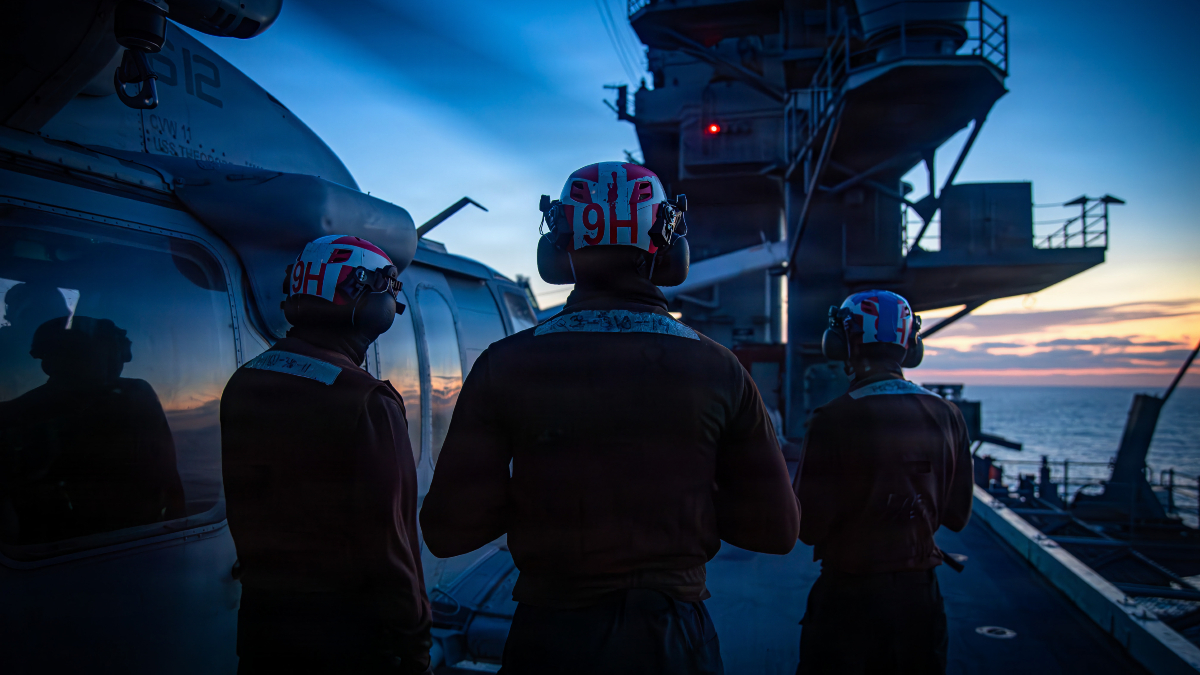
Another carrier strike group has deployed out of San Diego, the U.S. Navy confirmed, one month into the war on Iran, as the Secretary of Defense on Tuesday said he would not rule out boots on the ground.
The USS Theodore Roosevelt departed Sunday to conduct “routine operations,” leading naval forces in the Indo-Pacific, a spokesperson for the U.S. Third Fleet said, adding that the flagship of the carrier group has more than 5,000 Sailors and Marines “who are highly trained, tested and certified in all warfare areas.”
“In the interest of operational security, we do not discuss future operations, schedules, or specific personnel numbers,” the spokesperson said, before noting, “A carrier group’s mission can be changed at any time.”
The USS Roosevelt joins the USS Abraham Lincoln and the USS Boxer Amphibious Ready Group in deploying from San Diego as the conflict continues in the Middle East. While the USS Boxer carrier group included the 11th Marine Expeditionary Unit out of Camp Pendleton, the Navy said Tuesday that there is no MEU training with the Roosevelt carrier strike group.
While none of the thousands of troops currently deployed are in Iran, news of the latest deployment came as Defense Secretary Pete Hegseth said Tuesday that he would not publicly rule out boots on the ground.
“We’re not going to foreclose any option. You can’t fight and win a war if you tell your adversary what you are willing to do, or what you are not willing to do, to include boots on the ground,” Hegseth said in a news conference from the Pentagon. “Our adversary right now thinks there are 15 different ways we could come at them with boots on the ground. And guess what? There are.”
From the Oval Office Tuesday, President Donald Trump signaled a possible end to the war could be weeks away.
“We’re finishing the job. And I think within maybe two weeks, maybe a couple of days longer to do the job, but we want to knock out every single thing they have. Now, it’s possible that we’ll make a deal before that because we’ll hit bridges, and we’ve hit some,” Trump said. “If they come to the table, that’ll be good. But it doesn’t matter whether they come or not. We’ve set them back. It’ll take 15 to 20 years for them to rebuild what we’ve done to them.”
For military families in San Diego, the latest deployments have brought renewed uncertainty.
“The family member that’s left on that dock waving goodbye, you know, for them, they’re going back and trying to go back to their daily activities, but with not knowing what’s going to happen to their service member,” said Maggie Meza, executive director of the Southern California chapter of the nonprofit organization Blue Star Families, which connects military families with resources and community in San Diego.
“We live in such a beautiful place where we visually see our military. We see the ships out on the water and we can see our Marines on the base,” Meza said. “And I just think that we need to remember that these are human beings and, you know, they’re experiencing a lot of apprehension and living kind of on hope. And every day is new for them. And I just think that we as a community, you know, it’s time for us to step in and show them our support.”
“This type of situation, you don’t know how long the deployment is, right? So what’s the end state?” said Adm. David Boone (Ret.), who now leads the San Diego Military Advisory Council. “That’s a real challenge for our military community as they contemplate what their participation and role is going forward.”
Organizations assisting service members and their families said situations like this, when deployments are unexpected or earlier than planned, create stress for military families.
“When you get that order, you got to go. It’s a shock to the system. And you almost are numb for a while until it becomes a new normal,” Boone said. “As a family, you immediately try to think of every conceivable plan that, you know, you need to put in place to take care of your family before you go. And so it’s a drill. It really is.”
He pointed to San Diego’s Emergency Action Group, a coalition of five organizations including SDMAC, formed to assist military families, as a place to turn for San Diegans who want to show their support.
This story was originally reported for broadcast by NBC San Diego. AI tools helped convert the story to a digital article, and an NBC San Diego journalist edited the article for publication.