
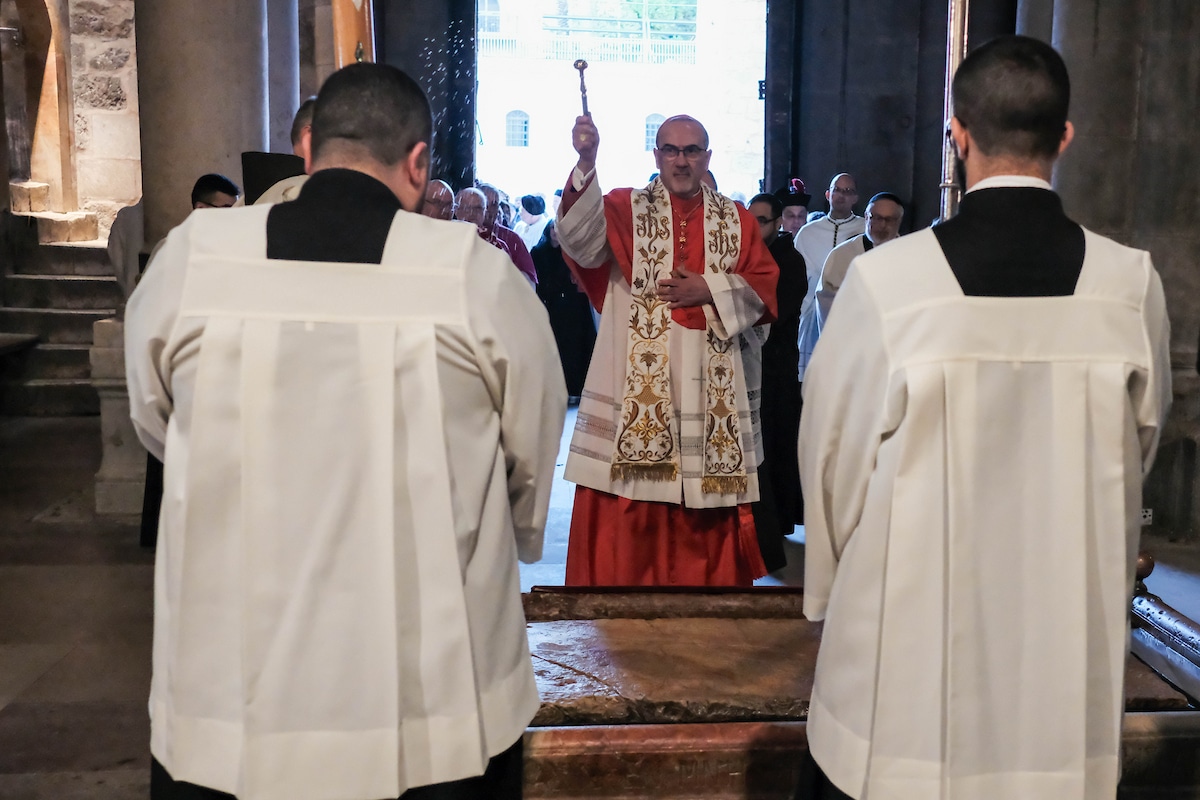
Last Sunday, Jerusalem’s Latin Patriarch Cardinal Pierbattista Pizzaballa and the Official Guardian of the Church Fr. Francesco Ielpo were barred by Israeli police from entering the Church of the Holy Sepulchre, the traditional site of Jesus’ crucifixion, burial, and resurrection. They had come to celebrate Palm Sunday, the first day of Holy Week, during which Christians around the globe remember Jesus’ life and death.
Since the start of the Israel-U.S. war on Iran, the church and other Christian and Islamic holy places have been closed to the faithful and to international pilgrims. But clergy had been allowed to conduct services inside. The church’s complete closure came as a surprise.
It marks the first time in centuries that Christian leaders have been prevented from celebrating Palm Sunday mass in Christendom’s holiest site, and a further erosion of the Status Quo.
Prime Minister Netanyahu’s explanation for the closure–”to protect worshippers”–was patently false, and Israeli police explanations for their action were equally duplicitous.
According to a Sunday press release from Jerusalem’s Latin Patriarchate, preventing the Patriarch’s entrance to the church “constitutes a manifestly unreasonable and grossly disproportionate measure.” The Patriarchate continued, “This incident is a grave precedent and disregards the sensibilities of billions of people around the world who, during this week, look to Jerusalem.”
The Patriarchate also warned of a growing and even graver threat to both Palestinian and Muslim worshippers when it charged that the “hasty and fundamentally flawed decision… represents an extreme departure from basic principles of reasonableness, freedom of worship, and respect for the status quo.”
Fr. Fadi Diab, Anglican priest at Ramallah’s St. Andrew’s Episcopal Church, told Mondoweiss, “The denial of Cardinal Pierbattista Pizzaballa’s access to the Church of the Holy Sepulchre has intensified concerns among Christian communities regarding increasing restrictions on religious practice in Jerusalem… Within this broader context, Sunday’s incident is not viewed in isolation but as part of a pattern of sustained pressure on the Christian community in Palestine.”
Similarly, in an Instagram post from the Jordanian television network, AlMamlaka TV, Greek Orthodox Archbishop Atallah Hanna condemned Sunday’s police action and repeated Diab’s characterization of Israel’s actions as part of a disturbing pattern, charging, “The prevention of his Beatitude and the Guardian of the Holy Places from entering the Church of the Holy Sepulchre falls squarely within a deliberate, systemic plan aimed at changing Jerusalem and marginalizing Christian and Islamic and Palestinian [life] in the Holy City.”
Hanna continued, “This, of course, is an attack on Jerusalem, its identity, its history, its heritage as Christian and Islamic holy sites.”
Diab and Hanna, like the Patriarchate, point to the centuries-old Status Quo, which refers to the historical rights governing Christian and Muslim holy places and institutions. Over time, these rights extended beyond the management of holy sites to safeguard many aspects of the daily life of Christians and Muslims under occupation in Jerusalem. Formalized during the Ottoman period, the Status Quo has been embedded since then in international law, including in UN resolutions.
According to the Status Quo, the closure of the Holy Sepulchre, Al-Aqsa Mosque/Haram Al-Sharif, and other holy places is a prerogative of the religious authorities, not the police.
“The Status Quo is not merely a local or customary practice, but a binding legal framework that must be respected by all actors, including an occupying power,” according to a report on the history of and the current obligations under the Status Quo. The 33-page analysis with recommendations was released this past Sunday by Basalan Initiative for Human Rights—an independent, non-partisan Palestinian human rights organization.
“Since the outset of its occupation and illegal annexation of Jerusalem, Israel adopted a policy of unilateral modifications to undermine the Status Quo, through administrative, legislative, and practical measures, which constitute clear violations of international law, and of its obligations as an occupying power,” according to the report. “Israel’s Systematic Breaches of the Status Quo of Jerusalem and The Consequential Erosion of Christianity: Between the Israeli Occupation and International Complicity.”
The barring of Patriarch Pizzaballa, it turns out, is just one of many developments pointing to the erosion of the Status Quo governing Jerusalem. As the Basalan report lays out, these include repeated Israeli plans to impose taxation and administrative measures targeting church properties and institutions, Israel’s restrictions on freedom of Christian and Muslim worship especially during major religious observances, and demographic and social pressures resulting from Israel’s discriminatory laws and policies, including residency revocations and restrictions on movements—all of which, according to the report, contribute “to the shrinking presence of Palestinian Christian and Muslim communities in Jerusalem.”
In his conversation with Mondoweiss, Fr. Diab pointed to Israeli actions in the wider West Bank, in the Christian communities of Taybeh and Aboud, including “recurring reports of land restrictions, settler-related violence, and movement constraints that disrupt both daily life and religious observance.” He said, “Such conditions are contributing to increased emigration and undermining the social fabric that has sustained a continuous Christian presence in the Holy Land for centuries. Taken together, these developments are increasingly seen as posing a significant threat to the continuity of Christianity’s historic roots in the region.”The Basalan report insists, “Preserving the Status Quo is not solely a matter of protecting historic arrangements; it is essential to ensuring the continued religious, cultural, and communal diversity of Jerusalem. Its erosion risks irreversible consequences for the city’s identity and for the presence of its indigenous Christian and Muslim communities. As such, safeguarding the Status Quo must be recognized as a shared international responsibility requiring immediate and sustained engagement.”