
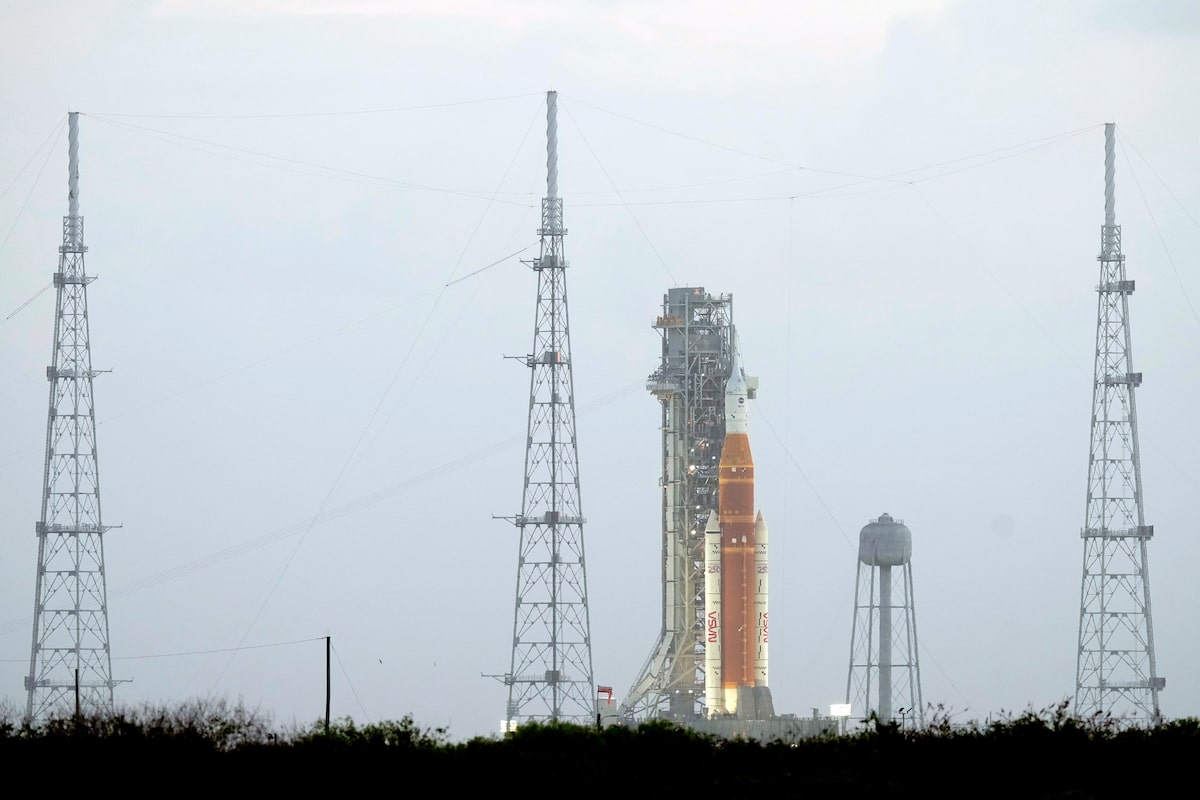
NASA’s Artemis II moon rocket sits on Launch Pad 39-B at the Kennedy Space Center hours ahead of a planned launch attempt on Wednesday in Cape Canaveral, Fla.Chris O’Meara/The Associated Press
04/01/26 13:17Rocket fuel tanks full, crew members begin suiting up
– Ivan Semeniuk
Victor Glover on the left and Reid Wiseman on the right, suiting up for an Artemis II launch attempt on Wednesday.Ivan Semeniuk
This is what people here are very happy to see. Crew members are suiting up for launch. (Here we see Victor Glover on the left and Reid Wiseman on the right.)
All four fuel tanks on the rocket are full, the weather is still showing favourable overall and at this point it’s certainly looking like there will be a launch attempt today.
04/01/26 12:43What’s the difference between L-minus and T-minus?Open this photo in gallery:
People gather ahead of the rocket launch in Titusville, Fla., on Wednesday.Marco Bello/Reuters
L-minus tracks the overall time to liftoff, counting down the days, hours and minutes away before the planned blastoff. It doesn’t include built-in holds, or pauses — that’s T-minus time.
The T-minus countdown in the final 10 minutes is where nerves tense up and hearts start pounding. Automated software kicks off a series of highly choreographed milestones. During this period, the clock can be stopped if a problem is spotted and restarted if it’s fixed in time.
T-0 is the moment of liftoff — zero — when the boosters ignite and the rocket begins its journey.
– The Associated Press
04/01/26 12:43Artemis II crew receives weather briefing about six hours before launch window opens
– Ivan Semeniuk
We’re about six hours before the launch window opens and crew members should be getting a briefing now on weather conditions for launch.
At midday there’s quite a bit more cloud than there was this morning and the wind has picked up. One advantage of a two-hour long launch window is that if an evening storm whips up there could still be time for it to clear and allow the rocket to launch.
However, if there is a scrub, the rocket will have to be emptied of fuel and all systems reset. Mission managers have said they have the capability to turn things around for an attempt in 24 or 48 hours. Whether they wait one day or two before trying again will depend in part on how deep into the two hour window they get before a scrub.
04/01/26 12:11What is the Artemis II mission, and when does it launch?
– Globe staff
The Artemis II crew place their mission insignia on the outside door of the Neil A. Armstrong Operations and Checkout Building at NASA’s Kennedy Space Center in Florida on Monday. It’s a tradition for any crewed mission to place their insignias on the door leaving where they have quarantined and suited up ahead of launch.Kim Shiflett/Supplied
Artemis II is the first mission in more than 50 years that is planned to take astronauts further than about 400 kilometres above Earth’s surface – the orbiting altitude of the International Space Station. It will mark the first crewed launch of the 98-metre-tall rocket – known as the Space Launch System or SLS – carrying the Orion crew capsule with astronauts on board.
The launch is set to take place on April 1 at 6:24 p.m. ET, with a two-hour launch window, provided all final preparations are completed.
04/01/26 11:55Jeremy Hansen records message for Canadians ahead of launch
– Abigale Subdhan
In a video posted to X, astronaut Jeremy Hansen shared a final message for Canadians ahead of the Artemis II launch.
“Canada, I am thinking of you and am hoping all of you see your greatness reflected in this journey around the moon,” he said in the message that was recorded early Wednesday morning ahead of his final sleep before the journey.
“I’m just so proud of all of you.”
Col. Hansen is set to make history as the first Canadian Space Agency astronaut to fly around the moon.
04/01/26 11:47Ask us your questions about the Artemis II mission
– Globe staff
What do you want to know about the Artemis II launch? Submit your questions
This week, three Americans and one Canadian will embark on a trip around the moon before safely splashing down in the Pacific Ocean just over nine days later. What do you want to know about the launch, its long preparation time and what they hope to accomplish? Leave your question in the form below, or send an e-mail to audience@globeandmail.com.
04/01/26 11:38Hydrogen fuelling finishes, a promising sign for Artemis team
– Ivan Semeniuk
The countdown clock runs at Kennedy Space Center in the late morning on Wednesday.Joe Raedle/Getty Images
Hydrogen fuelling is now completed for both the core and upper stages of the Artemis II SLS (space launch system) rocket. Oxygen fuelling of the core stage continues and is 98 per cent complete.
After a long history of delays related to fuelling, the smooth operations so far this morning can only come as welcome news to the Artemis ground team.
04/01/26 11:20What do astronauts eat in space?
– Globe staff
Quiche, barbecued beef brisket and more, according to a NASA crew menu.
Hot sauces – five of them – are available for dressing up meals, along with spicy mustard and various spreads including strawberry jam and peanut butter.
04/01/26 11:02The Globe on the ground in FloridaOpen this photo in gallery:
Journalists, including The Globe’s Ivan Semeniuk (second row, right), fill the Kennedy Space Center media room as preparations continue for the Artemis II launch on Wednesday.Steve Nesius/Reuters
04/01/26 10:52Hydrogen fuelling of core stage is completed
– Ivan Semeniuk
A screen shows fuelling of the core stage of the rocket.Ivan Semeniuk
Hydrogen fueling of the core stage has been completed and is now in replenish mode, which means hydrogen is being added as it gradually boils off to make sure the tank is topped up.
This is big a step since the most significant technical issue with the rocket earlier this year occurred during hydrogen loading of the core stage.
Loading of liquid oxygen continues as well as both tanks in the upper stage.
04/01/26 10:46Fuelling for Artemis II continues
– Ivan Semeniuk
With just under eight hours to go before the launch window opens, fuelling for Artemis II continues apace.
Hydrogen is now being loaded into the upper stage as well as the core stage of the SLS rocket. The role of the core stage is to carry the Orion capsule into a low Earth orbit. The upper stage will take over later in the flight to raise the orbit much higher.
The crew is slated to spend the first 25 hours or so of their mission orbiting Earth and performing checkouts and tests of the capsule before the “translunar injection burn” that sends them out to the moon.
04/01/26 10:33How NASA is letting people from around the world join the moon mission
– Abigale Subdhan
Is your name set to orbit the moon with NASA’s Artemis II mission?
The space agency collected millions of names as part of its “Send Your Name with Artemis II” effort. People from around the world were able to submit their names on NASA’s website leading up until the launch. The collected names have been added to a SD card that will be loaded aboard the Orion spacecraft.
The names were downloaded onto an SD card that is stored inside “Rise,” the zero gravity indicator designed by second-grader Lucas Ye from California, according to a video posted to Commander Reid Wiseman’s X account.
The crew is bringing 5,647,889 names aboard.
04/01/26 10:16Media interest grows ahead of mission launch
– Ivan Semeniuk
The packed press room at the Kennedy Space Center ahead of the Artemis II launch on Wednesday.Ivan Semeniuk
The launch window does not open for another eight and a half hours but already this press room for foreign media at the Kennedy Space Center is packed and busy.
Outside, the field is lined with tents, cameras and temporary stages for television crews broadcasting the event.
If a launch occurs today all of this setup will vanish quickly as action shifts to the Johnson Space Center in Houston, Tex., which houses mission control for the 10-day journey around the moon and is home base for NASA’s human spaceflight program.
04/01/26 09:55Artemis II crew starting their day
– Ivan Semeniuk
Artemis II crew members, from left, Mission Spc. Jeremy Hansen, of Canada, Mission Spc. Christina Koch, Commander Reid Wiseman, and Pilot Victor Glover pose for a photo after the crew’s arrival at the Kennedy Space Center on Friday in Cape Canaveral, Fla.Chris O’Meara/The Associated Press
We’re told the crew members of Artemis II are now officially waking up and starting their day.
The crew has been time shifting while here in Florida to reflect the fact that the evening launch is not going to be the end of their day but closer to the middle of a day that includes a busy series of activities immediately after launch.
The four crew members are commander Reid Wiseman, pilot Victor Glover, mission specialist Christina Koch and Canadian Space Agency Astronaut Jeremy Hansen who is also a mission specialist on the flight.
04/01/26 09:53Space enthusiasts watch sunrise ahead of Artemis II launchOpen this photo in gallery:
Space enthusiasts watch the sunrise from a park in Titusville, Fla., several hours before the planned launch time.GREGG NEWTON/AFP/Getty Images
04/01/26 09:50The astronauts on the Artemis II mission
The Artemis II crew consists of three Americans and one Canadian: commander Reid Wiseman, pilot Victor Glover, mission specialist Christina Koch and London, Ont.,-born astronaut Jeremy Hansen, who will make history as the first Canadian Space Agency astronaut to fly around the moon. The mission’s crew was selected in 2023.
Victor Glover, a Navy test pilot, was the first Black astronaut to live and work aboard the space station in 2020 and 2021. He also was one of the first astronauts to launch with SpaceX.
Christina Koch, who will be the first woman to travel to the moon, already holds the record for the longest single spaceflight by a woman. During her 328-day mission at the International Space Station spanning 2019 and 2020, she took part in the first all-female spacewalk.
Artemis II will be Jeremy Hansen’s first flight into space. The former fighter pilot was selected as one of two recruits by the Canadian Space Agency for its astronaut recruitment program in 2009 and began working at the Mission Control Center in Houston in 2011.
Their commander is Reid Wiseman, a retired Navy captain who lived aboard the space station in 2014 and later headed NASA’s astronaut corps. They range in age from 47 to 50.
The four-person crew entered quarantine on March 18 in Houston “to ensure they remain healthy leading up to launch.” They spent time with their families over the weekend at the Kennedy Space Center’s beach house, a spot where astronauts rest before blasting off into space.
– Globe staff, The Associated Press
04/01/26 09:42Less than nine hours away from launch
– Ivan Semeniuk
The opening of today’s launch window is now less than nine hours away. Fuel loading of the core stage continues in fast fill mode. Both the liquid hydrogen and liquid oxygen tanks on the core stage are now close to one third full. The weather forecast still points to an 80 per cent chance of a go for launch this evening. There’s a growing sense that we are likely to see a launch attempt today.
04/01/26 09:40Astronaut Jeremy Hansen’s wife prepares for his lunar mission
As Jeremy Hansen prepares to begin a historic mission to the moon aboard the Artemis II, his wife says his family will be trying to take in every single moment.
If everything goes as planned, Catherine Hansen will be on the roof of the launch control centre at Florida’s Kennedy Space Center Wednesday evening to watch her husband begin a 10-day lunar fly-around.
“I’m really trying to encourage everyone – and very, very specifically myself – to be in that moment and to allow whatever emotions may come,” she told The Canadian Press on Tuesday. “There will be excitement, there will be exhilaration, there will be terror and fear.”
Jeremy Hansen, 50, of London, Ont., will serve as the mission specialist for Artemis II and become the first non-American to travel beyond low Earth orbit. He will be joined by veteran NASA astronauts Reid Wiseman, Victor Glover and Christina Koch.
For the Hansen family it marks the culmination of 16 years of preparation and the fulfilment of a lifetime dream.
Catherine Hansen, an accomplished obstetrician-gynecologist, met her husband in Moose Jaw, Sask., when she went to watch her brother get his Air Force pilot wings. Jeremy Hansen told her right away he planned to be an astronaut.
She said she initially thought it was “a crazy thing to say out loud,” but after a little contemplation decided that “if he’s saying it out loud, he must really mean it.”
“And as I got to know him, even over that day, weeks, months later, I realized he meant every word of it,” she said with a wide smile. “And we were going to do everything we could to make it happen.”
Catherine Hansen said they had a look at their lives together, what they wanted and how they could both accomplish it.
“I cannot really explain to people how important it is to just lift each other up, and that’s exactly what we’ve done,” she said. “He’s done that with my work and my business. I’ve done that with him and his work.”
They’ve now been married 23 years — most of which they’ve spent connected to NASA.
To watch her husband live out his childhood dream “feels like no less than a miracle,” she said.
– The Canadian Press
04/01/26 09:30Canadians gathering at museums, libraries to watch moon launch
Canadians across the country are assembling today to watch the Artemis II launch, which is set to send humans back to the moon for the first time in more than 50 years.
The first two-hour launch window opens at 6:24 p.m. ET, with a six-day launch window running through April 6.
People across Canada are gathering at historical sites, museums, libraries and arts centres to watch the launch.
In Vancouver, people are meeting at the H.R. MacMillan Space Centre, while Halifax residents plan to watch the launch from the Discovery Centre.
If there are no problems today, Canadian astronaut Jeremy Hansen of London, Ont., will serve as the mission specialist for Artemis II and become the first non-American to travel beyond low Earth orbit.
– The Canadian Press
04/01/26 09:23How to watch the Artemis II launch
The Artemis II launch will be streamed live on NASA+, NASA’s YouTube channel, and the NASA app.
The official launch broadcast on YouTube begins at 12:50 p.m. ET, though viewers are able to see the tanking process and other mission activities with live commentary in the meanwhile. Liftoff is scheduled for no earlier than 6:24 p.m. ET.
In-person viewing is available at the Kennedy Space Center Visitor Complex, but it said on its website that only guests with a “Launch Viewing Package” will be allowed entry on Artemis II launch attempt days.
NASA also released a flight tracker on its website that will be available once Artemis II launches.
04/01/26 09:14A good sign for today’s launch
– Ivan Semeniuk
The Artemis II ground crew has now shifted to fast fill for both liquid hydrogen and liquid oxygen fuel in the rocket’s main (core) stage. This is a good sign for a launch today. There are no signs of issues with the fuelling at this point. Fuelling of the rocket’s upper stage has yet to begin.
04/01/26 09:01Teams begin to fill SLS rocket with liquid hydrogen and oxygen
– Ivan Semeniuk
A slow fill of propellant is underway on the SLS rocket that is set to fly four astronauts around the moon. The fuelling process begins slowly so that the ultra-cold liquid fuel does not damage the system.
All eyes will be on the hydrogen field loading which delayed the launch of Artemis II and was also an issue ahead of the launch of Artemis I, an uncrewed flight in 2022.
04/01/26 08:14Artemis II SLS rocket is currently in ‘chill down’
– Ivan Semeniuk
The NASA Artemis II SLS (Space Launch System) rocket with the Orion spacecraft is seen at Launch Complex 39B at the Kennedy Space Center on Tuesday in Cape Canaveral, Fla.John Raoux/The Associated Press
The Artemis II Space Launch System rocket is currently in “chill down”. It is being cooled in advance of loading the liquid hydrogen and oxygen fuel for its upper and lower stages. To be ready for launch the rocket will need to be loaded with approximately one million kilograms of fuel in the coming hours.
04/01/26 07:57T-10 and half hours to go
– Ivan Semeniuk
With 10 and a half hours to go before the opening of today’s launch window, the launch team has been given the go-ahead to start loading the rocket with fuel. This is what everyone will be watching this morning.
During a dress rehearsal in February, hydrogen leaks that appeared while the rocket was being fueled delayed the launch by a month. Then a second issue with the rocket’s upper stage ultimately pushed it to April.
04/01/26 07:45A sunny arrival to Kennedy Space Center
– Ivan Semeniuk
Early arrivals at the Kennedy Space Centre’s press center were treated to a gorgeous sunrise over the launch complex.Ivan Semeniuk/The Globe and Mail
Early arrivals at the Kennedy Space Center’s press center this morning were treated to a gorgeous sunrise over the launch complex. So far the skies are mainly clearly. Those cumulus clouds in the distance are currently sitting offshore. If weather became an issue for the launch later today it may be because of afternoon storms that can develop and move inland. Yesterday, Mark Burger at the center’s launch weather office put the chances of weather interfering with the launch at about 20 percent today.
04/01/26 07:00Hello from Cape Canaveral
– Ivan Semeniuk
This is Ivan Semeniuk at NASA’s Kennedy Space Center at Cape Canaveral in Florida. The launch window for the Artemis II mission that aims to fly four astronauts around the moon, including Canada’s Jeremey Hansen, has a good chance of lifting off today as early as 6:24 pm.
With less than 12 hours remaining on the countdown clock, I’ll be here through the day watching final preparations on the way to a possible launch.
04/01/26 07:00The steps to make a journey to the far side of the moon
Canadian Space Agency astronaut Jeremy Hansen will be the first Canadian to fly beyond low Earth orbit. Hansen explains the stages of the Artemis II, a mission that will fly astronauts around the Moon’s far side.
04/01/26 07:00What to know about NASA’s historic Artemis II moon missionOpen this photo in gallery:
Photographers set up remote cameras near NASA’s Artermis II moon rocket on Launch Pad 39-B just before sunrise at the Kennedy Space Center on Tuesday.Chris O’Meara/The Associated Press
Long delayed by a series of technical challenges, NASA is now preparing to launch Artemis II today in its first human mission to fly around the moon in more than 50 years.
The mission will send four astronauts, including Canadian astronaut Jeremy Hansen, on an approximately 10-day journey around the moon and back, sending them some 406,000 kilometres into space – the farthest humans have ever traveled.

Orion will travel more than
400,000 km from Earth and
could set a new record for
the farthest humans have
ever gone into space
Lift-off from Cape Canaveral
Two minutes after launch, boosters
separate followed by launch abort system
Eight minutes after launch ICPS and Orion
separate from Core stage. Orion’s solar
arrays unfurl
After 90-minute orbit, ICPS fires engines
to raise Orion to higher Earth orbit.
Crew begins multiple system checks
If everything is in order, Orion separates
from ICPS.Then, astronauts manually fly
Orion toward and away from ICPS, practising
proximity operations for future missions
Around 23 hours later, Orion Service Module
carries out Translunar Injection (TLI) burn –
sending Orion on a trajectory around
the moon
After lunar flyby on Day 6, gravity draws
Orion back toward Earth
Just before re-entry, Orion’s crew module
separates from service module
Capsule re-enters atmosphere at speed of
32,187 km/h and temperatures of up to
2,200°C
Series of parachutes slow craft before
splashdown in Pacific Ocean
THE GLOBE AND MAIL, Sources: GRAPHIC NEWS;
NASA; ESA; Lockheed Martin

Orion will travel more than
400,000 km from Earth and
could set a new record for
the farthest humans have
ever gone into space
Lift-off from Cape Canaveral
Two minutes after launch, boosters
separate followed by launch abort system
Eight minutes after launch ICPS and Orion
separate from Core stage. Orion’s solar
arrays unfurl
After 90-minute orbit, ICPS fires engines
to raise Orion to higher Earth orbit.
Crew begins multiple system checks
If everything is in order, Orion separates
from ICPS.Then, astronauts manually fly
Orion toward and away from ICPS, practising
proximity operations for future missions
Around 23 hours later, Orion Service Module
carries out Translunar Injection (TLI) burn –
sending Orion on a trajectory around
the moon
After lunar flyby on Day 6, gravity draws
Orion back toward Earth
Just before re-entry, Orion’s crew module
separates from service module
Capsule re-enters atmosphere at speed of
32,187 km/h and temperatures of up to
2,200°C
Series of parachutes slow craft before
splashdown in Pacific Ocean
THE GLOBE AND MAIL, Sources: GRAPHIC NEWS;
NASA; ESA; Lockheed Martin

After lunar flyby on Day 6,
gravity draws Orion back
toward Earth
Just before re-entry, Orion’s
crew module separates from
service module
Capsule re-enters atmosph-
ere at speed of 32,187 km/h
and temperatures of up to
2,200°C
Series of parachutes slow
craft before splashdown in
Pacific Ocean
Orion will travel more than
400,000 km from Earth and
could set a new record for
the farthest humans have
ever gone into space
Lift-off from
Cape Canaveral
Two minutes after launch,
boosters separate followed
by launch abort system
Eight minutes after launch,
ICPS and Orion separate from
Core stage. Orion’s solar arrays unfurl
After 90-minute orbit, ICPS fires engines
to raise Orion to higher Earth orbit.
Crew begins multiple system checks
If everything is in order, Orion separates
from ICPS.Then, astronauts manually fly
Orion toward and away from ICPS, practising
proximity operations for future missions
Around 23 hours later, Orion Service Module
carries out Translunar Injection (TLI) burn –
sending Orion on a trajectory around the moon
THE GLOBE AND MAIL, Sources: GRAPHIC NEWS; NASA; ESA; Lockheed Martin
NASA mission managers polled “go” to launch the Artemis II mission’s towering, 98-metre Space Launch System (SLS) rocket topped with the astronauts’ Orion crew capsule as early as 6:24 p.m. ET on Wednesday.
It will launch from NASA’s Kennedy Space Center in Florida just one pad away from where the last moon-bound astronauts of the U.S. Apollo program lifted off more than half a century ago.
The Artemis II crew includes NASA astronauts Christina Koch, Victor Glover and Reid Wiseman and Canadian astronaut Jeremy Hansen, who landed in Florida from Houston on Friday.
They had been in a two-week quarantine leading up to liftoff and spent time with their families over the weekend at the Kennedy Space Center’s beach house, a spot where astronauts rest before blasting off into space.
The launch had originally been planned for as early as February 6, and then March 6, until a pesky hydrogen leak prompted NASA to roll the rocket back to its vehicle assembly building for scrutiny.
– Globe staff, Reuters