
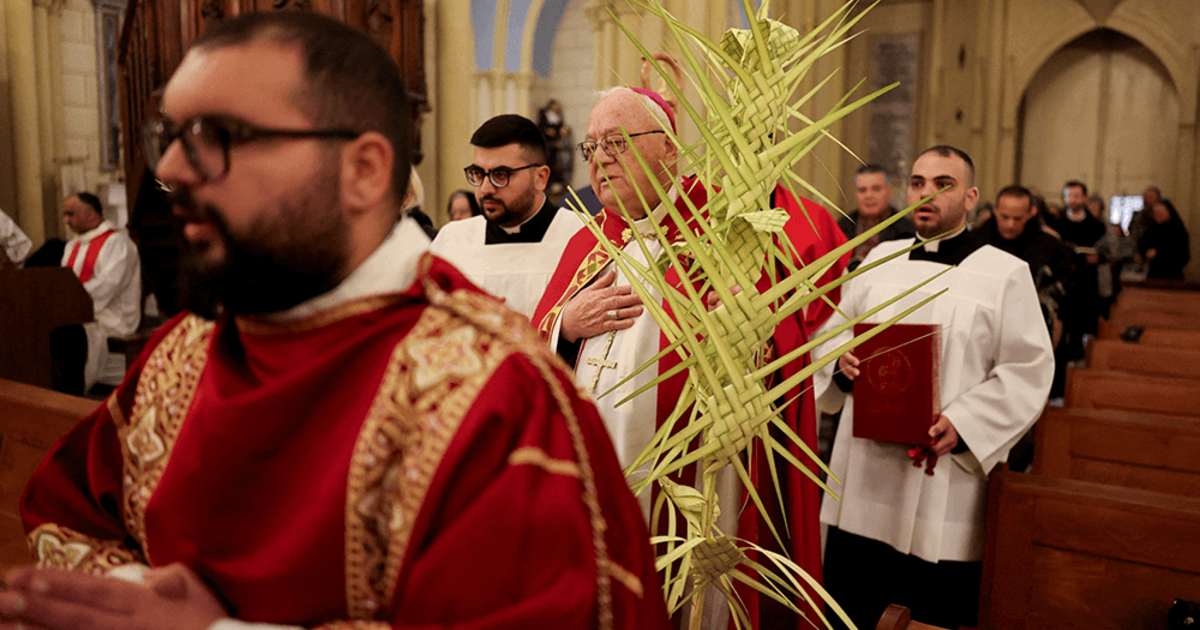
As Christians across the globe remember Jesus’ journey through Holy Week, Israel is taking the unprecedented steps of restricting access to holy sites in Jerusalem.
Israel is blocking access to the Church of the Holy Sepulchre, as well as the Western Wall, and the Al-Aqsa Mosque complex indefinitely after the outset of the U.S.-Israeli war with Iran, impacting typical observance of the Christian Holy Week, Ramadan, and Passover and restricting travel into East Jerusalem.
For Palestinian Christians, it would mark the first time that access to the church—which is known as the site of Jesus’ crucifixion, burial, and resurrection—is blocked over Easter. Historically, thousands of Christians around Jerusalem have traveled to the city and church as part of their Easter celebration.
“Christianity is a religion created here,” political scientist Xavier Abu Eid, author of Rooted in Palestine: Palestinian Christians and the Struggle for National Liberation 1917-2004, said. “Being a Palestinian Christian for centuries meant living Christianity in the footsteps, the physical footsteps, of Jesus Christ.”
Despite those generational roots, settler violence and Israeli government restrictions over decades have distanced many Palestinian Christians, and Palestinians of any belief, from walking those footsteps.
Early in Holy Week, Israeli police said they rejected a request from the Latin Patriarchate of Jerusalem for a Palm Sunday exemption, barring Catholic Cardinal Pierbattista Pizzaballa and Fr. Francesco Ielpo’s entry to the Church of the Holy Sepulchre on Palm Sunday. The Patriarchate said in a statement that it was the “first time in centuries, the Heads of the Church were prevented from celebrating the Palm Sunday Mass at the Church of the Holy Sepulchre.”
After international outcry and criticism, Israeli Prime Minister Benjamin Netanyahu countermanded the police decision in a statement on X, saying he instructed Pizzaballa to be permitted access as soon as he learned of the incident.
To Rev. Mae Elise Cannon, executive director of Churches for Middle East Peace, the idea that Israel couldn’t coordinate with the Patriarchate for Pizzaballa’s visit is “absurd.”
“The military and the police coordination in Israel is some of the most effective in the world, and the idea that they would not have coordinated about [the cardinal visiting] is absurd, but that’s kind of the point, right?” Cannon said. “Sure, technical errors happen, but when you have something of this magnitude in the middle of a war, police and military don’t make those kinds of technical mistakes.”
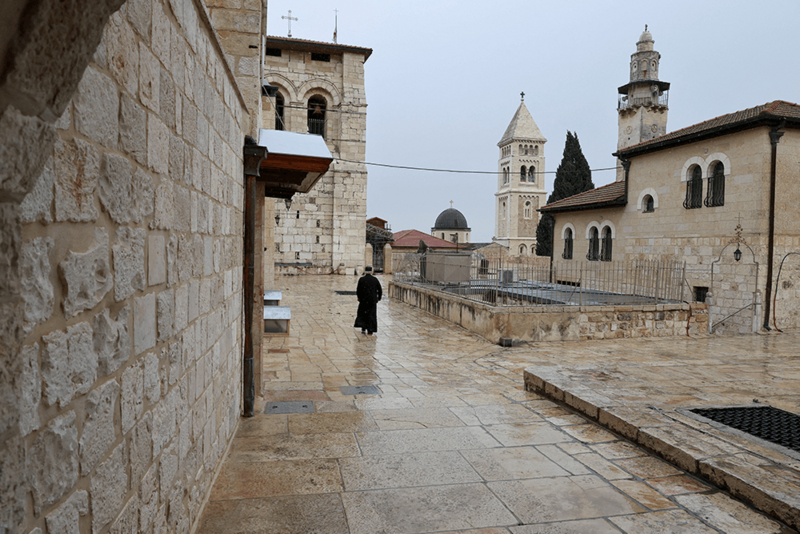
A person walks near the Church of the Holy Sepulchre as it is locked following the cancellation of the traditional Palm Sunday procession from the Mount of Olives, amid restrictions on gathering in large groups and the U.S.-Israel war with Iran, in Jerusalem’s Old City March 29, 2026. REUTERS/Ammar Awad
As it stands, Israel is allowing some small groups to gather on a case-by-case basis. The Western Wall, for example, has been able to host some worshippers because it has a nearby bomb shelter. On Easter, some church leaders will be allowed at the Church of the Holy Sepulchre and services will be livestreamed, but Israel will continue to deny the majority of Palestinians access to the church.
East Jerusalem, where the holy sites sit, was Jordanian territory before the Six-Day War in 1967, when Israel militarily occupied the area. In 1980, Israel formally annexed East Jerusalem on its own authority. East Jerusalem is considered “Occupied Palestinian Territory,” and Israel governs it under the “status quo”—arrangements meant to preserve the holy sites and access to them.
While the closures are the first of their kind in Jerusalem, barriers to accessing the holy sites, especially for Palestinians, are not. Last year, Israel said it issued 6,000 permits to enter the city of Jerusalem from the West Bank for Easter. The Guardian reported that only 4,000 were actually given, an estimated 50,000 Christians live in the West Bank according to the State Department.
George Rishmawi, general director of the Palestinian Heritage Trail and a Palestinian Christian, said that although he can see parts of Jerusalem from his home, he could be stuck for hours at Israeli checkpoints trying to get there.
He described a multi-step process involving a $60 fee, an appointment at an Israeli military base, and downloading an app to apply electronically to visit the Old City of Jerusalem. The application may or may not be accepted, and then Palestinians must navigate the frequent checkpoints.
“Freedom of movement … has been stolen completely from us, especially in the past two and a half years, we have not been able to move around, to go to different areas,” he said.
In 2024, the Easter celebration was scaled down due the nascent war between Israel and Hamas. Palestinians needed special permission to cross checkpoints into Jerusalem. For the Holy Fire ceremony of 2023 (a day before Orthodox Easter), Israeli police restricted the number of attendees to 1,800 people in the name of crowd safety. The restriction was attributed to an event two years prior when a crowd rush at a Jewish holy site killed 45 people.
“For us West Bankers, one of the joys of our life was to go to walk in the narrow alleys of the Old City of Jerusalem and do our shopping there, and bring everything home,” Rishmawi said. “And we think the taste of the food that’s coming from Jerusalem is different in our mouths, you know? … We are denied this type of heritage that we have.”
Cannon said there is legitimate reason to enact security measures in the face of the war between Israel and Iran, but that the current restrictions sustain a pattern of pressure which is not focused on Christians alone.
“There are legitimate restrictions being imposed, but it’s in a context where Christians and Muslims and non-conforming Jews have been squeezed and experienced increased pressure over past months and years, regardless of the context of war,” she said.
Rev. Jack Sara, president of Bethlehem Bible College who was born and raised in the Old City of Jerusalem, said outcry for Palestinian Christians would have greater impact if global Christian visitors honored all Palestinian existence.
“The holy places, we don’t claim that we own them only for ourselves. We want to share them with the world. Yet the irony is that a lot of people forget that there is a local Palestinian church … their eyes only see the stone, and forget that there are living stones,” Sara said. “It’s not just the stones, it’s not just the Holy Sepulchre, it’s not just the Nativity church, but it is also us.”
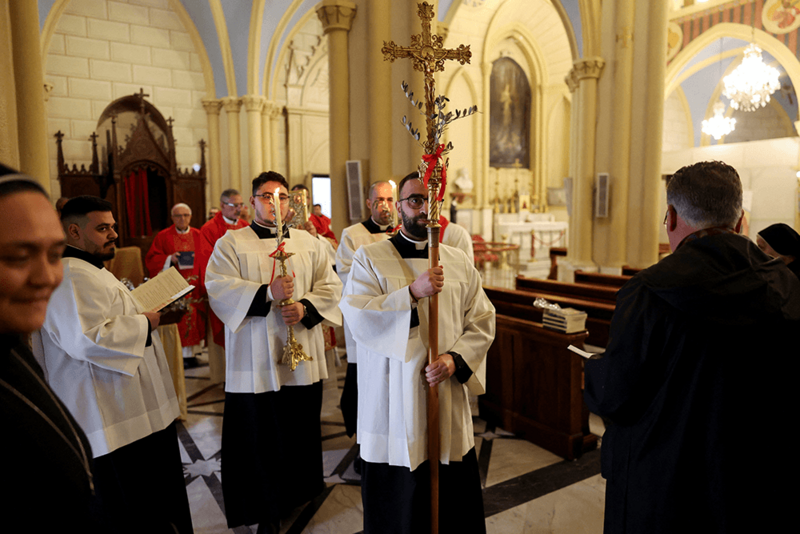
Christian worshippers mark Palm Sunday, following the cancellation of the traditional Palm Sunday procession from the Mount of Olives, amid restrictions on gathering in large groups and the U.S.-Israel war with Iran, at the Latin Patriarchate of Jerusalem in Jerusalem’s Old City March 29, 2026. REUTERS/Ammar Awad
Kyle Cristofalo, senior director of advocacy and government relations for CMEP, said he was surprised by the scale of the reaction to Pizzaballa’s barring.
“I’ve been doing this work for over a decade,” he said, “but I would never have imagined such a quick and swift reaction from voices that generally are not going to be as openly critical of Israel necessarily.”
Cristofalo said he was encouraged by the result of the pressure from other leaders, but that a sticking point moving forward would be to sustain that commitment when access is denied to people less famous than a cardinal.
“There are violations of religious freedom that happen against Christians, against Muslims in Jerusalem on a very regular basis,” he said. “If it has to be to the level of the cardinal being denied entry on Palm Sunday—that’s a high bar.”
When looking forward from a long history of restrictions and denials of other Palestinian rights, Abu Eid compared their situation to the Easter story.
“Resurrection didn’t take place before Holy Friday, that we refer to in Arabic as the Sad Friday, al-Jum‘atu l-Ḥazīna. That’s a message of hope in itself, that after death, there is life,” he said. “That’s, I think, the most powerful message of Christianity. But if Christians are truly committed with that message, well, let them contribute for us to get out of this Good Friday that we have been living for 78 years.”
Reuters reporting contributed to this story.
“The holy places, we don’t claim that we own them only for ourselves. We want to share them with the world. Yet the irony is that a lot of people forget that there is a local Palestinian church … their eyes only see the stone, and forget that there are living stones.” — Rev. Jack Sara