
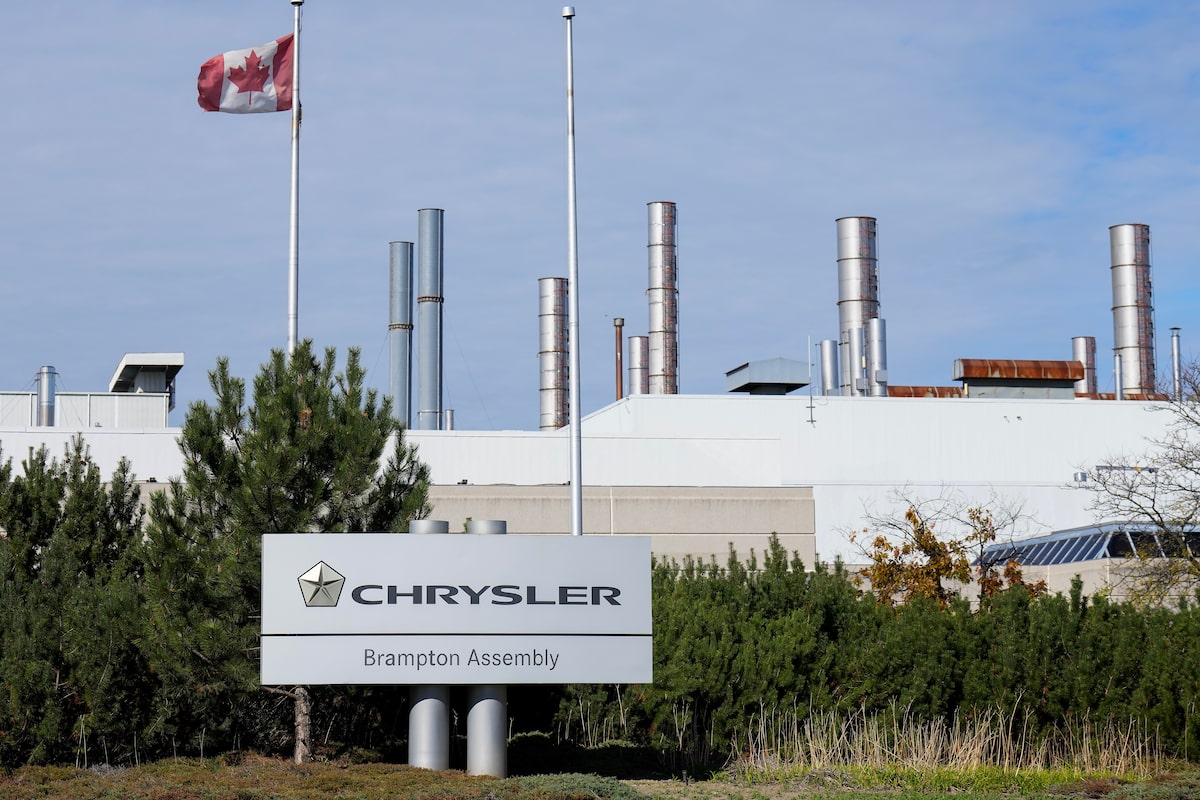
The Stellantis vehicle assembly plant in Brampton, Ont., in October, 2025. Detroit-based Stellantis invested 1.5 billion euros in Leapmotor in 2023.Nathan Denette/The Canadian Press
Stellantis NV STLA-N has proposed assembling Chinese electric cars at its idled plant near Toronto in partnership with Leapmotor, a China-based automaker it partly owns, according to a Unifor union official and a source familiar with the matter.
Lana Payne, national president of Unifor, which represents the 3,000 laid-off workers at the plant in Brampton, Ont., said Stellantis is proposing assembling Chinese cars using parts imported from China, or “knock-down kits.” This is the way Chinese EV makers operate in Mexico and other countries, and it involves little local manufacturing and few local suppliers. It can be a way to skirt domestic tariffs and keep labour costs low.
The source confirmed the proposal, which was first reported by Bloomberg. The Globe and Mail is not naming the source because they were not authorized to discuss the matter publicly.
The investment is not finalized at this stage. If it becomes reality, it would be the first time a Chinese carmaker has entered into such an arrangement with a Canada-based plant, offering a possible path forward for assembly facilities whose future has been thrown into doubt by punitive U.S. tariffs.
Chinese EV maker BYD in talks to open Canadian dealerships, consultant says
But Ms. Payne and other labour officials cautioned on Wednesday that such arrangements would not restore Canada’s auto plants to their pre-trade-war job levels.
“This is not a proposal for assembly and manufacturing,” Ms. Payne said. “It’s knock-down kits and it’s a huge problem.” Many Chinese manufacturers – including Leapmotor – ship parts and partly assembled components to overseas factories for final assembly.
“The jobs are kept in China where the parts are made, and the vehicle is preassembled before it is shipped overseas for kit assembly,” she said, calling on Stellantis to live up to its commitments to the Brampton workers.
Vito Beato, the local Unifor union leader who represents the Brampton workers, said China’s model of assembling vehicles from imported parts provides a fraction of the jobs that a traditional assembly plant does. “I don’t think it’s something the government should be looking at,” he said.
Ontario Premier Doug Ford, speaking to reporters in Texas, where he is meeting with business leaders and politicians this week in part to attempt to persuade them to oppose tariffs, echoed the union leaders’ concerns. He said the federal government shouldn’t allow the potential Stellantis-Leapmotor deal to proceed, and that Ontario is looking into its options.
“It’d be pretty tough if Lana Payne said, you know, workers aren’t going back until we see Ontario-made parts, manufacturing Ontario-made vehicles,” he said.
Stellantis posts huge loss after ‘over-estimating’ EV transition
Detroit-based Stellantis invested 1.5 billion euros in Leapmotor in 2023, in a deal that gave it control over the EV maker’s international ventures, the companies said at the time.
The Brampton plant has been closed for more than two years. Stellantis had planned to produce its Jeep Compass at the plant, but announced in October that it was shifting production of that model to Illinois as part of a broader plan to boost production in the U.S. The move was widely attributed to U.S. tariffs.
The plant had previously been retooled with federal money, and Industry Minister Mélanie Joly has threatened to sue Stellantis for what she says is a violation of the funding agreement’s jobs and production requirements.
Isabella Orozco-Madison, Ms. Joly’s spokesperson, said the resolution process is continuing and confidential, and that its goal is securing production, jobs and long-term investment. “Any new auto investments will prioritize Canada’s supply chain, including Canadian labour and parts suppliers,” she said.
The federal government has been repairing ties with China as it seeks to reduce Canada’s dependence on U.S. trade. Prime Minister Mark Carney in January reduced tariffs on up to 49,000 of China’s EVs to 6.1 per cent from 100 per cent. He did so in exchange for lower Chinese duties on Canadian canola and other food.
Ottawa said the agreement is expected within three years to attract Chinese joint-venture investment in the Canadian EV supply chain. The EV import quota rises to 70,000 in five years – more than half of which will sell for less than $35,000. It was not immediately clear whether vehicles assembled in Canada from Chinese parts would count toward the quota.
LouAnn Gosselin, a Stellantis Canada spokesperson, declined to confirm the Brampton proposal, but said the company is “actively evaluating future programs for Brampton, with the objective to ensure that any investment decision is sustainable and a long-term commitment that supports workers and suppliers.”
“We are in active discussions with government officials and key stakeholders to ensure that the conditions for success are in place to support continued investment in Canada,” she said, adding the company had no announcement to make on Wednesday.
Stellantis and Leapmotor jointly opened a plant in Poland in 2024 to make the electric T03 car, but closed it in a year. The partnership is expected to produce EVs in Spain this year. The companies have also announced production plans in Brazil and Malaysia.
Flavio Volpe, head of the Automotive Parts Manufacturers’ Association, said any vehicle made at the Brampton plant should meet the 75-per-cent North American content rule laid out in the North American free trade agreement.
“Stellantis’s full vehicle assembly with local suppliers has underpinned the local economy since 1962 around that plant,” Mr. Volpe said. “Allowing Chinese knockdown kits there would freeze out hundreds of Canadian auto parts suppliers who are waiting for that plant to resume production.”
With reports from Adam Radwanski and Laura Stone