
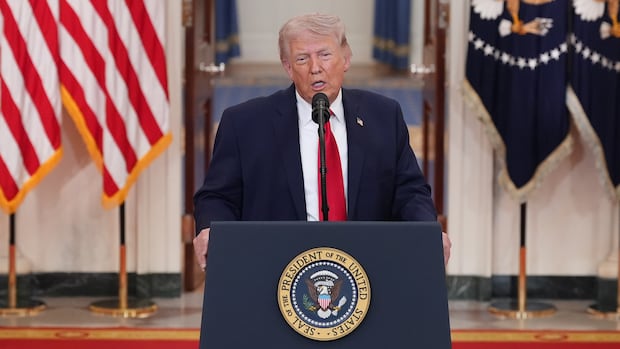
U.S. President Donald Trump told Americans that while his objectives for the war against Iran are nearly achieved, he intends to keep military operations going for at least another two weeks and is threatening to escalate the intensity of the strikes.
In his first live address to the nation since launching the war more than a month ago, delivered on prime-time network television Wednesday night, Trump tried to sell his audience on the merits of continuing a war he has already repeatedly declared to be nearing its end.
“We are on track to complete all of America’s military objectives shortly, very shortly,” Trump said.
“We are going to hit them extremely hard over the next two to three weeks. We’re going to bring them back to the stone ages where they belong,” he continued.
Only once in his 20-minute speech did Trump touch on the possibility that negotiations with the regime in Tehran could bring an end to the war.
That led analysts — including Brett McGurk, a former U.S. National Security Council adviser on the Middle East — to conclude Trump’s next steps most likely involve escalation.
WATCH | Highlights of Trump’s address to the nation on Iran war:
Trump declares Iran war is ‘nearing completion’
In his first public address since the U.S.-Israel war against Iran began, U.S. President Donald Trump touted his accomplishments in the conflict and said it would be over in a few weeks. He also praised U.S. allies in the Middle East.
“I thought we might hear a de-escalatory speech, that we’re going to wrap this up in a couple weeks,” McGurk told CNN after Trump finished speaking.
“I actually heard something quite different,” he said. “I think this war is going to continue for some time, that’s what I heard.”
Janice Stein, founding director of the Munk School of Global Affairs & Public Policy in Toronto, told CBC News chief correspondent Adrienne Arsenault that she was astonished by Trump’s speech.
“When you’re trying to coerce your adversary to come to the table and do what Donald Trump says he’s expert at, the art of the deal, you never signal openly to them that the war is coming to an end. Because if you do that, why wouldn’t they just wait you out?” Stein said.
Much of the president’s speech focused on what the U.S. military has achieved in destroying Iranian targets — often delivered in the boastful style that defines Trump.
He described Iran’s navy as gone, its air force in ruins, most of its leaders dead, its Islamic Revolutionary Guard Corps decimated, its weapons factories blown to pieces.
WATCH | As Trump says war with Iran will be over soon, Tehran steps up missile attacks: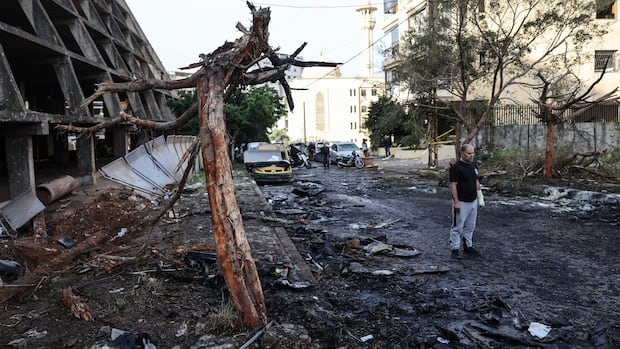
Iran, Israel continue firing strikes as Trump says war is near its end
U.S. President Donald Trump has said the war in the Middle East will soon reach an end. However, Iran has continued to fire on targets across the region and Israel has continued its strikes on Iran.
“Never in the history of warfare has an enemy suffered such clear and devastating large-scale losses in a matter of weeks,” he said.
What Trump did not explain: why the war must continue for at least two more weeks at potentially greater intensity if Iran’s military targets have already been so clearly devastated.
‘We are going to finish the job’
“Because of the actions we have taken, we are on the cusp of ending Iran’s sinister threat to America and the world,” he said. “We are going to finish the job and we’re going to finish it very fast.”
Yet Trump appeared to cast aside the pursuit of two operations that have been floated as ways of finishing the job: taking control of the Strait of Hormuz or seizing Iran’s stockpile of highly enriched uranium.
According to the International Atomic Energy Agency, Iran stockpiled some 440 kilograms of highly enriched uranium, potentially enough to make 10 nuclear weapons once fully enriched, at two sites that were bombed by the U.S. last June.
Although Trump has said Iran was getting close to developing nuclear weapons before he launched the war, on Wednesday night he said the sites were hit so hard it would take months to get access to what he called the “nuclear dust.”
WATCH | What U.S. ground troops could target in Iran, and what the risks would be: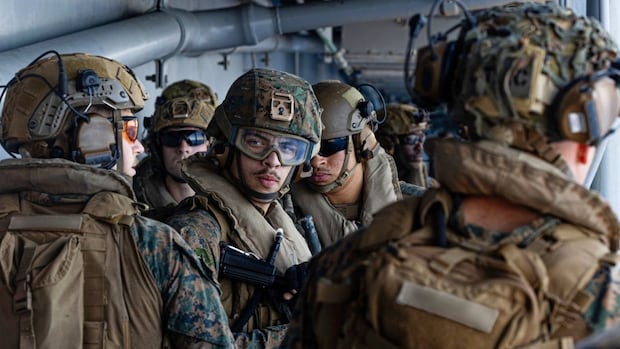
Trump is threatening a ground invasion of Iran. How would that work?
U.S. President Donald Trump is mulling ordering ground troops into Iran. Capturing any of the most likely targets would pose a significant challenge, experts say.
Meanwhile, Trump appeared to shrug off any responsibility for getting the the crucial Strait of Hormuz fully reopened to commercial shipping.
Before the war began, roughly 20 per cent of global supplies of crude oil and liquified natural gas passed through the narrow body of water at the mouth of the Persian Gulf.
Trump urges others to ‘grab’ Strait of Hormuz
Iran has launched strikes on tankers from nations allied with the U.S., effectively closing the strait to all but a handful of Tehran-approved vessels, driving up global oil prices.
Gas prices around the world have likewise spiked, including in the U.S., where the national average price at the pumps hit $4.06 US a gallon on Wednesday, up more than 35 per cent since the war began.
Trump said in his speech the U.S. doesn’t need any of the crude oil that is usually transported through the Strait of Hormuz, and told countries who do to “grab ” and “cherish” it.
“Go to the strait and just take it,” he said. “Iran has been essentially decimated. The hard part is done, so it should be easy.”
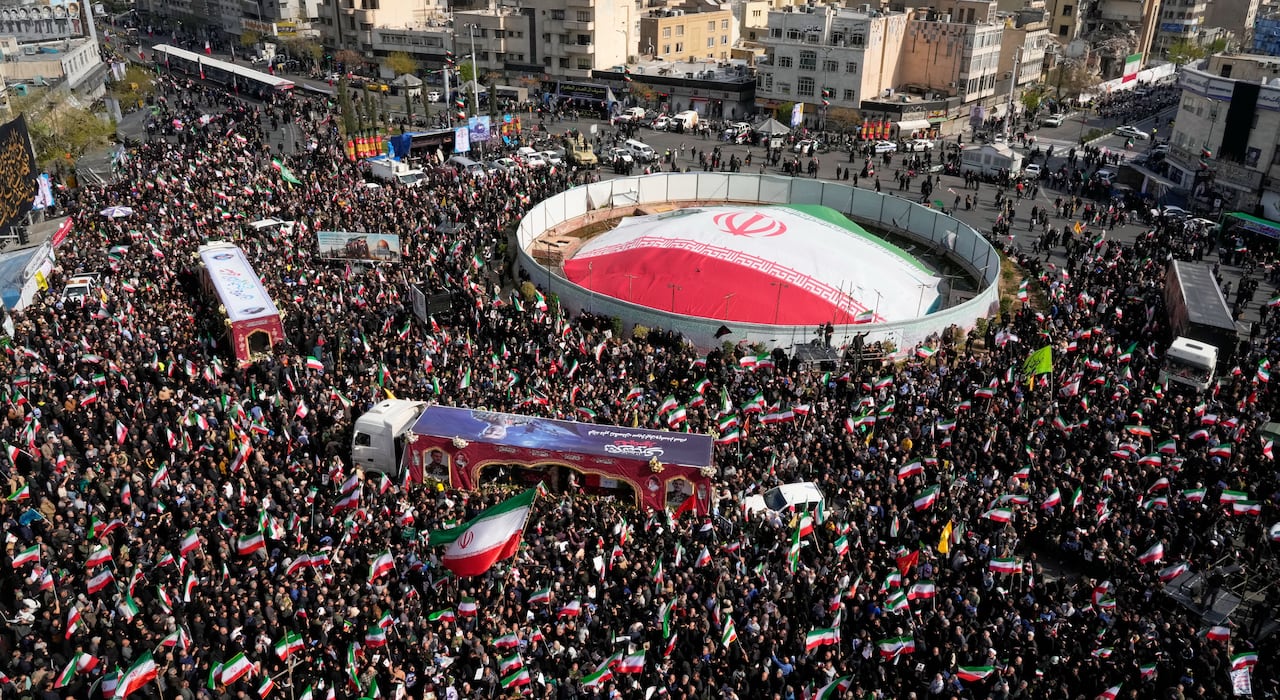 Mourners gathered in Tehran on Wednesday during a funeral procession for Alireza Tangsiri, head of Iran’s Islamic Revolutionary Guard Corps Navy, and others killed in recent Israeli strikes. (Vahid Salemi/The Associated Press)
Trump has flipped back and forth multiple times on the importance of opening the strait to traffic, including in the past 48 hours.
In a social media post on Monday morning, Trump threatened to attack Iran’s electricity and water desalination plants if the strait was not “immediately ‘Open for Business.'”
On Tuesday afternoon in the White House, Trump told reporters that the U.S. was “not going to have anything to do with” making the strait safe for shipping because his country doesn’t need it.
Trump also appeared to engage in some revisionist history by claiming he never intended to bring about real regime change in Iran — an end to the Islamic government that’s been in place since 1979.
“Regime change was not our goal,” he said. “But regime change has occurred because all of their original leaders’ deaths. They’re all dead.”
This has been Trump’s line for several days now: he insists that Tehran’s new leaders are different, even though an Islamic government is still in place.
WATCH | Trump says the U.S. can take Kharg Island easily. Here’s what could complicate that: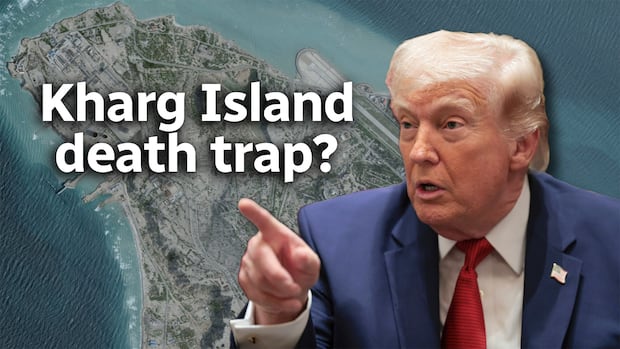
Is the U.S. about to make a major military mistake? | About That
U.S. President Donald Trump says a U.S. takeover of one of Iran’s most critical assets — Kharg Island — could happen “very easily,” but experts warn the reality is far more complicated. Andrew Chang breaks down why even a successful assault could lead to heavy losses and uncertain gains.
Images provided by The Canadian Press, Adobe Stock, Reuters and Getty Images
“We have had regime change,” Trump said at the White House on Tuesday. “Now we have a group of people that’s very different. They’re much more reasonable.”
While Trump described Iran’s current leadership as “much less radicalized” and “much more rational,” there’s been no publicly discernible shift in tone from Tehran, let alone any noticeable change in the regime’s treatment of Iranian civilians.
It’s a dramatic shift from Trump’s messaging shortly after ordering the first strikes on Tehran.
“The hour of your freedom is at hand,” he said to the Iranian people in a video posted to social media on Feb. 28. “When we are finished, take over your government. It will be yours to take.”
A variety of polls conducted in the U.S. over the course of the past month have consistently shown a majority of respondents opposing the war. Its impact on the cost of living isn’t helping win people over.
Trump devoted part of his speech to urging Americans to “keep this conflict in perspective” by listing off how long the U.S. spent involved in the two world wars as well as Korea, Vietnam and Iraq, and contrasting that with the Iran war’s 32-day timeline so far.
“This is a true investment in your children and your grandchildren’s future,” he said.
What remains to be seen is whether that message will resonate with Americans, especially if the war intensifies and the costs grow.